




Hi, IÔÇÖm TestprepKart.
Your Partner In Exam Preparation
Welcome to the captivating realm of thermodynamics, where energy and matter dance through the laws that govern their transformations. From the fundamental principles of heat and work to the intricacies of entropy, thermodynamics unveils the science behind energy flow in systems. Join us on a journey through the thermal landscapes, exploring the profound insights that shape our understanding of physical and chemical processes. Thermodynamics not only guides the behavior of gases, liquids, and solids but also holds the key to unlocking the mysteries of energy transfer and the fundamental principles that govern the universe.
What is Thermodynamics?
Thermodynamics is a branch of physical science that deals with the principles governing energy, heat, and work in physical and chemical systems. It provides a framework for understanding how energy moves within and between different forms, as well as the effects of this energy transfer on the properties and behavior of matter.
Key concepts in thermodynamics include:
Energy: The capacity to do work or transfer heat. It exists in various forms, including kinetic energy (associated with motion), potential energy (associated with position or state), and internal energy (the sum of kinetic and potential energies within a system).
System and Surroundings: In thermodynamics, the system is the specific part of the universe under consideration, while the surroundings include everything outside the system that can exchange energy or matter with it.
Laws of Thermodynamics: The four fundamental laws that govern energy and matter in the universe, including principles of conservation, heat transfer, and the directionality of natural processes.
Processes and Cycles: Thermodynamic processes describe how a system changes from one state to another, while thermodynamic cycles involve a series of processes that eventually return a system to its initial state.
Heat Transfer: The movement of thermal energy between systems due to a temperature difference. Heat transfer occurs through conduction, convection, and radiation.
Work: In thermodynamics, work is the transfer of energy from one system to another that results in a change in the state of the system. It can be done by mechanical, electrical, or other means.
Entropy: A measure of the disorder or randomness in a system. The second law of thermodynamics states that the entropy of an isolated system tends to increase over time.
Equilibrium: A state in which no further changes occur in a system. Thermodynamic equilibrium is a key concept for understanding the behavior of systems.
Thermodynamics plays a crucial role in various scientific and engineering disciplines, including physics, chemistry, and mechanical engineering. It provides essential principles for analyzing and predicting the behavior of natural and engineered systems.
What are the Laws of Thermodynamics?
The laws of thermodynamics are fundamental principles that govern the behavior of energy and matter in the universe. There are four laws, though the zeroth law is often considered an initial condition for the others. The primary laws are as follows:
Zeroth Law of Thermodynamics:
If two systems are each in thermal equilibrium with a third system, then they are in thermal equilibrium with each other. This law allows the
definition of temperature and the establishment of temperature scales.
First Law of Thermodynamics (Law of Energy Conservation):
Energy cannot be created or destroyed in an isolated system; it can only change from one form to another. This law is often stated as the conservation of energy and is expressed by the equation ΔU = Q – W, where ΔU is the change in internal energy, Q is the heat added to the system, and W is the work done by the system.
Second Law of Thermodynamics:
Third Law of Thermodynamics:
As the temperature of a system approaches absolute zero (0 Kelvin), the entropy (a measure of disorder or randomness) of the system approaches a minimum or constant value. This law implies that it is impossible to reach absolute zero in a finite number of steps.
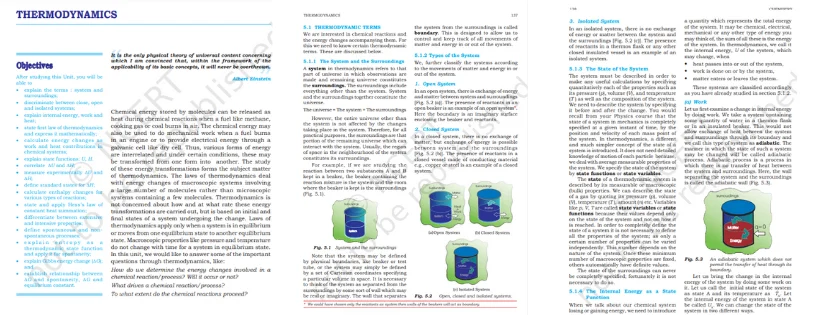
| CHAPTER NAME | Thermodynamics |
| Topic Number | Topic Name |
| 5.1 | Thermodynamic Terms |
| 5.2 | Applications |
| 5.3 | Measurement of ∆U and ∆H: Calorimetry |
| 5.4 | Enthalpy Change, ∆rH of a Reaction – Reaction Enthalpy |
| 5.5 | Enthalpies for Different Types of Reactions |
| 5.6 | Spontaneity |
| 5.7 | Gibbs Energy Change and Equilibrium |
[Previous Year Question Solution Physics Download Button]
[Previous Year Question Solution Chemistry Download Button]
[Previous Year Question Solution Math Download Button]
| CBSE CLASS 11th Chemistry Chapters |
| Chapter2: STRUCTURE OF ATOMS |
| Chapter3: CLASSIFICATION OF ELEMENTS AND PERIODICITY IN PROPERTIES |
| Chapter4: CHEMICAL BONDING AND MOLECULAR STRUCTURE |
| Chapter6: EQUILIBRIUM |
| Chapter7: REDOX REACTIONS |
| Chapter8: ORGANIC CHEMISTRY – SOME BASIC PRINCIPLE AND TECHNIQUES |
| Chapter9: Hydrocarbons HYDROCARBONS |
| CBSE Class 11 Physics Chapters |
| Chapter1: UNITS AND MEASUREMENTS |
| Chapter2: MOTION IN A STRAIGHT LINE |
| Chapter3: MOTION IN A PLANE |
| Chapter4: LAWS OF MOTION |
| Chapter5: WORK, ENERGY AND POWER |
| Chapter6: SYSTEM OF PARTICLES AND ROTATIONAL MOTION |
| Chapter7: GRAVITATION |
| Chapter8: MECHANICAL PROPERTIES OF SOLIDS |
| Chapter9: MECHANICAL PROPERTIES OF FLUIDS |
| Chapter10: THERMAL PROPERTIES OF MATTER |
| Chapter12: KINETIC THEORY |
| Chapter13: OSCILLATIONS |
| Chapter14: WAVES |
| CBSE Class 11 Mathematics chapter |
| Chapter1: SETS |
| Chapter2: RELATIONS AND FUNCTIONS |
| Chapter3: TRIGONOMETRIC FUNCTIONS |
| Chapter4: COMPLEX NUMBER AND QUADRATIC EQUATIONS |
| Chapter5: LINEAR INEQUALITIES |
| Chapter6: PERMUTATIONS AND COMBINATIONS |
| Chapter7: BINOMIAL THEOREM |
| Chapter8: SEQUENCES AND SERIES |
| Chapter9: STRAIGHT LINES |
| Chapter10: CONIC SECTIONS |
| Chapter11: INTRODUCTION TO THREE-DIMENSIONAL GEOMETRY |
| Chapter12: LIMITS AND DERIVATIVES |
| Chapter13: STATISTICS |
| Chapter14: PROBABILITY |
| Class 8 Link soon |
| Class 9 Link soon |
| Class 10 Link soon |
| Class 12 Link soon |
CBSE Class 11th Downloadable Resources:
|
1. CBSE Class 11th Topic Wise Summary |
View Page / Download |
|
2. CBSE Class 11th NCERT Books |
View Page / Download |
|
3. CBSE Class 11th NCERT Solutions |
View Page / Download |
|
4. CBSE Class 11th Exemplar |
View Page / Download |
|
5. CBSE Class 11th Sample Papers |
View Page / Download |
|
6. CBSE Class 11th Question Bank |
View Page / Download |
|
7. CBSE Class 11th Topic Wise Revision Notes |
View Page / Download |
|
8. CBSE Class 11th Last Minutes Preparation Resources |
View Page / Download |
|
9. CBSE Class 11th Best Reference Books |
View Page / Download |
|
10. CBSE Class 11th Formula Booklet |
View Page / Download |
Being in CBSE class 11th and considering the board examinations you must be needing resources to excel in your examinations. At TestprepKart we take great pride in providing CBSE class 11th all study resources in downloadable form for you to keep you going.
Below is the list of all CBSE class 11th Downloads available on TestprepKart for both Indian and NRI students preparing for CBSE class 11th in UAE, Oman, Qatar, Kuwait & Bahrain.
Q1. What is thermodynamics?
Answer. Thermodynamics is a branch of physical science that deals with the principles governing energy, heat, and work in physical and chemical systems. It provides a framework for understanding energy transfer and its effects on the properties and behavior of matter.
Q2. What are the fundamental laws of thermodynamics?
Answer. The four laws are Zeroth Law (defines temperature and thermal equilibrium), the First Law (conservation of energy), the Second Law (describes the direction of natural processes), and the Third Law (addresses behavior at absolute zero).
Q3. How is energy defined in thermodynamics?
Answer. Energy is the capacity to do work or transfer heat. It exists in various forms, such as kinetic energy (associated with motion) and potential energy (associated with position or state).
Q4. What is a thermodynamic system?
Answer. A thermodynamic system is a specific part of the universe under consideration, and the surroundings include everything outside the system that can exchange energy or matter with it.
Q5. What is the role of entropy in thermodynamics?
Answer. Entropy is a measure of the disorder or randomness in a system. The second law of thermodynamics states that the entropy of an isolated system tends to increase over time.








Copyright © 2024 CounselKart Educational Services Pvt. Ltd.. All Rights Reserved


Post a Comment