





Hi, I’m TestprepKart.
Your Partner In Exam Preparation
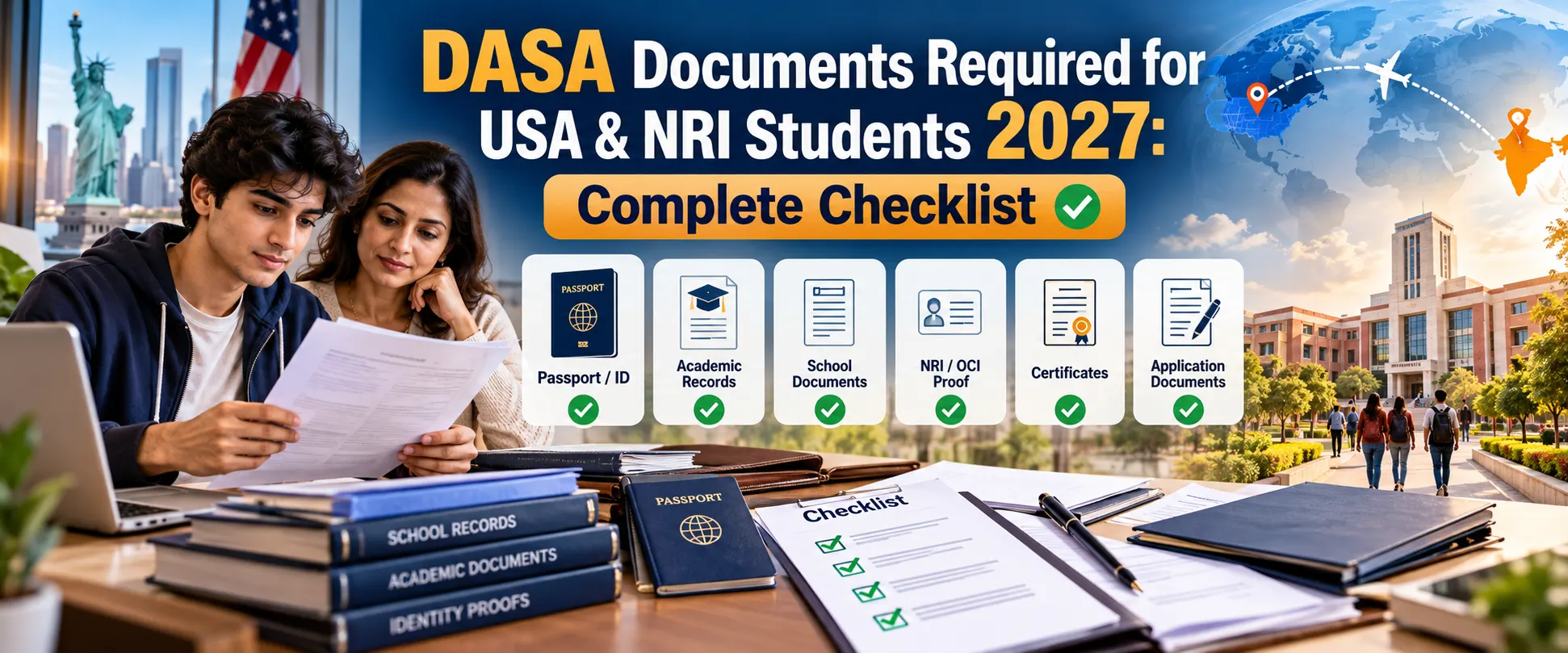
Quick Answer: The students applying for DASA 2027 need to gather the documents related to their identity, academic performance, overseas studies, and other category-wise documents in advance of the actual process of application. As per the procedure of DASA 2026, which has been successfully completed, some important documents that needed to be gathered by candidates include passport, birth date proof, class 10, 11, and 12 or its equivalent, overseas study proof, etc.
USA-based students should pay particular attention to official school transcripts, Grade 11 and Grade 12 study evidence, school-issued certificates, grading-scale information and proof of education abroad.Even though a transcript from the U.S. may not be similar to the marksheet in India, it is essential for parents to check whether the transcript meets the requirements laid out by DASA.
Planning year: 2027. Latest confirmed source baseline:DASA UG 2026. The 2027 brochure for DASA UG is not used in the preparation of this article. Families need to check the final list of 2027 documents, annexes, uploading instructions, and deadlines once the official brochure is out.
Important: The year 2026 cannot just be substituted by 2027 for an annexure, deadline, or certificate. The list of 2026 should be used for preparing records, which is then replaced by the official list for 2027 once issued.
Before collecting category-specific documents, families should first confirm the student’s eligibility using the DASA UG Eligibility Criteria.
Based on the confirmed DASA 2026 document framework, students preparing for a future DASA cycle should organize the following records early.
| Document | Who Needs It | USA Family Planning Note |
|---|---|---|
| Candidate Passport | DASA applicants | Check name, nationality and readability. |
| Date of Birth Proof | Applicants | Keep the accepted official record ready. |
| Class 10 / Equivalent Record | Applicants | US students should prepare the corresponding official academic record. |
| Class 11 / Equivalent Record | Applicants | Can also support overseas-study history. |
| Class 12 / Equivalent Record | Applicants when available | Keep transcript and final qualification documents. |
| School Certificate for Classes 11 & 12 | Applicable candidates | May need to be completed by the U.S. school in the prescribed format. |
| Percentage / CGPA Equivalence | Where applicable | Do not create your own GPA-to-percentage conversion. |
| Proof of Education Abroad | Applicable NRI candidates | Use school-issued evidence, not only residential proof. |
| Medical Certificate | Applicants where prescribed | Use the current DASA format. |
| OCI Certificate / PIO Card | Applicable candidates | Keep status evidence with passport records. |
| Parent Passport | CIWG applicants | Use the qualifying parent’s record. |
| Parent Gulf Visa | CIWG applicants | Check current validity requirements. |
| Parent Work Permit | CIWG applicants | Keep a clear copy with employment details. |
| Employer Certificate | CIWG applicants | Use the current prescribed format. |
| Class 12 Result Undertaking | Where permitted and applicable | Use only the current-cycle undertaking format. |
For the broader registration, counselling, fees and institute process, read the Complete DASA UG Admission Guide.
DASA document verification will be conducted during the admission procedure. Applicants might be required to submit the necessary documents and answer any document verification questions through the candidate portal.
That is the reason why families should not wait till the last day of registration to ask for documents from an educational institution or any governmental department in America.
Documents that depend on another institution should be collected first because they may take longer than files already held by the family.
Keep your DASA document preparation and JEE preparation in separate checklists so admission paperwork does not interrupt exam preparation.
A copy of the candidate’s passport is one of the primary DASA identity documents under the confirmed 2026 framework.
The passport can be used to verify:
The earlier version of the DASA 2026 process had another clause whereby Nepalese citizens without a passport could submit proof of their citizenship, according to the rule.
Parent check: Compare the candidate’s passport name with the student’s school records and JEE Main records before DASA registration.
DASA applicants should prepare valid date-of-birth evidence according to the current brochure.
The 2026 process included examples such as:
Students targeting DASA 2027 should check the exact accepted-document wording after the new brochure is published.
Candidates should keep a clear copy of their Class 10 or equivalent academic record.
USA-based students may not have the Indian-style Class 10 mark sheet. In such a case, it is recommended for the parents to get ready the official academic transcript of the school of the student at the Grade 10 or equivalent level.
Do not create an unofficial marksheet yourself if the U.S. school issues transcripts instead.
A Class 11 or equivalent academic record can be particularly important for NRI candidates whose overseas-study history must be established.
Individuals who study in nations like the US, UAE, Kuwait, Bahrain, Saudi Arabia, Qatar, Oman, Canada, Singapore or the UK must maintain documentation from their school which indicates the location at which the particular academic year was studied.
For USA students, this may include an official high school transcript showing the school’s identity, subjects, grades, credits and academic year.
Candidates should prepare their Class 12 or equivalent result when it becomes available.
For a student studying outside India, the final qualification may be represented through the applicable:
The qualification still needs to satisfy the academic requirements applicable to the current DASA cycle.
The confirmed process of 2026 DASA comprised an assigned process for specific candidates whose Class 12 or equivalent marks were yet to be declared or were still under the specified pending/revaluation process.
The 2026 version referred to a prescribed Annexure 14 and had a final-result deadline of September 30, 2026.
Do not use September 30, 2026 as the DASA 2027 deadline. Await the DASA 2027 brochure, and use the current project and deadline if there is still a pending result clause.
The verified list of DASA 2026 documents contains the school certificate that proves that the applicant completed Class 11 and Class 12 or its equivalent.
In the 2026 cycle, the prescribed form was listed as Annexure 11 and was to be issued on school letterhead.
This can be especially important for students studying abroad because the school may need time to complete, sign and return the form.
USA parents should contact the appropriate:
Use the official 2027 certificate format once it is published rather than sending the school an old 2026 form.
International schools may report academic performance using:
According to the old DASA equivalence rules, since the 2026 pattern grading or CGPA was done according to a different scale, the equivalence for it had to be provided by the Principal Examination Authority.
Do not create your own percentage conversion. The parent-made spreadsheet or the ordinary online GPA calculator cannot be considered as valid equivalence documentation.
Keep the student’s official transcript and school grading scale together so that the family’s documentation clearly explains how academic performance is reported.
Use the TestPrepKart JEE & DASA eBook to organize exam preparation, DASA eligibility, counselling, document planning and engineering-admission research.

Download Free JEE & DASA E-Book
Proof of overseas education is one of the most important document areas for applicable NRI candidates.
The old article records that under the confirmed DASA 2026 framework, applicable Indian national / OCI-PIO(I) candidates had an overseas-study condition involving at least two years of education abroad, including Class 11 and Class 12 or equivalent, along with completion of the qualifying examination abroad.
Possible supporting records included:
The previous version of the DASA 2026 article also pointed out that there was an Annexure 13 study certificate and evidence of two years of studying overseas on the checklist.
Students completing the relevant school years in the USA should keep:
Do not assume that a passport or U.S. home address alone proves the overseas-study condition.
For the detailed eligibility framework, read DASA UG Eligibility Criteria.
The confirmed DASA 2026 process required a medical certificate in the prescribed format.
The 2026 version was attached as Annexure 10.
If the current DASA cycle provides a specific medical format, students should use that form rather than uploading a general fitness note from a doctor.
For DASA 2027, wait for the official current form before completing the final medical document.
Candidates applying under an applicable OCI or PIO category should prepare the relevant status evidence.
This may include:
The eligibility and documentation criteria may differ from one category to another for treatment under the existing policy, so families must not presume that all OCI students follow the same procedure.
USA families dealing with Indian citizenship, U.S. citizenship, OCI status or green-card status should also read the JEE & DASA Eligibility Guide for US Citizen, OCI, Green Card and H-1B Families.
CIWG stands for Children of Indian Workers in Gulf and operates as a category within the DASA framework.
CIWG applicants need their regular DASA records plus additional evidence connected to the qualifying parent’s Gulf employment.
| CIWG Document | Purpose |
|---|---|
| Parent Passport | Identifies the parent whose Gulf employment supports the CIWG claim. |
| Parent Gulf Visa | Supports the applicable Gulf visa status. |
| Parent Work Permit | Supports employment authorization. |
| Employer Certificate | Confirms the applicable Gulf employment in the prescribed format. |
| Candidate’s normal DASA documents | Still required in addition to CIWG-specific evidence. |
The old 2026 document framework required CIWG applicants to prepare the passport of the parent whose qualifying Gulf employment was being relied upon.
The employment and supporting records should refer to the same parent.
The confirmed 2026 checklist included the applicable parent’s Gulf visa with the required validity under that cycle’s rules.
For 2027, check the actual validity requirement instead of simply changing the year on the 2026 wording.
The old CIWG checklist also required the applicable parent’s work permit.
Families should keep clear copies showing details such as:
The old content records that DASA 2026 used a prescribed employer-certificate format identified as Annexure 12.
The family should ask the employer for the current-cycle certificate after the new brochure is released rather than relying on an old form.
The confirmed 2026 CIWG framework covered the following eight Gulf countries:
| CIWG Country |
|---|
| United Arab Emirates |
| Kuwait |
| Bahrain |
| Oman |
| Iraq |
| Qatar |
| Iran |
| Saudi Arabia |
Students should verify whether the same list and CIWG conditions continue for DASA 2027.
Potentially, yes. CIWG status is not determined only by where the student currently studies.
For example, a student could be studying in the USA while a qualifying parent works in an eligible Gulf country.
Therefore:
USA student does not automatically mean Non-CIWG.
And:
Studying in a Gulf country does not automatically establish CIWG eligibility.
The family should check the complete current DASA and CIWG eligibility conditions.
Students studying in the United States should prepare documents early because their academic records may use a different format from Indian Class 10, 11 and 12 marksheets.
| Document | USA Student Planning |
|---|---|
| Passport | Keep the candidate passport valid, clear and readable. |
| Grade 10 equivalent record | Keep the applicable academic / DOB-supporting record. |
| Grade 11 transcript | Useful as academic evidence and potentially for overseas-study history. |
| Grade 12 transcript | Keep current and final versions when issued. |
| School study certificate | May be required to confirm the relevant study period abroad. |
| Diploma / qualifying certificate | Keep once issued. |
| School grading scale | Useful where GPA or grades need to be interpreted. |
| Percentage / GPA equivalence | Prepare only where required by the applicable official rules. |
| Equivalence evidence | Where applicable to the student’s foreign qualification. |
| Medical certificate | Use the current prescribed DASA format. |
| OCI / PIO document | Keep where applicable. |
| CIWG parent documents | Only where the student is claiming the applicable CIWG category. |
Students should not assume that AP courses replace the need for official school transcripts, graduation records or other qualification evidence.
For students following a U.S. curriculum, read Can American Curriculum Students Give JEE?.
This is an important distinction because many older online DASA checklists mix JEE Main records with the DASA mandatory-upload list.
Your existing article notes that the official Annexure 5 of the DASA 2026 brochure did not separately list a JEE Main scorecard or DASA payment receipt as mandatory document uploads.
Under that process, candidates used their JEE Main credentials for the relevant DASA / CSAB Special portal workflow, while fee payment was handled separately through the admission process.
Practical advice: These documents must still be saved securely by students but should never be called “mandatory DASA 2027 uploads” unless they are specified as such on the official checklist for the year 2027.
For JEE Main-specific records, read Documents Required for NRI Students for JEE Main.
USA families can also use How NRIs in the USA Can Apply and Sit for JEE.
Your current content states that in the context of DASA 2026, transcripts, mark sheets, and grade sheets for the qualifying exam required self-attestation.
Students should make sure uploaded files are:
Do not upload screenshots when the current portal requires official scanned documents.
Different names across documents can create verification problems.
Compare the candidate’s details across:
Potential mismatches include:
Families should identify these issues before registration and follow the applicable current instructions for corrections or supporting evidence.
After documents are uploaded, they are reviewed during the applicable verification process.
If a discrepancy is identified, a query may be raised through the candidate portal.
The candidate should respond within the official time limit.
Your existing article notes that under the 2026 process, failure to respond to verification queries could affect the candidate’s continuation in the DASA seat-allocation process.
Families should therefore:
Document collection and JEE preparation can run in parallel. USA-based students can continue Physics, Chemistry and Mathematics preparation while parents organize school, passport and admission records.
Uploading scanned documents does not mean original records are no longer important.
Your current article states that in case of 2026 DASA procedure, the original mark cards along with their records had to be presented in the designated institute for admission / physical reporting as per instructions by the institute.
USA and Gulf students travelling for reporting should prepare a separate original-document folder.
Depending on the applicable current rules and institute instructions, families may need to organize:
Always check the individual institute’s reporting notice because the reporting document list may contain additional requirements.
Because the final DASA 2027 schedule is not being assumed here, families can prepare documents by milestone rather than by guessed dates.
| Stage | What to Prepare |
|---|---|
| Before DASA 2027 brochure | Passport, academic transcripts, school records and general study-abroad evidence. |
| Before JEE Main 2027 | Identity and applicable academic details needed for the exam process. |
| When DASA 2027 brochure releases | Download the official document list, annexures and current instructions. |
| Before DASA registration | Finalize overseas-study proof, medical record, OCI / PIO evidence and category-specific forms. |
| CIWG preparation | Collect qualifying-parent passport, Gulf visa, work permit and employer certificate. |
| During registration | Upload the current official records in the required format. |
| Verification stage | Monitor the portal and answer document queries on time. |
| After allotment | Organize originals and institute-specific reporting documents. |
| DASA Resource | What It Helps With |
|---|---|
| DASA Admission Process | Registration, verification, counselling and seat-allocation planning. |
| DASA Participating Colleges | Participating institutes and programme planning. |
| DASA vs CIWG | Understand the DASA and CIWG admission categories. |
| DASA Eligibility | Nationality, overseas-study and academic eligibility. |
| DASA / CIWG Cutoff | Historical admission trends. |
| DASA / CIWG Fee Structure | Fee planning. |
| DASA Registration Process | Registration workflow. |
Taking into consideration the process of 2026 which is now confirmed, the basic documents are those that include the passport of the applicant, proof of the date of birth, class 10, 11 and 12 or its equivalent academic records, school certificates, percentage/CGPA conversion wherever needed, overseas study proof wherever applicable in case of NRI candidates, medical certificate and OCI / PIO documents wherever applicable.
The old 2026 checklist included the qualifying parent’s passport, Gulf visa, work permit and employer certificate in addition to the student’s normal DASA documents.
Passport for candidate was in the confirmed checklist for 2026, including the provision for citizenship card for Nepali citizens without a passport. Refer to the 2027 brochure for the updated policy.
Class 11 or its equivalent academic record was part of the established format for the 2026 document. For relevant NRI applicants, Grade 11 documentation can further assist in proving overseas study experience.
In the verified framework of 2026, NRI eligibility criteria included studying abroad conditions wherein Class 11 and 12 or their equivalents were covered. Please refer to the brochure of 2027 for the rule that applies to your category.
U.S. schools often issue official transcripts rather than Indian-style marksheets. Use the official academic record that proves the information required by the current DASA instructions.
Do not use a self-created conversion unless the current admission authority explicitly accepts that method. Follow the official equivalence or grading requirement applicable to the student’s qualification.
The confirmed 2026 process had a prescribed undertaking for certain eligible pending-result situations. The 2027 undertaking, conditions and deadlines must be checked after the new brochure is released.
According to your previous document for 2026, Annexure 5 does not separately mention either JEE Main Scorecard or DASA Payment as compulsory documents to be uploaded. These documents need to be kept safely by you for future use.
Documents in scanned form are required for online verification, but sometimes the original documents need to be submitted at the designated institute when the time comes for the final admission or reporting.
N. The CIWG supporting documentation applies only in cases where the student qualifies for the respective CIWG category, and the respective parent has the required employment in the Gulf region.
Recognize the inconsistency prior to registration and refer to the present-day DASA guidelines for remedy or documentation. Do not discover a pre-existing disparity at the time of document verification.
As indicated in the earlier article, there is a need for translation of any document that is not in the accepted language. Use the present official guideline on certified translation in making your 2027 document package.
Don’t take annexures for 2026 as 2027 forms. These might guide the families to see which documents need to be collected earlier, but the forms for 2027 should be considered once released officially.
Begin preparation even before registration through documentation which will be dependent on the school, the exam body, your employer, or other organizations. Once the 2027 booklet becomes available, cross-check the documents gathered with the checklist provided officially.
DASA paperwork and JEE Main preparation should be two different streams of work. The parents could prepare the passports, school documents, and Category Proof while the student prepares for Physics, Chemistry, and Mathematics.
USA-based students can explore Online JEE Coaching for NRI Students in USA for academic preparation.
Ask About DASA Documents Download Free JEE & DASA E-Book Book Free JEE Demo
Before uploading any document for DASA 2027, please cross-check the current-year brochure, mandatory upload list, annexures, allowed file format, self-attestation procedure, translation norms, and document verification process.
Use the official forms in their current format and ascertain who is responsible for issuing or signing the form. The historical requirements for DASA 2026 will be considered as preparatory guidance rather than assurance of the actual procedure in 2027.








Copyright © 2024 CounselKart Educational Services Pvt. Ltd.. All Rights Reserved

Post a Comment