





Hi, I’m TestprepKart.
Your Partner In Exam Preparation
Work, a term commonly associated with our daily grind, takes on a profound and nuanced meaning when viewed through the lens of physics. In the realm of science, work is more than just a job; it's a fundamental concept that governs the dynamics of motion and energy. Join us on a journey of exploration as we delve into the intricacies of work, unraveling its definitions, principles, and real-world applications.
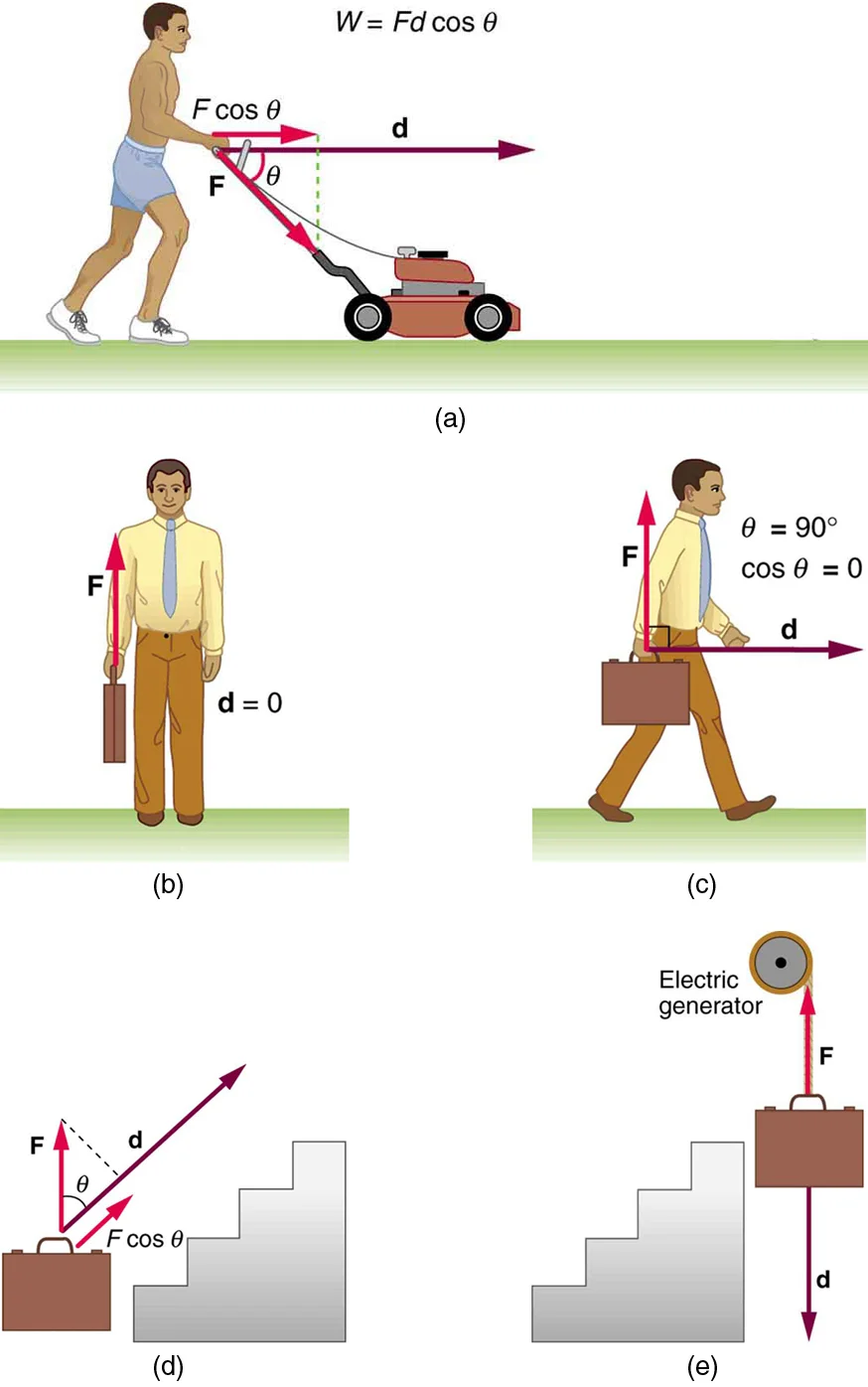
Physics Perspective: In physics, work is done when a force is applied to an object, causing it to undergo a displacement in the direction of the force. The key here is that the force must have a component in the direction of the displacement.
Mathematical Expression: Mathematically, work (W) is expressed as the product of force (F), displacement (d), and the cosine of the angle (θ) between the force and displacement vectors. The formula is represented as W=F⋅d⋅cos(θ).
Positive Work: Occurs when the force applied is in the same direction as the displacement. In this case, the work done increases the energy of the system.
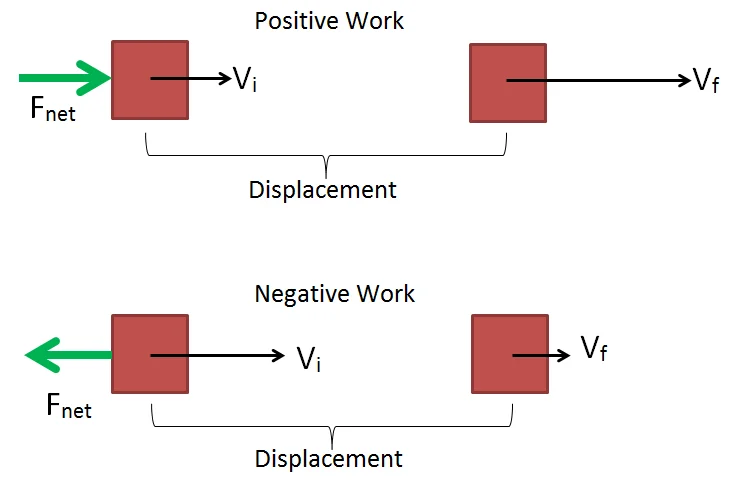
Negative Work: Takes place when the force acts opposite to the direction of displacement. Negative work results in a decrease in energy, often seen when a force opposes the motion.
Units of work:
The unit of work in physics is the joule (J). The joule is a derived unit in the International System of Units (SI) and is used to quantify energy transfer through the performance of work. One joule is defined as the amount of work done when a force of one newton is applied to move an object one metre in the direction of the force.
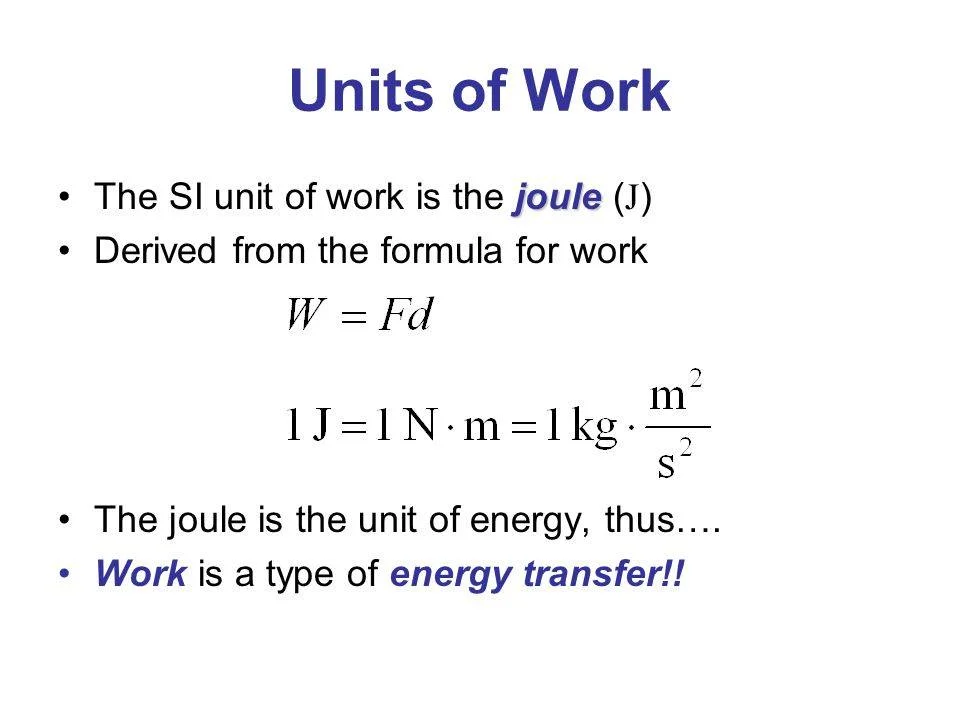
Mathematically, the relationship is expressed as:
Work (Joule)=Force (Newton)×Distance (Metre)
Work (Joule)=Force (Newton)×Distance (Metre)
This definition aligns with the conceptualization of work in physics, where work is performed when a force causes a displacement in the direction of the force. The unit of work, the joule, provides a standardised measure for quantifying energy transfer and is widely used in scientific, engineering, and everyday contexts to describe and calculate the amount of work done in various physical processes.
Factors Affecting Work
Several factors influence the amount of work done in a physical system. Understanding these factors is crucial for analysing and predicting the outcomes of various mechanical processes. Here are key factors affecting work:
Force Applied:
The magnitude of the force applied to an object is a fundamental factor. Greater force results in more work done, assuming the displacement remains constant.
Displacement:
The distance over which an object is moved in the direction of the applied force is the displacement. Work is directly proportional to displacement; increasing displacement increases the work done.
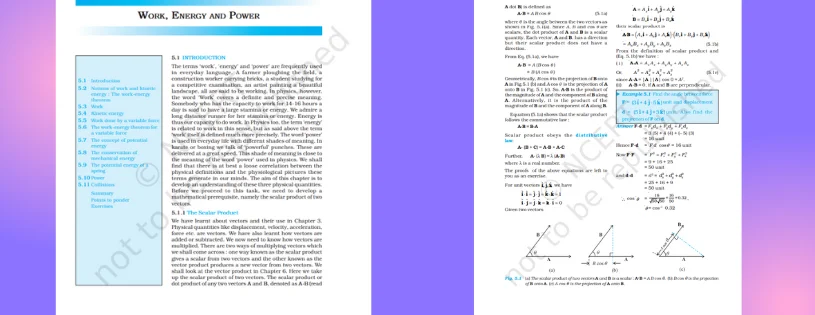
Angle Between Force and Displacement:
The angle (θ) between the direction of the applied force and the direction of displacement affects the work done. Work is maximised when the force is applied parallel to the direction of motion (θ=0∘) and is zero when the force is applied perpendicular (θ=90∘).
Constant vs. Variable Force:
For a constant force, work is calculated straightforwardly as the product of force and displacement. In the case of a variable force, integration is often required to find the total work done.
Energy Transfers:
Work is closely tied to energy transfers. Changes in kinetic energy or potential energy contribute to the work done on or by an object. For instance, lifting an object against gravity involves work and potential energy changes.
| 1. CBSE Class 11th Topic Wise Summary | View Page / Download |
| 2. CBSE Class 11th NCERT Books | View Page / Download |
| 3. CBSE Class 11th NCERT Solutions | View Page / Download |
| 4. CBSE Class 11th Exemplar | View Page / Download |
| 5. CBSE Class 11th Previous Year Papers | View Page / Download |
| 6. CBSE Class 11th Sample Papers | View Page / Download |
| 7. CBSE Class 11th Question Bank | View Page / Download |
| 8. CBSE Class 11th Topic Wise Revision Notes | View Page / Download |
| 9. CBSE Class 11th Last Minutes Preparation Resources | View Page / Download |
| 10. CBSE Class 11th Best Reference Books | View Page / Download |
| 11. CBSE Class 11th Formula Booklet | View Page / Download |
Being in CBSE class 11th and considering the board examinations you must be needing resources to excel in your examinations. At TestprepKart we take great pride in providing CBSE class 11th all study resources in downloadable form for you to keep you going.
Below is the list of all CBSE class 11th Downloads available on TestprepKart for both Indian and NRI students preparing for CBSE class 11th in UAE, Oman, Qatar, Kuwait & Bahrain.
SAMPLE PRACTICE QUESTIONS OF SIGNIFICANT FIGURES :
Q1. What is Work in Physics?
Answer: In physics, work is defined as the product of force and displacement in the direction of the force. It's expressed mathematically as⋅cos(W)=F⋅d⋅cos(θ), where W is work, F is force, d is displacement, and θ is the angle between the force and displacement vectors.
Answer: Work is a scalar quantity. Although it involves force and displacement, it lacks direction. The scalar nature of work means that it only has magnitude and no specific direction.
Answer: The SI unit of work is the joule (J). One joule is equivalent to one newton-meter (N·m). In the CGS system, the unit of work is the erg.
Answer: Work is positive when the force and displacement are in the same direction, negative when they are in opposite directions, and zero when the force is perpendicular to the displacement.
Answer: Yes, work can be done without motion if the force applied doesn't cause any displacement. For work to occur, there must be a component of force in the direction of the displacement.
| Class 11th CBSE Physics Chapters |
| Chapter1: UNITS AND MEASUREMENTS |
| Chapter2: MOTION IN A STRAIGHT LINE |
| Chapter3: MOTION IN A PLANE |
| Chapter4: LAWS OF MOTION |
| Chapter5: WORK, ENERGY AND POWER |
| > Introduction |
| > Notions of work and kinetic energy: The work-energy theorem |
| > Kinetic energy |
| > Work done by a variable force |
| > The concept of potential energy |
| > The conservation of mechanical energy |
| > The potential energy of a spring |
| > Power |
| > Collisions |
| Chapter6: SYSTEM OF PARTICLES AND ROTATIONAL MOTION |
| Chapter7: GRAVITATION |
| Chapter8: MECHANICAL PROPERTIES OF SOLIDS |
| Chapter9: MECHANICAL PROPERTIES OF FLUIDS |
| Chapter10: THERMAL PROPERTIES OF MATTER |
| Chapter12: KINETIC THEORY |
| Chapter13: OSCILLATIONS |
| Chapter14: WAVES |
| Class 11th CBSE Chemistry Chapters |
| Chapter1: SOME BASIC CONCEPTS OF CHEMISTRY |
| Chapter2: STRUCTURE OF ATOMS |
| Chapter3: CLASSIFICATION OF ELEMENTS AND PERIODICITY IN PROPERTIES |
| Chapter4: CHEMICAL BONDING AND MOLECULAR STRUCTURE |
| Chapter5: THERMODYNAMICS |
| Chapter6: EQUILIBRIUM |
| Chapter7: REDOX REACTIONS |
| Chapter8: ORGANIC CHEMISTRY – SOME BASIC PRINCIPLE AND TECHNIQUES |
| Chapter9: Hydrocarbons HYDROCARBONS |
| Class 11th CBSE Mathematics chapter |
| Chapter1: SETS |
| Chapter2: RELATIONS AND FUNCTIONS |
| Chapter3: TRIGONOMETRIC FUNCTIONS |
| Chapter4: COMPLEX NUMBER AND QUADRATIC EQUATIONS |
| Chapter5: LINEAR INEQUALITIES |
| Chapter6: PERMUTATIONS AND COMBINATIONS |
| Chapter7: BINOMIAL THEOREM |
| Chapter8: SEQUENCES AND SERIES |
| Chapter9: STRAIGHT LINES |
| Chapter10: CONIC SECTIONS |
| Chapter11: INTRODUCTION TO THREE-DIMENSIONAL GEOMETRY |
| Chapter12: LIMITS AND DERIVATIVES |
| Chapter13: STATISTICS |
| Chapter14: PROBABILITY |
| Class 8 Link soon |
| Class 9 Link soon |
| Class 10 Link soon |
| Class 12 Link soon |








Copyright © 2024 CounselKart Educational Services Pvt. Ltd.. All Rights Reserved


Post a Comment