






Hi, IÔÇÖm TestprepKart.
Your Partner In Exam Preparation
The Indian government has introduced two unique initiatives, namely DASA (Direct Admission of Students Abroad) and CIWG (Children of Indian Workers in Gulf), aiming to provide avenues for NRI/OCI/PIO students aspiring to pursue undergraduate engineering courses in India.
These programs continue to support students, especially those living in the USA and the Middle East (UAE, Oman, Qatar, Kuwait, Bahrain, Saudi Arabia) by simplifying the admission process and creating opportunities for diverse international learners. Both schemes now operate entirely on the basis of JEE Main rank, making the pathway more structured and transparent for the 2025-26 admission cycle.
When it comes to pursuing higher education in India, understanding the admission process and its criteria becomes crucial, especially for NRI students living in the USA and across the Middle East (UAE, Qatar, Oman, Kuwait, Bahrain, Saudi Arabia). Two terms that often create confusion are DASA Rank and CIWG Rank. Although both fall under the same admission framework, many students are unsure whether these ranks are the same or different. Let’s break down these educational terms and understand how the ranking works for the 2025-26 admission cycle.
Get JEE Prep Help Download NRI DASA CIWG JEE E-BOOK
DASA, which stands for Direct Admission of Students Abroad, is a scheme introduced by the Ministry of Human Resource Development (now MoE), Government of India. It provides a dedicated admission pathway for Foreign Nationals, OCI/PIO students, and Non-Resident Indians (NRIs), including those living in the USA and the Middle East (UAE, Qatar, Oman, Kuwait, Bahrain, Saudi Arabia), to secure seats in premier engineering institutions such as NITs, IIITs, CFTIs, and SPAs.
Understanding the DASA Rank (Updated for 2025–26)
CIWG, or Children of Indian Workers in Gulf, is a dedicated subcategory under the DASA scheme. It is specifically designed for students whose parents are Indian expatriates working in Gulf countries such as UAE, Oman, Qatar, Kuwait, Bahrain, and Saudi Arabia. This scheme offers reduced tuition fees and a reserved quota, making it highly beneficial for Gulf-based NRI families.
Understanding the CIWG Rank (Updated for 2025–26)
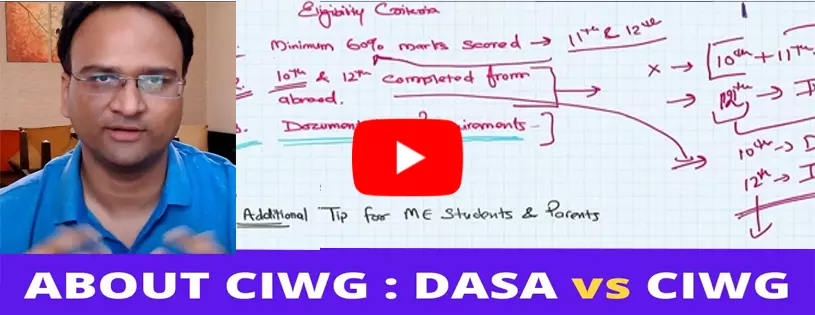
Despite sharing similarities in eligibility criteria and admission guidelines, DASA Rank and CIWG Rank are NOT separate ranks.
For the 2025-26 cycle, both DASA and CIWG use the same JEE Main Rank for seat allocation. There is no separate “DASA Rank” or “CIWG Rank” generated by the system, but the seat category, quota, and fee structure differ, which is why students often get confused.
Below are the updated differences relevant for NRI students in the USA and Middle East (UAE, Oman, Qatar, Kuwait, Bahrain, Saudi Arabia).
1. Target Audience
2. Geographical Focus
3. Quota System
4. Fee System (Updated for 2025–26)
This difference is one of the biggest reasons Gulf-based families prefer CIWG over regular DASA.
While the DASA Rank and CIWG Rank may seem similar at first glance, they actually cater to different segments of the global NRI student community. It is especially important for students and parents living in the USA or the Middle East (UAE, Qatar, Oman, Kuwait, Bahrain, Saudi Arabia) to understand these differences clearly before planning the admission pathway.
Understanding the nuances of these ranking systems helps students navigate the evolving landscape of international admissions with confidence. Whether you fall under the DASA category or the CIWG category, your JEE Main rank remains the deciding factor and will play a pivotal role in shaping your academic future. In the broader journey of education, both pathways, DASA and CIWG-serve as valuable opportunities, guiding NRI students toward a brighter, globally connected engineering career in India.

FAQ’s on DASA CIWG
1. Are DASA Rank and CIWG Rank different?
No. For 2025-26, there is no separate DASA Rank or CIWG Rank. Both categories use the same JEE Main All India Rank for admissions. The only differences lie in quota, fee structure, and eligibility criteria for Gulf-based (CIWG) students.
2. Is JEE Main mandatory for DASA/CIWG admissions in 2025–26?
Yes. JEE Main is fully mandatory, and SAT scores are no longer accepted. All NRI/OCI/PIO students, including those in the USA and Middle East, must submit their JEE Main Rank for admission under DASA and CIWG schemes.
3. What is the eligibility requirement for CIWG students?
CIWG applicants must be children of Indian workers living in Gulf countries (UAE, Oman, Qatar, Kuwait, Bahrain, Saudi Arabia). They must complete Class 11 and 12 abroad and apply through JEE Main Rank-based admission under the DASA/CIWG framework.
4. Do USA-based NRI students qualify for CIWG?
No. CIWG applies only to students whose parents work in approved Gulf countries. NRI students in the USA can apply only through the regular DASA category and not CIWG, even though both use JEE Main Rank.
5. How many seats are reserved for CIWG in 2025–26?
CIWG holds 1/3rd of the total DASA seats, derived from the 15% supernumerary quota across participating institutes. This ensures exclusive seat availability for Gulf-based NRI students before they are considered under the general DASA list.
6. What is the fee difference between DASA and CIWG?
CIWG students pay the same fee as Indian students, ₹1,25,000 per year. DASA (Non-SAARC) students typically pay USD 4000 per semester, and DASA (SAARC) students pay USD 2000 per semester. Final 2026 fees must be verified in the official brochure.
7. What documents are required for DASA/CIWG registration?
Applicants must upload a passport, Class 10-12 mark sheets, proof of 2 years of education abroad, school certificate, JEE Main Score, and SWIFT/online payment receipts. Additional documents are required for CIWG eligibility verification for Gulf-based families.
8. How does seat allocation work for DASA and CIWG categories?
Seat allocation happens entirely through JEE Main Rank. CIWG candidates get priority within reserved CIWG seats. If CIWG seats are filled, eligible applicants who opted for both categories are automatically considered under the regular DASA list.
9. Is coaching necessary for NRI students applying through DASA/CIWG?
With increasing competition and JEE Main being mandatory, dedicated preparation is strongly recommended. Many NRI students in the USA and Middle East opt for online coaching to manage time zones, solve high-level JEE questions, and improve AIR rank for admissions.
10. Which institutes accept DASA/CIWG admissions in 2025–26?
All NITs, IIITs, SPAs, and several CFTIs accept admissions under DASA and CIWG. Seat availability varies by institute, branch, and category. Updated participating institutes will be listed in the official DASA 2025–26 brochure once released.








Copyright © 2024 CounselKart Educational Services Pvt. Ltd.. All Rights Reserved


Post a Comment