






Hi, I’m TestprepKart.
Your Partner In Exam Preparation
The principle of conservation of momentum is a fundamental concept in physics that plays a crucial role in understanding the behavior of objects in motion. Momentum is a vector quantity defined as the product of an object's mass and its velocity.
 \
\
The conservation of momentum is a fundamental principle in physics that states that the total momentum of a closed system remains constant if no external forces act on it. Momentum is the product of an object's mass and velocity, and it is a vector quantity, meaning it has both magnitude and direction.
The conservation of momentum can be expressed mathematically as follows:
Total momentum before an event=Total momentum after the event

The conservation of momentum is based on Newton's third law of motion, which states that for every action, there is an equal and opposite reaction. When two objects interact, the forces they exert on each other are equal and opposite, and as a result, their individual momentum changes, but the total momentum of the system remains constant.
Example of Conservation of Momentum:
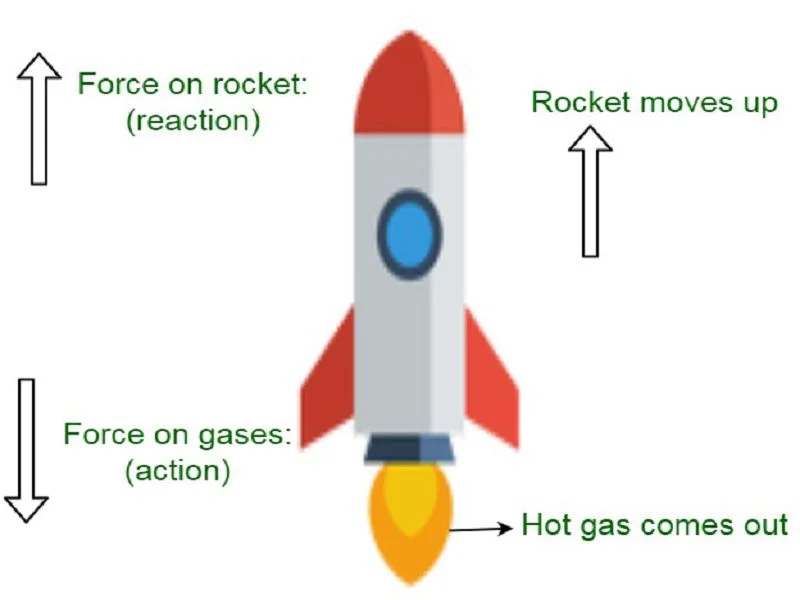
Conservation of Linear Momentum
The conservation of linear momentum is a fundamental principle in physics that states that the total linear momentum of a closed system remains constant if no external forces act on it. In other words, if a system of objects interacts only with each other (with no external forces like friction or air resistance), the total momentum before a collision or interaction is equal to the total momentum after the collision or interaction.
p = mv
Initial total momentum=Final total momentum
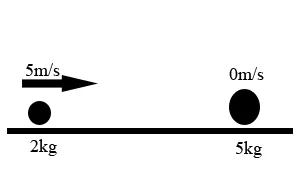
If you have a system of two objects colliding or interacting, the conservation of linear momentum equation can be written as.
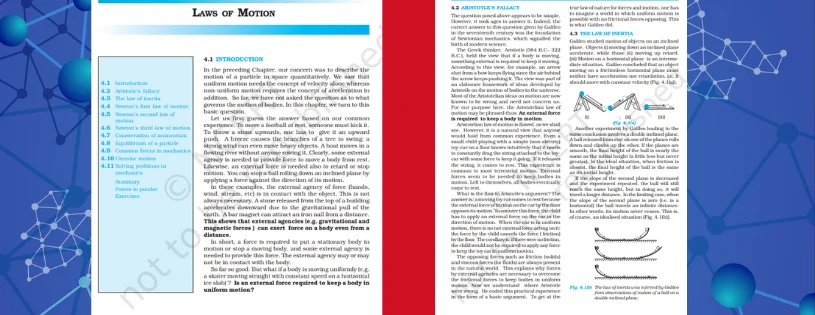
Newton’s third law states that for a force applied by an object A on object B, object B exerts back an equal force in magnitude, but opposite in direction. This idea was used by Newton to derive the law of conservation of momentum.
Consider two colliding particles A and B whose masses are m1 and m2 with initial and final velocities as u1 and v1 of A and u2 and v2 of B. The time of contact between two particles is given as t.
A=m1(v1-u1)
(change in momentum of particle A)
B=m2(v2-u2)
(change in momentum of particle B)
FBA=-FAB
(from third law of motion)
FBA=m2*a2 = m2(v2-u2)/t
FAB=m1*a1= m1v1-u1)/t
m2(v2-u2)/t = -m1(v1-u1)/t
m1u1+m2u2=m1v1+m2v2
| 1. CBSE Class 11th Topic Wise Summary | View Page / Download |
| 2. CBSE Class 11th NCERT Books | View Page / Download |
| 3. CBSE Class 11th NCERT Solutions | View Page / Download |
| 4. CBSE Class 11th Exemplar | View Page / Download |
| 5. CBSE Class 11th Previous Year Papers | View Page / Download |
| 6. CBSE Class 11th Sample Papers | View Page / Download |
| 7. CBSE Class 11th Question Bank | View Page / Download |
| 8. CBSE Class 11th Topic Wise Revision Notes | View Page / Download |
| 9. CBSE Class 11th Last Minutes Preparation Resources | View Page / Download |
| 10. CBSE Class 11th Best Reference Books | View Page / Download |
| 11. CBSE Class 11th Formula Booklet | View Page / Download |
Being in CBSE class 11th and considering the board examinations you must be needing resources to excel in your examinations. At TestprepKart we take great pride in providing CBSE class 11th all study resources in downloadable form for you to keep you going.
Below is the list of all CBSE class 11th Downloads available on TestprepKart for both Indian and NRI students preparing for CBSE class 11th in UAE, Oman, Qatar, Kuwait & Bahrain.
Q1. What is Conservation of Momentum?
Answer: Conservation of momentum is a fundamental principle in physics that states the total momentum of an isolated system remains constant if no external forces act on it.
Q2. How is Momentum Defined?
Answer: Momentum (p) is the product of an object's mass (m) and its velocity (v): =p=m⋅v.
Q3. Is Momentum a Vector or Scalar Quantity?
Answer: Momentum is a vector quantity, meaning it has both magnitude and direction. The direction is the same as the direction of the velocity.
Q4. When Does Conservation of Momentum Apply?
Answer: Conservation of momentum applies to closed or isolated systems, where no external forces (like friction or external pushes) act on the system.
Q5. Does Conservation of Momentum Apply to Collisions Only?
Answer: No, conservation of momentum applies to any situation where no external forces act on a system. This includes collisions, explosions, and interactions between objects.
| Class 11th CBSE Physics Chapters |
| Chapter1: UNITS AND MEASUREMENTS |
| Chapter2: MOTION IN A STRAIGHT LINE |
| Chapter3: MOTION IN A PLANE |
| Chapter4: LAWS OF MOTION |
| > Introduction |
| > Aristotle’s fallacy |
| > The law of inertia |
| > Newton’s first law of motion |
| > Newton’s second law of motion |
| > Newton’s third law of motion |
| > Equilibrium of a particle |
| > Common forces in mechanics |
| > Circular motion |
| > Solving problems in mechanics |
| Chapter5: WORK, ENERGY AND POWER |
| Chapter6: SYSTEM OF PARTICLES AND ROTATIONAL MOTION |
| Chapter7: GRAVITATION |
| Chapter8: MECHANICAL PROPERTIES OF SOLIDS |
| Chapter9: MECHANICAL PROPERTIES OF FLUIDS |
| Chapter10: THERMAL PROPERTIES OF MATTER |
| Chapter12: KINETIC THEORY |
| Chapter13: OSCILLATIONS |
| Chapter14: WAVES |
| Class 11th CBSE Chemistry Chapters |
| Chapter1: SOME BASIC CONCEPTS OF CHEMISTRY |
| Chapter2: STRUCTURE OF ATOMS |
| Chapter3: CLASSIFICATION OF ELEMENTS AND PERIODICITY IN PROPERTIES |
| Chapter4: CHEMICAL BONDING AND MOLECULAR STRUCTURE |
| Chapter5: THERMODYNAMICS |
| Chapter6: EQUILIBRIUM |
| Chapter7: REDOX REACTIONS |
| Chapter8: ORGANIC CHEMISTRY – SOME BASIC PRINCIPLE AND TECHNIQUES |
| Chapter9: Hydrocarbons HYDROCARBONS |
| Class 11th CBSE Mathematics chapter |
| Chapter1: SETS |
| Chapter2: RELATIONS AND FUNCTIONS |
| Chapter3: TRIGONOMETRIC FUNCTIONS |
| Chapter4: COMPLEX NUMBER AND QUADRATIC EQUATIONS |
| Chapter5: LINEAR INEQUALITIES |
| Chapter6: PERMUTATIONS AND COMBINATIONS |
| Chapter7: BINOMIAL THEOREM |
| Chapter8: SEQUENCES AND SERIES |
| Chapter9: STRAIGHT LINES |
| Chapter10: CONIC SECTIONS |
| Chapter11: INTRODUCTION TO THREE-DIMENSIONAL GEOMETRY |
| Chapter12: LIMITS AND DERIVATIVES |
| Chapter13: STATISTICS |
| Chapter14: PROBABILITY |
| Class 8 Link soon |
| Class 9 Link soon |
| Class 10 Link soon |
| Class 12 Link soon |








Copyright © 2024 CounselKart Educational Services Pvt. Ltd.. All Rights Reserved


Post a Comment