






Hi, I’m TestprepKart.
Your Partner In Exam Preparation

In the intricate world of Physics, the concepts of dimensional formulae and dimensional equations play a crucial role. These concepts remain an essential part of the Class 11 Physics syllabus and are highly relevant for JEE Main 2026 and onward.
Get JEE Prep Help Download NRI JEE E-Book
Dimensional formulae help students understand physical quantities, check the correctness of equations, and simplify complex numerical problems. This is especially helpful for NRI Students in USA and students preparing from the Middle East (UAE) who rely on structured notes and PDFs for effective self-study.
By mastering dimensional equations early in Class 11, students build a strong foundation for advanced topics in Mechanics and other areas of Physics, making this PDF a valuable revision resource for board exams and competitive entrance tests.
| Index | Quantity | Dimension | SI Unit |
| 1 | Area | L2L^2L2 | metre2^22 |
| 2 | Volume | L3L^3L3 | metre3^33 |
| 3 | Velocity | LT−1LT^{-1}LT−1 | ms−1^{-1}−1 |
| 4 | Acceleration | LT−2LT^{-2}LT−2 | ms−2^{-2}−2 |
| 5 | Force | MLT−2MLT^{-2}MLT−2 | newton (N) |
| 6 | Work or energy | ML2T−2ML^2T^{-2}ML2T−2 | joule (J) |
| 7 | Power | ML2T−3ML^2T^{-3}ML2T−3 | J s−1^{-1}−1/ watt |
| 8 | Pressure or stress | ML−1T−2ML^{-1}T^{-2}ML−1T−2 | Nm−2^{-2}−2 |
| 9 | Linear momentum or Impulse | MLT−1MLT^{-1}MLT−1 | kg ms−1^{-1}−1 |
| 10 | Density | ML−3ML^{-3}ML−3 | kg m−3^{-3}−3 |
| 11 | Strain | Dimensionless | Unitless |
| 12 | Modulus of elasticity | ML−1T−2ML^{-1}T^{-2}ML−1T−2 | Nm−2^{-2}−2 |
| 13 | Surface tension | MT−2MT^{-2}MT−2 | Nm−1^{-1}−1 |
| 14 | Velocity gradient | T−1T^{-1}T−1 | s−1^{-1}−1 |
| 15 | Coefficient of velocity | ML−1T−1ML^{-1}T^{-1}ML−1T−1 | kg m−1^{-1}−1s−1^{-1}−1 |
| 16 | Gravitational constant | M−1L3T−2M^{-1}L^3T^{-2}M−1L3T−2 | Nm2^22/kg2^22 |
| 17 | Moment of inertia | ML2ML^2ML2 | kg m2^22 |
| 18 | Angular velocity | T−1T^{-1}T−1 | rad/s |
| 19 | Angular acceleration | T−2T^{-2}T−2 | rad/s2^22 |
| 20 | Angular momentum | ML2T−1ML^2T^{-1}ML2T−1 | kg m2^22s−1^{-1}−1 |
| 21 | Specific heat | L2T−2θ−1L^2T^{-2}\theta^{-1}L2T−2θ−1 | kcal kg−1^{-1}−1K−1^{-1}−1 |
| 22 | Latent heat | L2T−2L^2T^{-2}L2T−2 | kcal/kg |
| 23 | Planck’s constant | ML2T−1ML^2T^{-1}ML2T−1 | J s |
| 24 | Universal gas constant | ML2T−2θ−1ML^2T^{-2}\theta^{-1}ML2T−2θ−1 | J/mol-K |
Dimensional formulae express a physical quantity in terms of the fundamental dimensions of mass (M), length (L), and time (T). Each measurable quantity can be uniquely represented using these base dimensions, which helps in understanding relationships between physical quantities.
Example:
The dimensional formula of velocity is [M⁰ L¹ T⁻¹], showing no dependence on mass, direct dependence on length, and inverse dependence on time. This concept is essential for Class 11 Physics and JEE 2026, especially for NRI Students in USA and learners from the Middle East (UAE) preparing through self-study.
Dimensional equations are derived from dimensional formulae and are used to check the correctness of physical equations. They are formed by equating the dimensions of all terms involved, ensuring both sides of an equation are dimensionally consistent.
Example:
In F = ma, the dimensional equation is [MLT⁻²] = [M¹L¹T⁻²], confirming validity.
Dimensional analysis helps solve problems, derive relationships between variables, convert units, and verify formulas. It is especially useful for Class 11 Physics and JEE preparation.
Example:
The time period of a simple pendulum is derived as
T = 2π√(L/g), where dimensions on both sides match.
This method is widely used by NRI Students in USA and learners from the Middle East (UAE) for concept-based problem solving.
An equation is valid only if dimensions on both sides are the same. Any mismatch indicates an error in formulation.
Example:
In E = mc², both sides have dimensions [ML²T⁻²], ensuring consistency.
Some physical quantities form dimensionless ratios, offering insight into system behavior.
Example:
The Reynolds number (Re), defined as the ratio of inertial forces to viscous forces, is widely used in fluid mechanics.
Understanding these concepts is essential for JEE 2026, particularly for NRI Students in USA and those studying from the Middle East (UAE).
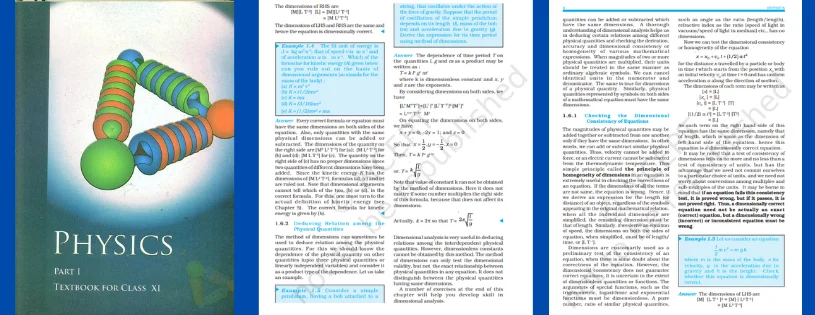
Dimensional equations are equations obtained by equating the dimensions of physical quantities involved in a formula. They are a key part of dimensional analysis and are used to verify the dimensional consistency and correctness of physical equations.
Below are some common examples of dimensional equations:
The equation for force is F = ma, where m is mass and a is acceleration.
Dimensional equation:
[F]=[M1L1T−2][F] = [M^1 L^1 T^{-2}][F]=[M1L1T−2]
Work is given by W = F · d, where F is force and d is displacement.
Dimensional equation:
[W]=[M1L2T−2][W] = [M^1 L^2 T^{-2}][W]=[M1L2T−2]
The time period of a spring–mass system is
T=2πmkT = 2\pi \sqrt{\frac{m}{k}}T=2πkm
where m is mass and k is the spring constant.
Dimensional equation:
[T]=[M0L0T1][T] = [M^0 L^0 T^1][T]=[M0L0T1]
The period of a simple pendulum is
T=2πLgT = 2\pi \sqrt{\frac{L}{g}}T=2πgL
where L is length and g is acceleration due to gravity.
Dimensional equation:
[T]=[L1/2T−1/2][T] = [L^{1/2} T^{-1/2}][T]=[L1/2T−1/2]
Einstein’s equation E = mc² relates energy, mass, and the speed of light.
Dimensional equation:
[E]=[M1L2T−2][E] = [M^1 L^2 T^{-2}][E]=[M1L2T−2]
| 1. CBSE Class 11th Topic Wise Summary | View Page / Download |
| 2. CBSE Class 11th NCERT Books | View Page / Download |
| 3. CBSE Class 11th NCERT Solutions | View Page / Download |
| 4. CBSE Class 11th Exemplar | View Page / Download |
| 5. CBSE Class 11th Previous Year Papers | View Page / Download |
| 6. CBSE Class 11th Sample Papers | View Page / Download |
| 7. CBSE Class 11th Question Bank | View Page / Download |
| 8. CBSE Class 11th Topic Wise Revision Notes | View Page / Download |
| 9. CBSE Class 11th Last Minutes Preparation Resources | View Page / Download |
| 10. CBSE Class 11th Best Reference Books | View Page / Download |
| 11. CBSE Class 11th Formula Booklet | View Page / Download |
Being in CBSE class 11th and considering the board examinations you must be needing resources to excel in your examinations. At TestprepKart we take great pride in providing CBSE class 11th all study resources in downloadable form for you to keep you going.
Below is the list of all CBSE class 11th Downloads available on TestprepKart for both Indian and NRI students preparing for CBSE class 11th in UAE, Oman, Qatar, Kuwait & Bahrain.

Q1. What is the Dimensional Formula of a Physical Quantity?
The dimensional formula of a physical quantity expresses how it depends on base quantities such as mass, length, and time. It is written using algebraic symbols to show the powers of fundamental dimensions representing that physical quantity.
Q2. Why are Dimensional Formulae Important?
Dimensional formulae help understand relationships between physical quantities. They are useful for checking the correctness of equations, deriving relationships between variables, converting units, and identifying possible errors in mathematical expressions used in physics problems.
Q3. What are the Seven Base Dimensions in the MKS System?
The seven base dimensions in the MKS system are length (L), mass (M), time (T), electric current (I), temperature (Θ), amount of substance (N), and luminous intensity (J), which together describe all physical quantities.
Q4. How is the Dimensional Formula Represented?
A dimensional formula is represented using square brackets containing base dimensions raised to appropriate powers. For example, velocity is expressed as [LT⁻¹], showing its dependence on length and time, and independence from mass.
Q5. Can Dimensional Formulae be Used to Derive Physical Equations?
Yes, dimensional formulae can be used to derive physical equations by equating dimensions on both sides. This method helps establish relationships between variables, though it cannot determine numerical constants like 2π or dimensionless coefficients.
Q6. What is Dimensional Consistency in an Equation?
Dimensional consistency means that the dimensions on both sides of a physical equation are identical. If dimensions do not match, the equation is incorrect. This principle helps students quickly verify formulas and avoid conceptual or calculation errors in physics problems.
Q7. Can Dimensional Analysis Check Numerical Accuracy of an Equation?
No, dimensional analysis cannot verify numerical constants or coefficients such as 2, π, or ½. It only checks whether the dimensions are correct. Therefore, an equation may be dimensionally correct but still numerically inaccurate.
Q8. How Does Dimensional Analysis Help in Unit Conversion?
Dimensional analysis helps convert units by comparing the dimensions of different systems. By expressing quantities in base dimensions, students can systematically change units without confusion, ensuring accuracy in calculations involving different measurement systems.
Q9. What are Dimensionless Quantities?
Dimensionless quantities have no dimensions because they are ratios of similar physical quantities. Examples include strain, refractive index, and Reynolds number. These quantities often describe physical behavior and are important in fluid mechanics and material science.
Q10. What are the Limitations of Dimensional Formulae?
Dimensional formulae cannot derive equations involving trigonometric, exponential, or logarithmic functions. They also cannot determine exact numerical constants. Hence, dimensional analysis should be used alongside theoretical understanding and experimental data.
| Chapter1: UNITS AND MEASUREMENTS | Chapter8: MECHANICAL PROPERTIES OF SOLIDS |
| Chapter 2: Motion in a Straight Line | Chapter9: MECHANICAL PROPERTIES OF FLUIDS |
| Chapter3: MOTION IN A PLANE | Chapter10: THERMAL PROPERTIES OF MATTER |
| Chapter4: LAWS OF MOTION | Chapter12: KINETIC THEORY |
| Chapter5: WORK, ENERGY AND POWER | Chapter13: OSCILLATIONS |
| Chapter6: SYSTEM OF PARTICLES AND ROTATIONAL MOTION | Chapter14: WAVES |
| Chapter7: GRAVITATION |
| Chapter1: SOME BASIC CONCEPTS OF CHEMISTRY | Chapter6: EQUILIBRIUM |
| Chapter2: STRUCTURE OF ATOMS | Chapter7: REDOX REACTIONS |
| Chapter3: CLASSIFICATION OF ELEMENTS AND PERIODICITY IN PROPERTIES | Chapter8: ORGANIC CHEMISTRY – SOME BASIC PRINCIPLE AND TECHNIQUES |
| Chapter4: CHEMICAL BONDING AND MOLECULAR STRUCTURE | Chapter9: Hydrocarbons HYDROCARBONS |
| Chapter5: THERMODYNAMICS |
| Chapter1: SETS | Chapter8: SEQUENCES AND SERIES |
| Chapter2: RELATIONS AND FUNCTIONS | Chapter9: STRAIGHT LINES |
| Chapter3: TRIGONOMETRIC FUNCTIONS | Chapter10: CONIC SECTIONS |
| Chapter4: COMPLEX NUMBER AND QUADRATIC EQUATIONS | Chapter11: INTRODUCTION TO THREE-DIMENSIONAL GEOMETRY |
| Chapter5: LINEAR INEQUALITIES | Chapter12: LIMITS AND DERIVATIVES |
| Chapter6: PERMUTATIONS AND COMBINATIONS | Chapter13: STATISTICS |
| Chapter7: BINOMIAL THEOREM | Chapter14: PROBABILITY |
Enhance your JEE preparation further by downloading our exclusive NRI Quota Prep eBook. Tailored to cater to the needs of Non-Resident Indian students, this comprehensive guide complements, providing valuable insights and strategies for success. Don’t miss out on this essential resource – click to download and elevate your JEE readiness today!

Q1. Is Dimensional Formulae a crucial topic for JEE?
Yes. Dimensional Analysis is a high-scoring topic in JEE Physics. Almost every year, 1-2 direct questions appear from Units, Dimensions, and Measurements, mainly testing dimensional correctness or unit conversion, making it important for JEE Main 2026 aspirants.
Q2. How many marks can I expect from Dimensional Analysis in JEE?
Typically, 1-2 questions worth 4-8 marks appear from Dimensional Formulae and Analysis in JEE Main and sometimes JEE Advanced. Due to its simplicity and predictability, it is considered a low-effort, high-return topic for students.
Q3. Is the Dimensional Formulae & Equations PDF useful for JEE Main 2026?
Yes, the PDF is very useful for JEE Main 2026. It includes key formulas, worked examples, and previous JEE-based problems, helping students, including NRI Students in the USA and those from the Middle East (UAE) revise the topic quickly and efficiently.
Q4. Is it enough to rely only on the PDF for this chapter?
The PDF is excellent for quick revision, but students should also practice numerical problems from standard books like D.C. Pandey or TestprepKart’s JEE Physics modules to develop application-level understanding required for JEE Main and Advanced.
Q5. Do questions from Dimensional Analysis appear in JEE Advanced as well?
Yes. Although less frequent than JEE Main, JEE Advanced may include conceptual or mixed-dimension questions involving motion, force, or energy. These questions test deeper understanding and are important for serious aspirants, including NRI Students in the USA.









Copyright © 2024 CounselKart Educational Services Pvt. Ltd.. All Rights Reserved


Post a Comment