




Hi, I’m TestprepKart.
Your Partner In Exam Preparation

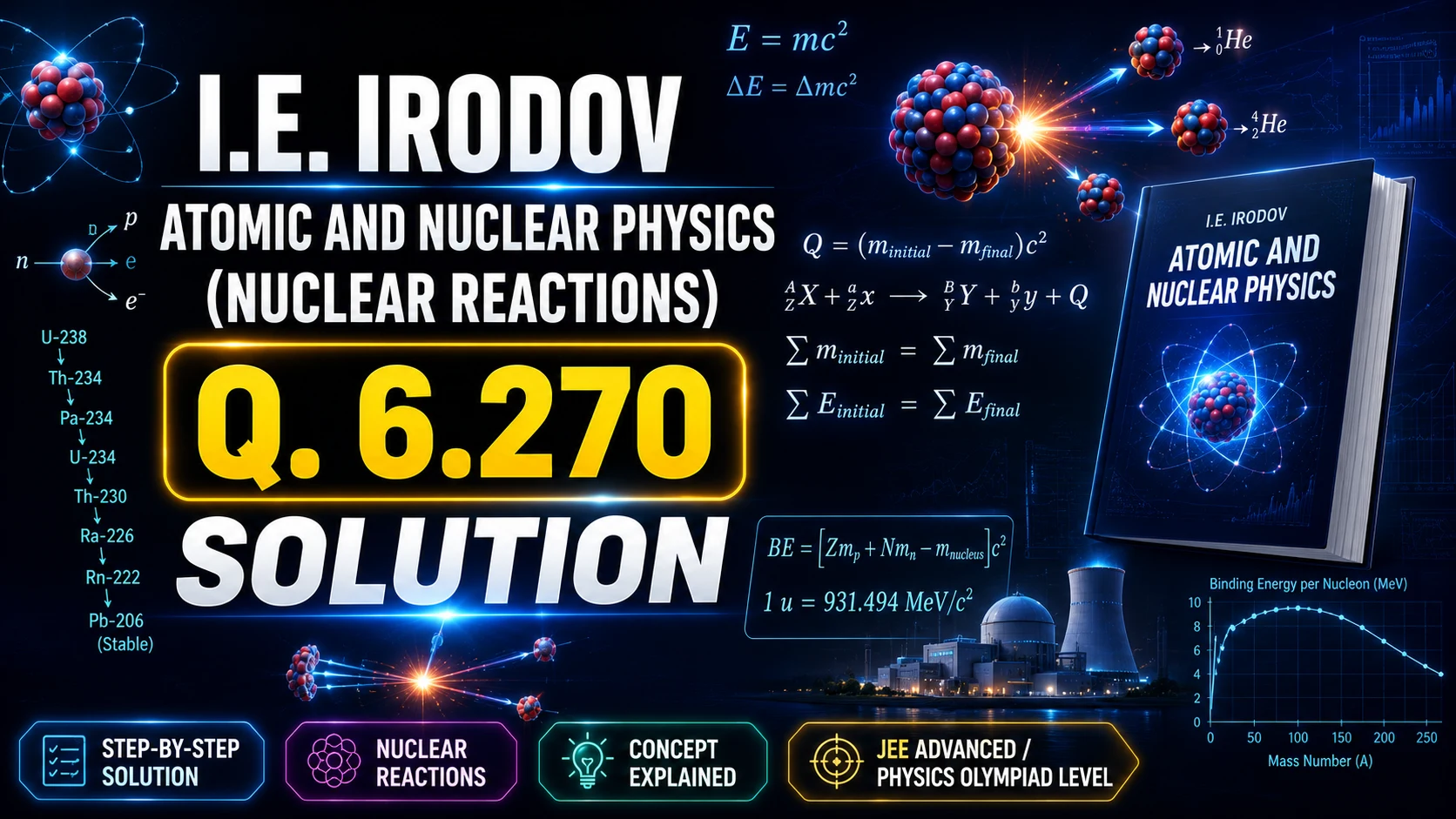
The I E Irodov Atomic and Nuclear Physics chapter is one of the most important chapters of Advanced Physics for students preparing for JEE Advanced, Physics Olympiads, KVPY level exams and other competitive entrance exams.
Students learn how nuclear particles interact, how energy is released in nuclear reactions, how the laws of conservation of energy and momentum are applied to solve advanced numerical problems.
I E Irodov Atomic and Nuclear Physics (Nuclear Reactions) Question 6.270 on this page, concept, formula and relation used in the solution are also given. Detailed step by step solution for.
This is an advanced level numerical problem which involves multiple ideas of Modern Physics and students appearing for JEE Advanced are advised to understand the concepts involved before solving this problem.
Download JEE Advanced revision notes and solution support material to strengthen your understanding of Atomic and Nuclear Physics.
| Resource | Purpose | Download |
| JEE Advanced Revision Notes | Complete Nuclear Physics Revision | Download Full Solution |
| Nuclear Physics Formula Sheet | Important Formula Revision | Download PDF |
| Advanced Physics Notes | Chapter-wise Revision | Download PDF |
Download Full SolutionBook Free Demo
Question
Protons with kinetic energy
T = 1.0 MeV
strike a lithium target and induce the nuclear reaction
p + Li⁷ → 2He⁴
Find:
This problem is based on advanced Nuclear Reactions.
Important concepts used include:
| Concept Used | Concept Used |
| Conservation of Linear Momentum | Binding Energy |
| Conservation of Total Energy | Alpha Particle Motion |
| Nuclear Reaction Equation | Symmetrical Particle Emission |
| Q-value of Nuclear Reaction | Momentum–Energy Relation |
| Mass Defect |
The two produced alpha particles are identical and move symmetrically. Thus, the two particles have same kinetic energy and same magnitude of momentum..
Given
Initial proton kinetic energy
Tp = 1.0 MeV
Reaction
p + Li⁷ → 2He⁴
Initially,
Lithium nucleus is at rest.
Let
We need to determine
The energy released during the nuclear reaction is
Q = [Mass of Reactants − Mass of Products] c²
Using the atomic masses,
Hydrogen
1.007825 u
Lithium-7
7.016003 u
Helium-4
4.002603 u
Therefore,
Q ≈ 17.35 MeV
This means the nuclear reaction releases approximately 17.35 MeV of energy.
This format is clean, easy to copy into WordPress, and has the same structure as your Relativistic Mechanics Q. 1.388 page. In Part 2 I’ll continue with Step 2 via the FAQs in the same copy-friendly format.
NRI students preparing for JEE from USA, UAE, Saudi Arabia, Qatar, Oman, Kuwait and Bahrain can download the free TestPrepKart JEE E-Book to understand syllabus planning, Physics preparation, previous year questions, mock test strategy and engineering admission options in India.

The total kinetic energy following the nuclear reaction is the sum of the initial kinetic energy of the incident proton and the energy released in the nuclear reaction.
Therefore,
Total Final Kinetic Energy = Initial Proton Energy + Q-value
Substituting the values,
Total Final Kinetic Energy = 1.0 MeV + 17.35 MeV
Total Final Kinetic Energy = 18.35 MeV
Since two identical alpha particles are produced and move symmetrically, they share the total kinetic energy equally.
Therefore,
2Kα = 18.35 MeV
Hence,
Kα = 18.35 / 2
Kα ≈ 9.17 MeV
Thus, the kinetic energy of each alpha particle is approximately 9.17 MeV.
The lithium nucleus is initially at rest.
Therefore, the initial momentum of the system is only the momentum of the incoming proton.
Since both alpha particles move symmetrically, their momentum components perpendicular to the proton direction cancel each other.
Only the components along the original proton direction remain.
Hence,
Proton Momentum = 2 × Alpha Particle Momentum × cos θ
Using the momentum relation,
p = √(2mK)
we get
cos θ = pp / 2pα
Substituting
we obtain
cos θ ≈ 0.0828
Therefore,
θ ≈ 85.25°
Each alpha particle moves at an angle θ with respect to the original proton direction.
Hence, the angle between the two alpha particles is
φ = 2θ
Therefore,
φ = 2 × 85.25°
φ ≈ 170.5°
Hence, the angle of divergence between the two alpha particles is
approximately 170.5° (≈171°).
Kinetic Energy of Each Alpha Particle
9.17 MeV
Angle of Divergence Between the Alpha Particles
170.5° (Approximately 171°)
After solving this question, students should revise the important concepts of Atomic and Nuclear Physics and practice more advanced numerical problems.
| Resource | Purpose | Download |
| JEE Advanced Revision Notes | Complete Nuclear Physics Revision | Download PDF |
| Nuclear Physics Formula Sheet | Formula Revision | Download PDF |
| Advanced Physics Practice Questions | Extra Numerical Practice | Download PDF |
The proton initially carries 1 MeV of kinetic energy.
In the nuclear reaction when it hits the lithium nucleus, another 17.35 MeV is released because a small amount of mass is converted to energy by Einstein’s mass-energy relation.
The total available energy therefore becomes
18.35 MeV
Since two identical alpha particles are produced and the reaction is perfectly symmetric, each alpha particle gets exactly half of the available kinetic energy.
The proton carries momentum , so the alpha particles can not be exactly opposite , but they are traveling in nearly opposite directions . The two particles move at a small angle to the original direction of the proton in an effort to conserve momentum. This gives a divergence angle of ~170.5°.
| Factor | Details |
| Book | I E Irodov |
| Chapter | Atomic and Nuclear Physics |
| Topic | Nuclear Reactions |
| Question | 6.270 |
| Difficulty | Advanced |
| Main Concept | Conservation of Energy and Momentum |
| Q-value | 17.35 MeV |
| Energy of Each Alpha Particle | 9.17 MeV |
| Divergence Angle | 170.5° |
| Best For | JEE Advanced, Physics Olympiad |
Students frequently make the following mistakes while solving this question:
Avoiding these mistakes helps students solve similar Nuclear Physics problems more accurately.
part3
I E Irodov problems help students develop a deeper understanding of advanced Physics concepts.
Regular practice can improve:
Students should attempt selected I E Irodov questions only after doing NCERT, class notes, coaching modules and previous year JEE questions.
No.
I E Irodov Q. 6.270 is more advanced than a typical JEE Main question because it combines:
This question is better suited for:
Students for JEE Main should focus on NCERT, official syllabus topics, previous year questions and mock tests first.
Yes.
Nuclear Physics is an important part of Modern Physics and can be a scoring area when the concepts are clear.
Students should prepare the following topics carefully:
Questions in Nuclear Physics are often formula-based, but more advanced questions may require careful use of conservation of energy and momentum.
| Topic | Practice Level |
| Rutherford-Bohr Atom | I E Irodov Problems |
| Wave Properties of Particles | I E Irodov Problems |
| Atomic Spectra | I E Irodov Problems |
| Molecules and Crystals | I E Irodov Problems |
| Radioactivity | I E Irodov Problems |
| Nuclear Reactions | I E Irodov Problems |
| Elementary Particles | I E Irodov Problems |
A recommended preparation order is:
Students should not try to solve every I E Irodov problem without understanding the underlying theory.
Selected I E Irodov questions can be useful for advanced Physics practice for NRI students preparing from:
Students of AP, IB, American or any other International boards should first match their school syllabus with JEE syllabus.
A suitable preparation approach is:
Online JEE coaching can help NRI students in choosing the right I E Irodov questions instead of wasting time on problems out of their preparation needs.
JEE Advanced guidance, previous year papers and mock tests are available for the selected I E Irodov questions for NRI students preparing from USA, UAE, Saudi Arabia, Qatar, Oman, Kuwait and Bahrain.
Students can also practice:
Link each question to its corresponding TestprepKart solution page.
After completing I E Irodov Q. 6.270, students can continue with:
| Resource | Purpose |
| JEE Advanced Revision Notes | Revise Physics concepts and solution methods |
| JEE Previous Year Papers | Practice exam-level questions |
| JEE Online Coaching | Start structured JEE preparation |
| Book Free Demo | Get a personalised preparation plan |
| JEE E-Book | Plan syllabus, revision and mock tests |
| JEE Coaching for NRI Students | Understand online preparation from abroad |
| JEE NRI Eligibility | Check eligibility requirements |
| DASA Eligibility | Understand admission eligibility for NRI students |
| DASA Cutoff | Compare admission trends |
| DASA Fee Structure | Plan engineering admission expenses |
The kinetic energy of each alpha particle is approximately:
9.17 MeV
The angle of divergence between the two alpha particles is approximately:
170.5°
The problem uses:
The two alpha particles are identical and move symmetrically. Therefore, they have equal masses, equal momentum magnitudes and equal kinetic energies.
The incoming proton has non-zero momentum. The alpha particles must have forward momentum components whose sum equals the proton’s initial momentum.
Therefore, they move almost opposite to each other, but not exactly at 180°.
The Q-value is approximately:
17.35 MeV
This is the energy released because of the reduction in total mass during the reaction.
It is above the usual JEE Main level. It is more suitable for JEE Advanced, Physics Olympiads and advanced Nuclear Physics practice.
Yes, selected I E Irodov questions are useful after students complete standard JEE preparation, coaching modules and previous year questions.








Copyright © 2024 CounselKart Educational Services Pvt. Ltd.. All Rights Reserved

Post a Comment