






Hi, I’m TestprepKart.
Your Partner In Exam Preparation
Getting admitted to engineering colleges in India is a hectic process as there are thousands and lakhs of applicants for a limited number of seats. The process becomes even more cumbersome for students living abroad, especially NRI students in the USA and Middle East (UAE, Oman, Qatar, Kuwait, Bahrain, Saudi Arabia). These students fall into three categories:
Person of Indian Origin (PIO)
A non-Indian resident who was earlier given a 15-year visa.
(PIO category has been officially discontinued by the Government of India).
Overseas Citizens of India (OCI)
Non-Indian citizens who are given a lifetime visa, allowing them to live, study, and work in India with minimal restrictions.
Non-Resident Indian (NRI)
A legal citizen of India living in another country due to employment, business, or other reasons.
This includes thousands of students studying in schools across the USA and Middle East preparing for engineering admissions in India.
Students falling into the categories of NRI, OCI, and foreign nationals can get admission into engineering colleges in India through the DASA scheme.
DASA is a short form for Direct Admission of Students Abroad. It is a scheme launched by the Ministry of Human Resource Development (now Ministry of Education), Government of India, for admission of NRI/OCI/PIO/Foreign National students into premier engineering institutions of India.
(The admission under the DASA scheme for UG and PG programs for the year 2023 was coordinated by NIT Warangal. For DASA 2026–27, the coordinating institute has not yet been officially announced in the brochure).
There are a number of institutions that offer admission into Undergraduate programs in Engineering, Architecture, and Planning under the DASA scheme. These include:
(These numbers remain consistent for recent DASA cycles unless updated by the official 2026 brochure.)

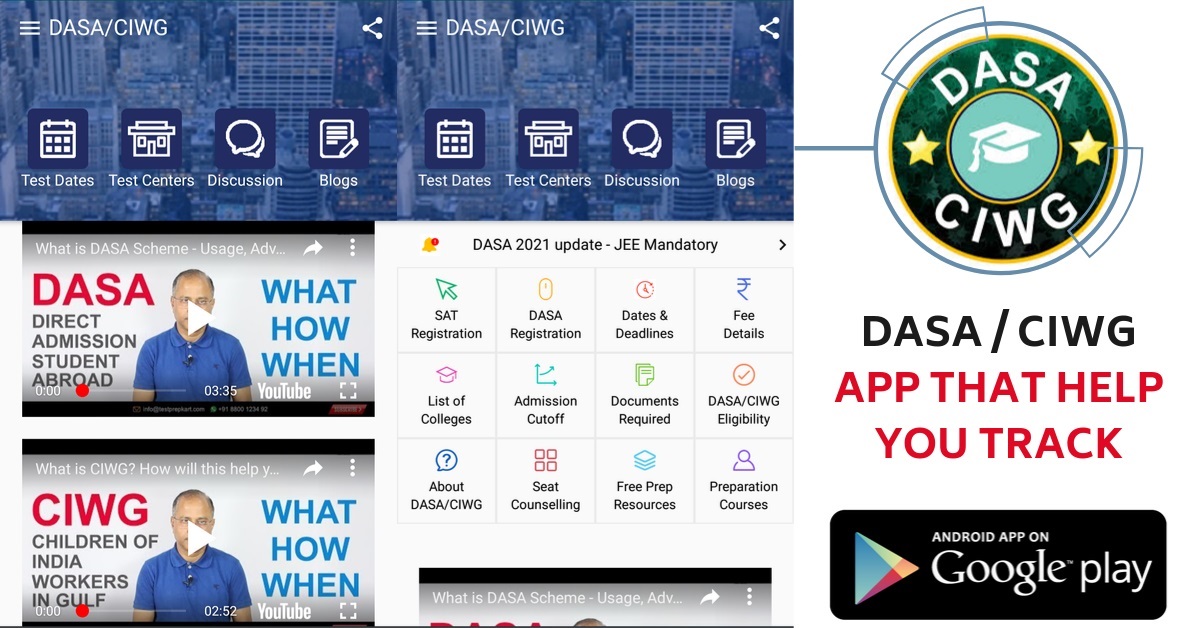
The NRI students applying for DASA/CIWG 2026 must meet all eligibility factors such as Age, Residential Status, Academic Eligibility, Class 12 Marks, and JEE Main requirements. These criteria apply equally to NRI/OCI/PIO students in the USA, UAE, Oman, Qatar, Kuwait, Bahrain, and Saudi Arabia.
| Eligibility Factor | Requirements (Updated for 2026 Cycle) |
| Age | No age limit for DASA UG 2026. Students must have completed Class 12 (or equivalent) at the time of admission. |
| Residential Status | NRIs, OCIs, and Foreign Nationals studying outside India are eligible. (PIO category discontinued, no longer valid under DASA). |
| Academic Qualification | • Must have completed 10+2 / Grade 12 from a recognized board abroad (USA, UAE, Oman, Qatar, Kuwait, Bahrain, Saudi Arabia, etc.). • Students appearing in Grade 12 (2026) are also eligible, provided marks are submitted before deadlines. |
| Class 12 Marks | Minimum 60% marks or 6.5 CGPA in Class 12. Physics & Mathematics are mandatory subjects for engineering admissions. |
| JEE Main Requirement | • JEE Main 2026 is mandatory for all DASA/CIWG UG engineering admissions. • Admissions are based on JEE Main AIR, not marks. (The old requirement “180+ marks” is outdated and not applicable). |
| JEE Main Attempts | If the student appears in multiple JEE Main attempts, NTA’s best rank rule applies automatically. |
| Document Matching | Name, DOB, and passport numbers must match exactly across: • Passport • JEE Main application • DASA application |
| Submission of JEE Main Scores | Students must upload their JEE Main scorecard on the DASA portal. (NTA no longer sends scores directly to MNNIT/DASA (old process discontinued). |
The students living in Middle Eastern countries are also eligible for the CIWG scheme. CIWG is a short form for Children of Indian Workers in the Gulf. There are 6 countries officially covered under CIWG:
United Arab Emirates (UAE), Oman, Qatar, Kuwait, Bahrain, and Saudi Arabia.
(Iran and Iraq are NOT officially listed in the CIWG category under DASA as per current guidelines).
(We must verify any future inclusion from the official brochure.)
CIWG students must submit valid proof showing that at least one parent is employed in an eligible Gulf country. Documents accepted include:
• Parent employment contract
• Valid Gulf work visa/work permit
• Certificate from employer on official letterhead
• Resident ID issued by Gulf authority
Within the 15% DASA supernumerary quota, 1/3rd of seats are reserved exclusively for CIWG students.
The remaining 2/3rd seats are allotted under the regular DASA category for NRI/OCI/PIO students from the USA, Europe, Asia, Africa, and other countries.
Every year, around 2,300–2,500 admissions are taken under DASA across NITs, IIITs, SPAs, and CFTIs.
(The previous “2350 admissions” figure must be verified from the 2025-26 brochure).
UG applicants must have completed Class 11 and Class 12 outside India to qualify.
(The old “minimum 5-year stay abroad” condition is no longer officially mentioned in post-JEE-Mandatory brochures; verification needed once the 2026 document is released).
The DASA/CIWG scheme greatly simplifies engineering admission for NRI students living in the USA and the Middle East into:
National Institutes of Technology (NITs)
Indian Institutes of Information Technology (IIITs)
Schools of Planning and Architecture (SPAs)
Centrally Funded Technical Institutes (CFTIs)
(IITs do NOT come under the DASA/CIWG admission framework).
If you qualify as a DASA/CIWG candidate, make sure to review our updated DASA Guide, specifically created for NRI students living in the USA and Middle East (UAE, Oman, Qatar, Kuwait, Bahrain, Saudi Arabia), covering eligibility, tuition fees, quota system, documents, and JEE Main preparation strategy.
There are numerous other premium engineering institutions offering admission to NRI students through their NRI/International quotas, including:
(Admission through these colleges is independent of the DASA/CIWG process and has separate eligibility and fee criteria).
Good Luck. Have a great career ahead.

Q1. Will the DASA Scheme continue in 2026?
Yes. DASA admissions for 2026 remain active for NRI/OCI/Foreign National students, including those in the USA and Middle East. All admissions will continue through JEE Main All India Rank, as SAT subject-based entry has been permanently discontinued since 2021.
Q2. What is the eligibility criteria for DASA/CIWG 2026?
Students must have completed Class 11 and 12 outside India, hold valid NRI/OCI/Foreign National status, score minimum 60%/6.5 CGPA in Class 12, and submit JEE Main 2026 rank. CIWG applicants must also prove parent employment in an eligible Gulf country.
Q3. Which grade students can apply for DASA 2026 using JEE Main?
Students currently in Class 12 in 2026 or who completed Class 12 in 2024 or 2025 are eligible. They must appear for JEE Main 2026, as DASA allocation is purely based on JEE Main All India Rank (AIR), not board marks.
Q4. Is JEE Main mandatory for DASA/CIWG 2026 admissions?
Yes. JEE Main has been mandatory since 2021, and the policy continues for 2026. No SAT scores or alternative tests are accepted for DASA/CIWG engineering seats in NITs, IIITs, SPAs, and CFTIs across India.
Q5. Can the government reverse the JEE-main-only rule for DASA 2026?
While government policy can evolve, no official indication suggests a reversal. Any change affecting NRI academic planning requires advance notice. Until officially stated otherwise, families should assume JEE Main remains compulsory for 2026 admissions.
Q6. Are there any changes in qualifying exam rules for DASA 2026-27?
The core criteria remain same: Class 12 completion abroad, minimum 60%/6.5 CGPA, PCM subjects, and JEE Main rank. Minor document or verification updates may appear in the official brochure, so students must review final guidelines once released.
Q7. How should NRI students prepare for JEE to qualify under DASA/CIWG 2026?
Start structured preparation from Class 11, focusing on NCERT, PYQs, full-length mock tests, and topic-wise analysis. NRI students in the USA and Middle East often choose online coaching designed for time-zone alignment and targeted JEE Main rank improvement.
Q8. What JEE Main rank is required for DASA/CIWG engineering seats in 2026?
For CSE at top NITs, closing ranks often fall below AIR 10,000. Mid-tier NITs may go up to AIR 25,000–40,000. Final cut-offs depend on seat demand, branch preference, DASA/CIWG quota, and applicant competition.
Q9. Do NRI students need coaching for DASA/CIWG 2026 JEE preparation?
Coaching isn’t compulsory but strongly beneficial due to competition with India-based students. USA and Middle East learners often use specialized online coaching to fill syllabus gaps, strengthen PCM fundamentals, and maximize rank for NIT/IIIT admissions.
Q10. Which is the best online JEE coaching for NRI students applying through DASA 2026?
Strong programs offer live sessions in US/Middle East time zones, topic mastery, mock tests, mentoring, and doubt support. Platforms focused on NRI preparation, like TestprepKart, design custom strategies for DASA/CIWG students targeting top JEE Main ranks.
Q11. How do I upload my JEE Rank for DASA admissions?
After receiving the JEE Main 2026 result, candidates must log into the official DASA portal, upload their rank card, submit documents, verify passport details, complete choice filling, and pay fees. Accuracy in student data is crucial to prevent rejection.
Q12. Do NRI students living in the USA get CIWG benefits?
No. CIWG concessions apply only to children of Indian workers residing in Gulf nations (UAE, Oman, Qatar, Kuwait, Bahrain, Saudi Arabia). USA-based NRI students can only apply under regular DASA, although both use JEE Main AIR.
Q13. What documents are needed for DASA/CIWG 2026 registration?
Documents include passport, Class 10–12 mark sheets, proof of Class 11–12 abroad, school certificate, JEE Main 2026 rank card, and fee receipts. CIWG applicants must also upload verified Gulf employment proof of a parent to qualify for reserved seats.
Q14. Can CIWG students apply under both CIWG and DASA categories in 2026?
Yes. Applicants from Gulf nations can select both categories. They are considered for CIWG seats first, and if seats fill, they automatically shift into the DASA pool, increasing chances of securing preferred branch and college.
Q15. What happens if I miss the DASA 2026 application deadline?
Missed deadlines cannot be extended individually. However, students may apply during the late “Choice Refilling & New Registration Window” in August 2026, allowing participation from Round 2 or Round 3, depending on available seats.








Copyright © 2024 CounselKart Educational Services Pvt. Ltd.. All Rights Reserved

Post a Comment