Schedule Your Free Exam Readiness Analysis Session!





Hi, I’m TestprepKart.
Your Partner In Exam Preparation

Testprepkart’s Digital SAT 90 Hrs course provides key strategies and practice for success.
.png)
TestprepKart’s SAT 90 Hours Course is designed for students who want a highly structured, deeply guided, and more premium Digital SAT preparation journey. This course is especially useful for U.S. high school students and Indian American students who want stronger concept mastery, repeated revision cycles, more full-length mock exposure, more personalized correction, and a more stable path toward higher SAT score bands.
This SAT 90 Hours Course is built for students who want a more complete Digital SAT preparation system with deeper coverage, more guided correction, more practice layers, and stronger performance stabilization. It is a strong fit for students aiming at ambitious score goals and families who want a less rushed, more measurable prep cycle.
| Course Snapshot Area | What Students And Parents Should Know |
|---|---|
| Course Name | SAT 90 Hours Course |
| Course Designed For | U.S. high school students, Indian American students, and serious Digital SAT aspirants who want stronger mastery and more complete score-building support |
| Best Grades | Grade 9, Grade 10, and Grade 11, though Grade 12 students can also benefit if they want a deeper preparation cycle |
| Course Format | Live online SAT classes with concept teaching, structured drills, revision windows, mock analysis, and performance tracking |
| Core Focus | Reading and Writing, Math, adaptive testing strategy, Bluebook familiarity, timing stability, error correction, and score improvement |
| Major Outcome Goal | Higher accuracy, better timing control, deeper understanding, more stable mock performance, and stronger real-test transfer |
| Ideal Student Type | Students who want more than a standard prep cycle and need stronger review, retesting, and refinement support |
| Parent Usefulness | Helpful for families who want a premium-feeling, more visible, and more dependable SAT preparation framework |
Our SAT success results are especially meaningful for U.S. students and Indian American families aiming for stronger college admission outcomes. With a 90-hour preparation structure, students get more room to build fundamentals, repair weak areas, revise strategically, and compete for higher score bands with stronger confidence.
 |
 |
Our SAT success results reflect the trust of U.S. students and Indian American families who aim for stronger college admission outcomes. The same trend table can be used cleanly for your SAT 90 Hours page as well.
| Year | No. Of Students | Avg. Score Improvement | Result Page |
|---|---|---|---|
| 2019 | 172 | 110 Points | Uploading Soon |
| 2020 | 181 | 125 Points | Uploading Soon |
| 2021 | 198 | 145 Points | Uploading Soon |
| 2022 | 208 | 165 Points | Uploading Soon |
| 2023 | 226 | 190 Points | Uploading Soon |
| 2024 | 241 | 220 Points | Uploading Soon |
| 2025 | 254 | 250 Points | Uploading Soon |
Students in the United States rarely prepare for the SAT in isolation. They are also handling school tests, GPA pressure, AP or Honors classes, essays, projects, extracurriculars, volunteering, and college planning. That is why some students benefit from a longer and more guided preparation cycle.
A 90-hour plan makes sense because it gives more room for concept mastery, structured reinforcement, revision, adaptive strategy development, repeated mock analysis, and performance stabilization. It is especially useful for students who want a serious preparation margin rather than a quick or moderate overview.
This is especially relevant for Indian American families in the U.S. because many of these students are academically strong but highly scheduled. The SAT rewards precision, timing discipline, decision-making, and repeated exposure to test patterns. A 90-hour structure supports all of those layers with more consistency and less rush.
A premium-style preparation plan built for students who want depth, revision, review, and stronger score stability.
Designed around the real Digital SAT structure, adaptive flow, Bluebook testing, and exam behavior.
Balanced support for both sections with more room for drills, revision, mock feedback, and performance correction.
Suitable for students balancing rigorous school life, AP or Honors coursework, extracurriculars, and college prep.
Interactive instruction improves consistency, accountability, engagement, and concept retention.
Students get more room to study patterns, fix mistakes, retest weak areas, and improve score reliability over time.
A strong SAT 90 Hours Course should do more than cover topics. It should help the student grow into the Digital SAT format with stronger concept mastery, timing control, review depth, and adaptive-test maturity.
The current SAT is digital and adaptive. Students take Reading and Writing and Math through Bluebook, and performance in the first module affects the second one. That means students need not only content coverage, but also strong execution habits and better performance control.
| What Weak SAT Prep Does | What Strong SAT 90 Hours Prep Should Do |
|---|---|
| Rushes concept delivery | Builds concepts with stronger reinforcement and revision time |
| Uses fewer review loops | Adds structured revision and retesting cycles |
| Focuses only on completion | Combines teaching, mock review, pacing, and refinement |
| Underuses full-length mocks | Uses repeated mock checkpoints for real readiness |
| Ignores score stability | Trains students to become more accurate and more consistent under pressure |
 |
 |
 |
 |
Parents do not only want more course hours. They want clarity. They want to know whether a longer and more premium preparation cycle can help a student move more steadily from a low or middle score into a stronger range with better stability and less score volatility.
| Outcome Indicator | What It Means |
|---|---|
| Baseline Score Clarity | Student understands the real starting point instead of guessing readiness |
| Score Improvement Potential | Student gets more realistic room to improve through guided long-form support |
| Domain-Level Insight | Weak areas become clearer across Reading and Writing and Math |
| Timing Improvement | Student learns where time is being lost and how to regain control |
| Confidence Building | Practice feels more stable, less rushed, and more measurable |
| College Planning Value | Families can better judge whether the student’s SAT path matches target colleges |
One of the strongest advantages of a SAT 90 Hours Course is that every block of time can do a specific job without forcing the learning journey to move too quickly.
| Hour Range | Focus Area | What Happens Here |
|---|---|---|
| Hours 1 to 12 | Digital SAT Orientation and Diagnostic | Students understand Bluebook, adaptive structure, digital test behavior, and take a baseline assessment |
| Hours 13 to 28 | Reading And Writing Foundation | Students work on craft and structure, information and ideas, grammar, transitions, and evidence logic |
| Hours 29 to 44 | Math Foundation | Students strengthen algebra, advanced math, problem solving, data analysis, and calculator decision-making |
| Hours 45 to 58 | Mixed Skill Development | Students do integrated drills, timed sets, and cross-domain repair work |
| Hours 59 to 76 | Mock Tests And Deep Review | Students do section-level and full-length mocks with repeated review, pattern analysis, and retesting |
| Hours 77 to 90 | Final Optimization And Test-Day Readiness | Students focus on time control, adaptive confidence, high-yield repair, mental composure, and final score strategy |
A SAT 90 Hours Course should stay tightly aligned to the current Digital SAT structure. The extra hours are meant to deepen mastery, strengthen revision, and improve test-readiness.
| SAT Component | Official Structure |
|---|---|
| Reading And Writing | 54 questions in 64 minutes |
| Math | 44 questions in 70 minutes |
| Total Questions | 98 |
| Total Test Time | 2 hours 14 minutes |
| Format | Digital |
| Practice Platform | Bluebook |
| Official Extra Practice Support | Khan Academy |
That is why Bluebook practice is so important. College Board specifically directs students to use full-length digital practice tests in Bluebook.
Many families hear the word “adaptive” but do not fully understand what it means for preparation.
In simple terms, each section has two modules. Performance in the first module affects the difficulty of the second one. Students do not need to obsess over the exact algorithm. What they do need to understand is this: strong early performance matters.
| Student Behavior | Likely Result |
|---|---|
| Careless early mistakes | Harder to maximize scoring trajectory |
| Poor pacing in Module 1 | Lower control over later section experience |
| Strong early accuracy | Better scoring potential |
| Calm, disciplined starts | Better overall test rhythm |
College Board groups Reading and Writing into four content domains: Craft and Structure, Information and Ideas, Standard English Conventions, and Expression of Ideas.
| Reading And Writing Domain | What Students Work On |
|---|---|
| Craft and Structure | Vocabulary in context, text purpose, tone, and cross-text relationships |
| Information and Ideas | Central idea, command of evidence, inferences, charts and graph-based reading |
| Standard English Conventions | Grammar, punctuation, sentence boundaries, agreement, and clarity |
| Expression of Ideas | Transitions, rhetorical synthesis, organization, and logic of writing |
College Board’s Math section covers Algebra, Advanced Math, Problem Solving and Data Analysis, and Geometry and Trigonometry.
| Math Domain | What Students Work On |
|---|---|
| Algebra | Linear equations, systems, functions, inequalities |
| Advanced Math | Quadratics, polynomials, nonlinear equations, exponent rules |
| Problem Solving and Data Analysis | Ratios, percentages, probability, statistics, tables, scatterplots |
| Geometry and Trigonometry | Angles, lines, circles, area, volume, right triangle trigonometry |
A good SAT 42 Hours Course must also teach test behavior, not just subject matter.
| Strategy Area | Why It Matters |
|---|---|
| Adaptive Testing Strategy | Helps students understand why early precision matters |
| Time Management | Students learn how to move fast without panicking |
| Calculator Usage | Students use digital tools efficiently instead of overusing them |
| Question Selection Logic | Helps reduce avoidable time traps |
| Wrong-Answer Elimination | Especially useful in Reading and Writing |
| Mental Performance | Helps students recover from one weak module instead of collapsing mentally |
 |
 |
One of the best parts of the course structure is the mock-and-review framework. It makes the course feel serious and data-driven.
Bluebook practice tests are one of the closest ways students can simulate the real testing environment. College Board recommends using Bluebook for full-length digital practice.
| Component | Why It Helps |
|---|---|
| Full-Length Adaptive Mocks | Builds familiarity with real test pacing and pressure |
| Section-Level Drills | Helps target one weak area at a time |
| Error Tagging | Helps identify repeated mistakes by skill |
| Time-Spent Analysis | Reveals where time is leaking |
| Score Projection Review | Helps students see whether current effort matches target score |
| Retest Strategy | Makes practice cumulative instead of random |
Start with a full baseline test and identify where the student is actually losing points.
Strengthen weak domains more thoroughly and use the extra hours for concept consolidation, drills, and revision.
Use realistic timed practice and repeated full-length mocks to build stronger test-day control.
Use retesting, error analysis, and performance refinement to push the student toward a stronger and more stable band.
| Phase | Goal |
|---|---|
| Diagnose | Know the real starting point |
| Build | Improve domain-level weaknesses with more depth |
| Simulate | Practice under real conditions repeatedly |
| Optimize | Turn preparation into more reliable score movement |

A 90-hour course allows a more gradual and more premium preparation journey for students who want structure without rushing the process.
| Week | Main Focus | What The Student Does |
|---|---|---|
| Week 1 | Orientation And Diagnostic | Understand digital SAT, take a baseline test, and review initial performance |
| Week 2 | Reading And Writing Core Skills | Work on vocabulary, craft and structure, evidence, and grammar |
| Week 3 | Math Core Skills | Strengthen algebra, advanced math, data handling, and calculator strategy |
| Week 4 | Mixed Timed Practice | Do integrated section work with adaptive awareness and pace control |
| Week 5 | Weak-Area Repair | Repair recurring mistakes with guided drills and targeted review |
| Week 6 | Mock Review Cycle | Use full-length and section mocks to improve decision-making and performance balance |
| Week 7 | Performance Stabilization | Retest weak areas, repair repeated patterns, and strengthen timing reliability |
| Week 8 | Advanced Refinement | Work on finer score leaks, consistency issues, and section-specific optimization |
| Week 9 | Final Sprint | Build final composure, adaptive confidence, and test-day execution readiness |
| Week 10 | Buffer And Optimization | Use final correction windows, score polishing, and last-round performance alignment |
Students who want a more premium and advanced SAT preparation path without overloading the final weeks before the exam.
Students from ambitious families who want deeper review, more stability, and stronger long-form performance control.
Students who need an SAT path that fits around a demanding schedule while still allowing serious progress.
Students aiming for stronger competitive ranges and needing more than a moderate course to get there comfortably.
Students who want stronger correction cycles, more accountability, and more meaningful mock-based guidance.
Parents who want a structured system with visibility, maturity, and a stronger roadmap toward score outcomes.
Indian American students in the U.S. often grow up in academically serious environments. Many are already balancing AP coursework, STEM-heavy school schedules, extracurricular expectations, and long-term college planning.
In these families, SAT prep is rarely just about taking one more exam. It is often about reaching a score range that matches strong college ambitions, using time efficiently without hurting GPA, and avoiding burnout from overscheduling. A SAT 90 Hours Course supports this especially well because it creates a more measured, better-supported, and more complete preparation rhythm.

Parents often want to know who is teaching, not just what is being taught.
A trust section should ideally communicate:
| Trust Factor | Why It Matters To Families |
|---|---|
| SAT-Focused Teaching Experience | Shows this is not generic Math or English tutoring |
| Understanding of College Board Format | Ensures preparation matches the actual test |
| Familiarity with U.S. Students | Makes scheduling, pressure, and school context more realistic |
| Score Analysis Skill | Helps identify why students are stuck |
| Parent Communication | Builds confidence for families comparing options |
Families connect strongly with outcomes, but this section should remain credible.
| Student Profile | Before | After | Improvement |
|---|---|---|---|
| Student A | 1080 | 1410 | +330 |
| Student B | 1120 | 1490 | +370 |
| Student C | 1240 | 1560 | +320 |
Use only real and verifiable student results if available. Authenticity helps ranking and trust more than inflated claims.
This section is very useful because students search with college-specific intent.
Important note: SAT ranges vary by year and school, so this section should be updated regularly from official university common data sets or admissions pages. For now, use it as a planning-style table, not as a permanent factual claim unless you verify each college’s latest published data.
| College Type | Suggested SAT Aim |
|---|---|
| Highly Selective Universities | 1500+ |
| Very Strong Public Universities | 1400 to 1500+ |
| Competitive State Universities | 1250 to 1450 |
| Balanced Admission Targets | 1150 to 1350 |
| Safer Options | Depends on school profile and major |
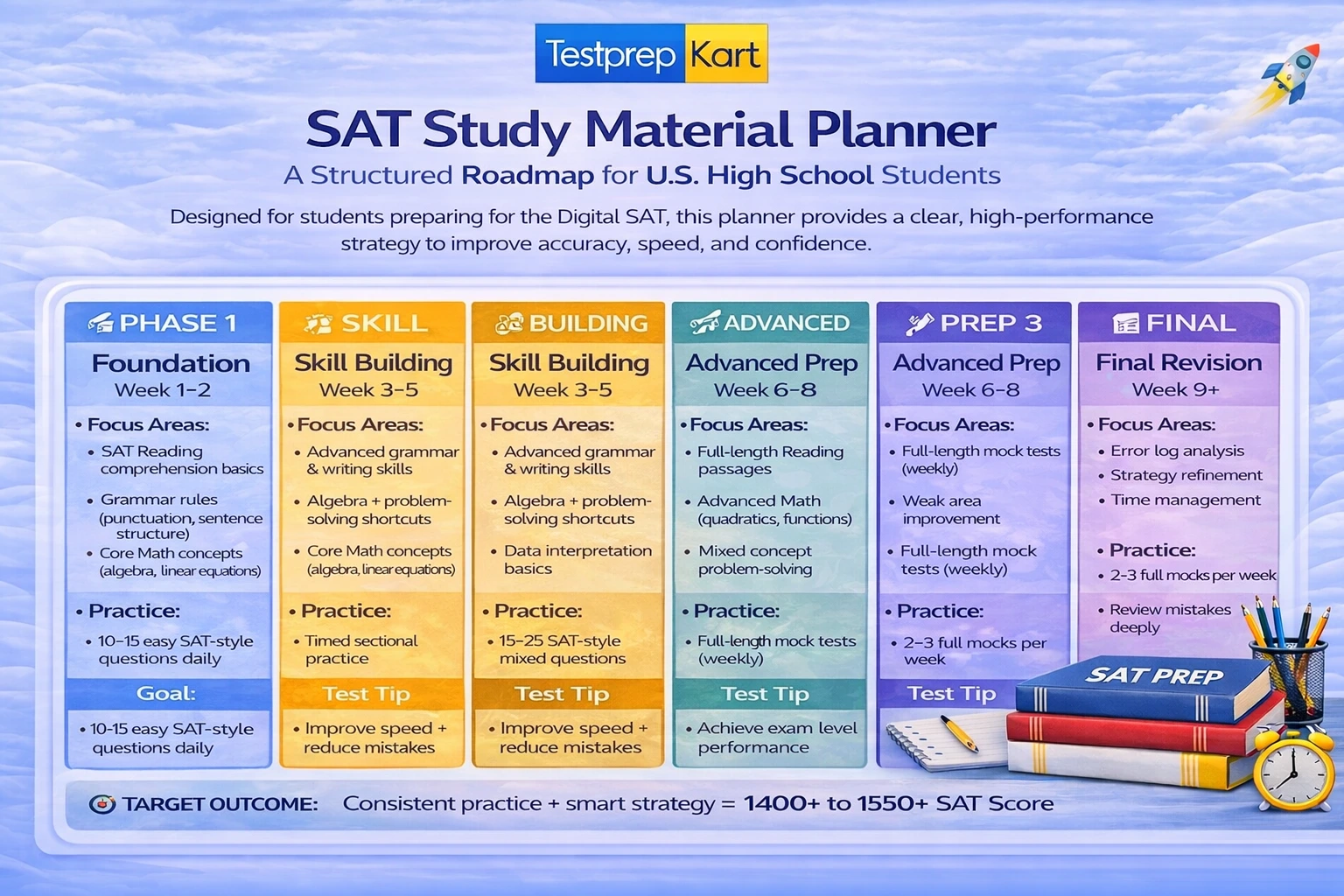
The SAT Course Planner and Study Material Planner help students and parents understand the full preparation path in a simple, visual, and organized way. For a 90-hour course, this becomes even more important because students are managing a longer and more layered preparation cycle.
| Planner Type | Why It Helps |
|---|---|
| Course Planner | Shows class flow, topic coverage, revision windows, and the full preparation arc |
| Study Material Planner | Helps students organize resources more systematically across a longer preparation cycle |
| Mock Test Planner | Tracks test timing, analysis windows, and retest strategy more clearly |
| Parent Review Planner | Helps families monitor progress without creating constant pressure or micromanagement |
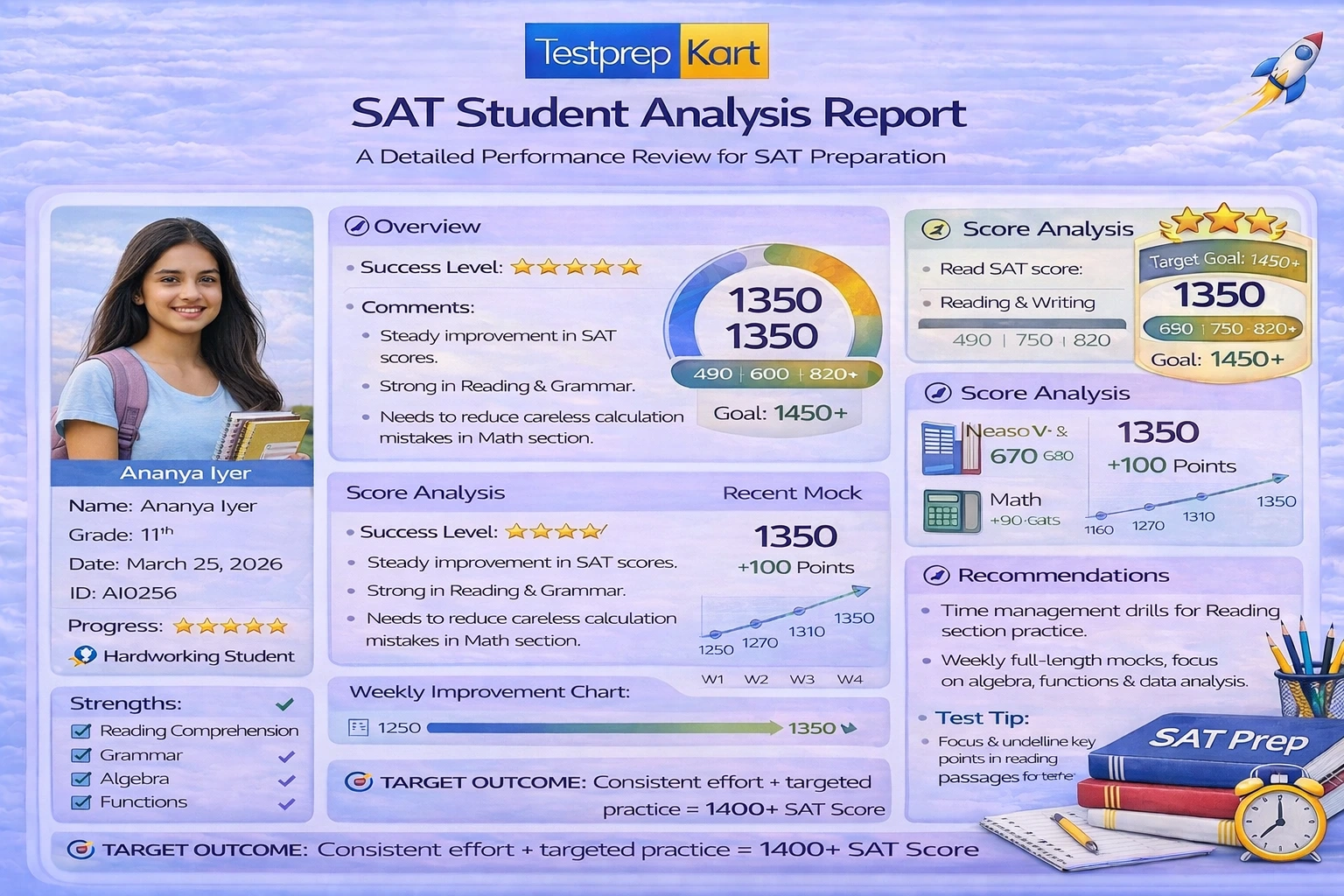
For many families, the biggest question is not whether the student wants to improve. It is whether the student is realistically positioned to do so, what kind of score jump is practical, and whether a deeper course structure is justified.
| Parent Question | How The Analysis Report Helps |
|---|---|
| Is my child on the right track? | Gives a current readiness picture |
| Why is the score not improving? | Identifies the real weak points and repeated score leaks |
| What should we fix first? | Prioritizes the biggest performance gaps |
| Is more prep needed? | Helps decide whether the 90-hour track is the stronger fit |
| Problem Without Structure | Benefit Of Structured Prep |
|---|---|
| Random practice | Clear weekly plan |
| No accountability | Better consistency |
| No score diagnosis | Smarter improvement path |
| Repeated mistakes | Better error correction |
| Last-minute panic | Better preparation rhythm and less volatility |
| Family Problem | How A SAT 90 Hours Course Helps |
|---|---|
| Student is busy with school | Creates a stronger but still manageable prep structure |
| Self-study started but did not continue | Builds accountability through live sessions, revision cycles, and retesting |
| Student knows concepts but still scores low | Fixes pacing, accuracy, review habits, and SAT-specific mistakes more thoroughly |
| Parent cannot judge progress clearly | Adds structure, mock-based tracking, and stronger performance clarity |
| Student is confused by Digital SAT | Makes the format familiar through guided and repeated exposure over time |
A good blog should mention official tools clearly. College Board points students to Bluebook for official practice tests and to Khan Academy for Official SAT Prep and leveled skill practice.
| Tool | Best Use |
|---|---|
| Bluebook | Full-length digital practice tests |
| Khan Academy | Skill-wise practice and guided study |
| College Board Test Dates Page | Planning test timing and registration |
For students preparing in the 2025 to 2026 cycle, College Board lists national SAT dates including March 14, 2026, May 2, 2026, and June 6, 2026. Registration deadlines are published separately for each date.
This matters because students should prep backward from the test they plan to take. A 42-hour course works especially well when tied to a specific target date.
| Student Situation | Why The 42-Hour Plan Fits |
|---|---|
| Planning a near-term SAT attempt | Gives focused prep over a controlled timeline |
| Wants a serious first attempt | Builds structure without wasting months |
| Needs a score jump before application planning | Offers guided review and mocks |
| Balancing AP season and SAT prep | More manageable than a very long course |
SAT scores vary widely by school and program. Here’s the middle 50% score range for popular universities so you know exactly what to aim for.
| University | SAT Score Range | Note |
|---|---|---|
| Harvard University | 1510–1580 | Middle 50% range |
| UC Berkeley | 1310–1530 | Middle 50% range |
| Penn State | 1130–1330 | Middle 50% range |
| Stanford University | 1500–1580 | Middle 50% range |
| Ohio State University | 1240–1450 | Middle 50% range |
| Yale University | 1500–1570 | Middle 50% range |
| University of Michigan | 1360–1530 | Middle 50% range |
| Georgia Tech | 1400–1560 | Middle 50% range |
If your child is studying in the United States and wants a serious Digital SAT preparation structure with more depth, more review, more refinement, and more performance support, this format can be a strong fit. It works especially well for students who want a more complete and confident SAT journey.
For many students, yes. A 90-hour structure is especially useful when the student wants deeper concept mastery, more revision, more mock exposure, and a more stable preparation cycle than a shorter course can provide.
Students who need more reinforcement, more revision, stronger mock-based correction, or a more ambitious score jump often benefit more from the 90-hour format.
Yes. It is especially suitable for students balancing school rigor, GPA, and extracurriculars who still want a serious SAT pathway with more preparation depth and less last-minute pressure.
Yes. A strong SAT 90 Hours Course should reflect the current digital format, Bluebook-style practice, Reading and Writing domains, Math domains, and adaptive structure.
Yes. Bluebook remains one of the most important official tools for Digital SAT preparation because it gives students full-length practice in the real testing environment.

Copyright © 2024 CounselKart Educational Services Pvt. Ltd.. All Rights Reserved