






Hi, I’m TestprepKart.
Your Partner In Exam Preparation

Download SAT Prep E-Book GuideBook a SAT Free Trial Class
A concentrated and methodical approach is necessary to prepare for the Digital SAT in a constrained amount of time. With expert-led instruction, focused practice, extensive study resources, and tried-and-true test-taking techniques, SAT Crash Courses Online are specifically made to help students maximize their scores. These intensive courses offer an organized learning experience that enhances math and reading and writing skills while boosting test-day confidence, regardless of whether you are taking the SAT for the first time or trying to improve a prior score. You will learn about the advantages of online SAT crash courses in this article, as well as how to select the best program to effectively reach your desired score.
Designed for students who need results quickly without long-term tutoring, an online SAT crash course is a brief, rigorous Digital SAT prep program (usually 2, 4, or 6 weeks) that raises scores quickly with timed Bluebook-style practice, accuracy training, and weekly progress tracking. The live, weekly crash courses offered by TestprepKart are designed to fit U.S. school schedules (EST, CST, and PST). Depending on their starting score and consistency, students can usually earn between 100 and 250+ points.
A thorough guide to the best online SAT crash courses created especially for Indian students residing in the US. It evaluates top programs according to their price, professional instructors, flexible scheduling, individualized feedback, teaching quality, and Digital SAT practice. This guide helps you select the ideal crash course to boost your performance swiftly and confidently, regardless of whether you’re preparing in a few weeks or aiming for a high score of 1400–1600.


Get Free SAT Expert Advice Explore Our Courses
| Course Features | 2-Week SAT Crash Course (Emergency Prep) | 4-Week SAT Crash Course (Most Popular) | 6-Week SAT Crash Course (Maximum Gain) |
| Best For (U.S. Students) | Students with strong fundamentals who need last-minute strategy + timed practice | U.S. Indian students balancing school/APs who want structured improvement | Students targeting bigger score jumps + scholarships and stronger endurance |
| Main Focus | Fast strategy training + high-frequency topics | Structured coverage + Digital SAT adaptive strategy | More practice volume + stronger accuracy systems + stamina |
| Digital SAT Skills Covered | Core Math patterns + key R&W rules + pacing for modules | Grammar rules + transitions + rhetorical skills + core Math mastery + Desmos strategy | Everything in 4-week + advanced mixed sets + deeper error correction |
| Study Plan (Realistic for U.S. Schedule) | Daily short plan to fit around school + activities | Weekly structure that fits after-school/weekend prep | Longer runway to master skills without burnout |
| Practice + Homework | 45–90 min/day timed drills + quick error-log review | 60–90 min/day, 5–6 days/week + weekly skill checks | 75–120 min/day, 6 days/week + redo drills + deep review |
| Mocks + Review (Bluebook-Style) | 2 mini-mocks + correction plan after each | 1 full mock/week + improvement tracking | 4–6 full mocks total + module-level analytics + retest weak skills |
Before you enroll, take a free trial class to learn more about our SAT preparation program. Learn from knowledgeable teachers, examine the format of the Digital SAT, and get individualized advice to determine your areas of strength and growth. It’s the ideal chance to experience how we educate, ask questions, and confidently begin your path to a higher SAT score.
.png) | .png) |
Download free Digital SAT study resources to prepare with confidence. Access official SAT practice tests, student guides, practice papers, cheat sheets, topic-wise Math and Reading & Writing materials, and other essential study resources. These carefully curated PDFs and practice materials will help you strengthen key concepts, improve test-taking strategies, and maximize your SAT score.
| SAT Resource | How It Helps | Access Resource |
|---|---|---|
| Official Digital SAT Practice Tests | Practice with official College Board Digital SAT tests to experience the real exam format, adaptive modules, and scoring. | Download Now |
| Official SAT Student Guide | Understand the Digital SAT format, scoring, test-day rules, and preparation strategies from the official guide. | Download Now |
| Digital SAT Practice Papers | Improve speed, accuracy, and confidence with full-length and section-wise Digital SAT practice papers. | Download Now |
| SAT Cheat Sheets | Quickly revise math formulas, grammar rules, vocabulary, punctuation, and essential Digital SAT concepts. | Download Now |
| SAT Math Topic-wise Resources | Master Algebra, Advanced Math, Problem Solving & Data Analysis, Geometry, and Trigonometry with targeted study materials. | Download Now |
| SAT Reading & Writing Resources | Practice grammar, vocabulary, punctuation, rhetorical synthesis, and reading comprehension by topic. | Download Now |
| Complete Digital SAT Prep E-Book | Get a comprehensive SAT preparation guide with study plans, expert strategies, practice questions, and exam tips. | Download Now |

As opposed to guessing about what to do next, students can study with a defined plan by using this free SAT Prep Guide. Priority themes, clever practice techniques, timing strategies, and typical errors that frequently lower scores are all covered. It makes SAT preparation more structured and easier to manage with school and AP assignments, and it was created for Indian NRI families and high school kids in the United States. Download it to begin planning with greater direction, clarity, and assurance.
Download SAT Prep E-book Guide
SAT Crash Course for Math in the U.S. (Live Online – EST/CST/PST Timings):
| SAT Math Crash Courses | Duration | Course Details |
| SAT Math Crash Course | 2 weeks | Enroll in the Program |
| SAT Math Crash Course | 4 Weeks | Enroll in the Program |
| SAT Math Crash Course | 6 Weeks | Enroll in the Program |
| SAT English Prep Crash Courses | Duration | SAT Course Details |
| SAT English (Reading and Writing) | 2 Weeks | Enroll in the Program |
| SAT English (Reading and Writing) | 4 Weeks | Enroll in the Program |
| SAT English (Reading and Writing) | 6 Weeks | Enroll in the Program |
Learn from seasoned Digital SAT instructors who have used targeted crash courses, flexible test-taking techniques, and individualized coaching to help thousands of American high school students raise their SAT scores.


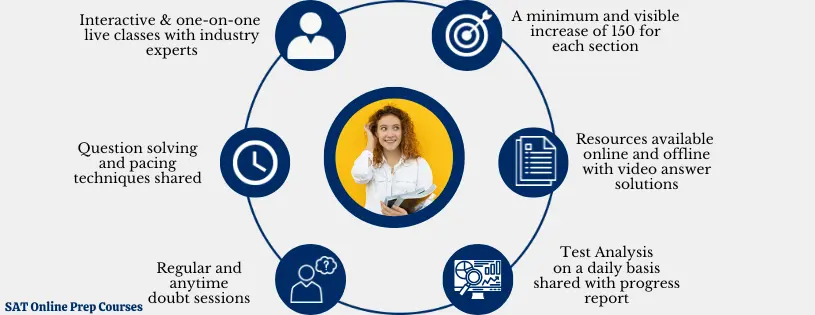
There’s more to an excellent online SAT crash course than just quick sessions. A diagnostic test, Bluebook-style practice, focused subject review, adaptive Digital SAT techniques, and weekly progress tracking are all included. Busy American students may quickly raise their SAT scores, increase accuracy, and gain confidence with this methodical technique.
| Key Feature | Description |
| Focused Study Plan | A methodical study schedule that gives priority to the most crucial SAT subjects, enabling students to raise their scores as much as possible in less time. |
| Expert Instruction | Learn from knowledgeable SAT teachers who break down complex ideas, impart tested test-taking techniques, and assist students in avoiding typical pitfalls. |
| Digital SAT Practice Tests | Full-length adaptive practice exams that closely resemble the official Digital SAT, enhancing exam readiness, accuracy, and confidence. |
| Personalized Performance Analysis | Students can concentrate on areas that require the greatest improvement by identifying their strengths and weaknesses through detailed performance reports. |
| Time Management Techniques | Useful techniques to increase accuracy and speed so that pupils finish each portion within the allotted time. |
| Targeted Practice | Learning is reinforced and problem-solving abilities are enhanced through section-specific exercises, topic-specific drills, and daily quizzes. |
| Latest Digital SAT Content | Study guides and practice questions have been updated to reflect the new Digital SAT adaptive style and syllabus. |
| Progress Tracking | Students can measure their progress and adjust their preparation method with the aid of regular evaluations and score tracking. |
Digital SAT Format (What Crash Courses Focus On)
A crash course should teach the Digital SAT the way it’s actually tested:
30-Day Digital SAT Crash Course Study Plan
This 30-day SAT study guide is intended for students who want to get ready for the Digital SAT in just one month. It begins with developing solid foundations, moves on to focused practice, and concludes with lengthy practice exams and methods for raising test scores.
| Days | Focus | Activity |
| Days 1–3 | Diagnostic & Foundation | Take the entire Digital SAT diagnostic test, pinpoint your areas of weakness, and go over the basics of reading, grammar, and algebra. Make a log of errors. |
| Days 4–6 | Core Skill Building | Use 40–50 official questions every day to practice reading comprehension, algebra, advanced math, grammar, and vocabulary in context. |
| Day 7 | Weekly Review | Examine errors, strengthen weak areas, and finish one timed mini-Digital SAT section. |
| Days 8–10 | Reading & Writing Mastery | Under timed circumstances, practice rhetorical synthesis, transitions, command of evidence, inference, and punctuation. |
| Days 11–13 | Math Mastery | With timed practice, concentrate on advanced math, geometry, trigonometry, data analysis, and Desmos techniques. |
| Day 14 | Full-Length Mock Test | Examine all of the wrong answers on one official Bluebook-style digital SAT practice test. |
| Days 15–17 | Targeted Improvement | Based on the analysis of Mock Test, focus exclusively on your weakest math and reading and writing skills. |
| Days 18–20 | Adaptive Module Practice | Finish the practice sets for Modules 1 and 2 while honing your accuracy, timing, and question picking techniques. |
| Day 21 | Weekly Review | Examine the error log, update grammatical rules and formulae, and do one mixed-timed practice set. |
| Days 22–24 | High-Frequency SAT Topics | Practice the SAT concepts that are most frequently assessed, including as functions, linear equations, punctuation, transitions, and vocabulary. |
| Days 25–27 | Full-Length Mock Test | Take another certified Digital SAT practice exam, compare your results, and concentrate on your areas of weakness. |
| Days 28–29 | Final Revision | Go over vocabulary, test-day tactics, Desmos shortcuts, SAT math formulas, and grammatical guidelines. |
| Day 30 | Test-Day Readiness | Before the test, do a quick practice session, go over your notes, get your test materials ready, and take a nap. |

Background:
Before the deadline for college applications, Sneha, a student in Grade 12 in New York, USA, was getting ready for her last SAT attempt. She barely had four weeks remaining before her test since she had put off structured SAT preparation. 1310 was her diagnostic SAT score.
Main Challenge:
The majority of SAT ideas were understood by Sneha, but she lacked a methodical revision strategy. Due to grammar, transitions, and time management, she routinely had lower grades in Reading & Writing, and her math score was impacted by minor calculation errors. Her parents were concerned that she wouldn’t be able to get a competitive SAT score for prestigious universities in just one month.
What TestPrepKart Did:
Sneha enrolled in TestPrepKart’s 4-Week SAT Crash Course, which aims to enhance scores as much as possible in a short amount of time. The program’s main objectives were focused practice, digital SAT methods, and targeted revision. It contained:
Sneha was able to successfully manage her normal high school classes and SAT preparation because classes were scheduled in the evening in accordance with the U.S. Eastern Time Zone (ET).
Result:
Sneha raised her SAT score from 1310 to 1470 after four weeks of concentrated study. She also entered her last SAT attempt with much more confidence and faster test-taking.
Parent Learning:
When students concentrate on individualized preparation, frequent mock exams, and focused error correction rather than attempting to relearn the entire course, a well-structured SAT Crash Course can provide notable score improvements even with just one month left. Sneha’s SAT score increased from 1310 to 1470 after taking the SAT Crash Course, and she felt much more confident going into her final SAT attempt.

Background:
Ishaan was a Grade 11 student in Dallas, Texas, USA, juggling college preparation, AP Chemistry, and AP U.S. History. Due to his busy extracurricular and academic schedule, he didn’t start studying for the SAT until just six weeks prior to the test. 1240 was his diagnostic SAT score.
Main Challenge:
Despite having a solid background in mathematics, Ishaan was not familiar with the format of the Digital SAT. He had trouble with time management in reading and writing, adaptable modules, and frequent grammatical errors. His parents were worried that he wouldn’t be able to get a competitive SAT score for elite universities in six weeks.
What TestPrepKart Did:
Ishaan signed up for TestPrepKart’s 6-Week SAT Crash Course, which aims to boost scores as much as possible in a short amount of time. High-impact subjects, digital SAT techniques, and extensive timed practice were the program’s main focuses. It contained:
Ishaan was able to continue juggling schooling, AP courses, extracurricular activities, and SAT preparation without scheduling issues because classes were scheduled in the evening in accordance with the U.S. Central Time Zone (CT).
Result:
Ishaan’s SAT score increased from 1240 to 1450 after six weeks of concentrated SAT Crash Course study. He also gained a great deal of confidence in the Math and Reading & Writing parts.
Parent Learning:
With an organized crash course that prioritizes strategic practice, adaptive test preparation, and regular performance tracking, even students with rigorous AP schedules can significantly increase their SAT scores.
How Much Can You Improve in an Online SAT Crash Course?
Your starting score, the amount of time left before the test, and how often you practice will all affect how much an online SAT crash course will raise your score. A well-designed crash course helps students make quantifiable progress quickly by emphasizing timed practice, digital SAT methods, high-impact ideas, and individualized error analysis.
When they stick to a strict study schedule, many students show improvements in as little as two to six weeks. Crash courses emphasize the most tested topics, enhance time management, and get rid of common blunders instead of attempting to relearn every topic.
| Starting SAT Score | Potential Target Score | What to Focus On |
| 1000–1150 | 1150–1350 | Build core concepts, improve accuracy, and master test-taking strategies. |
| 1150–1300 | 1300–1450 | Strengthen weak areas, practice adaptive modules, and improve time management. |
| 1300–1450 | 1400–1550 | Focus on advanced questions, reduce careless mistakes, and increase consistency. |
| 1450+ | 1500–1600 | Fine-tune strategy, maximize accuracy, and perfect pacing for top scores. |
During a SAT crash course, even motivated students squander important study time by concentrating on the incorrect tasks. Every study session should focus on the abilities that will have the biggest influence on your Digital SAT score because most crash prep only lasts a few weeks. If you want to maximize your score before exam day, stay away from these typical blunders.
| Common Mistake | Why It Hurts | Better Strategy |
|---|---|---|
| Studying random topics | Low-frequency concepts consume time while common question types remain weak. | Prioritize high-frequency SAT Reading, Writing, and Math topics first. |
| Practicing without a timer | Students perform well during practice but struggle under real exam pressure. | Complete full-length timed Digital SAT sections every week. |
| Skipping an error log | The same mistakes repeat because students never identify the real cause. | Maintain an error log with question type, mistake reason, and correction. |
| Ignoring Desmos | Missing built-in calculator shortcuts leads to slower solving and unnecessary errors. | Practice graphing, intersections, equations, and regressions using Desmos. |
| Spending too long on difficult questions | Easy questions are left unanswered, lowering the overall score. | Secure easy and medium questions first, then return to difficult ones. |
| Taking too many full-length tests | Scores plateau because mistakes are never reviewed. | Spend at least twice as much time reviewing mistakes as taking the test. |
| Ignoring weak sections | Students keep practicing strengths instead of improving low-scoring areas. | Allocate extra study time to the topics with the highest error rate. |
Pro Tip: During a SAT crash course, improving accuracy on simple and medium questions-rather than mastering the most difficult ones-usually results in the quickest score increases. To maximize your score in the little amount of time allotted, prepare under actual exam conditions, use Desmos effectively, reduce repetitive errors with an error log, and boost your confidence.
Online SAT crash courses work incredibly well when they’re built like real test training not just “content delivery.” The best programs are:
Live (not only recorded)
Structured by week (so students don’t feel lost)
Tracked with score analytics (so improvement is measurable)
Built around the Digital SAT format (modules, pacing, Desmos)
Aligned to U.S. school schedules (EST/CST/PST-friendly)
For U.S. Indian families, the best programs feel short, intense, measurable, and planned with clear accountability every week.
| What Matters in a Crash Course | TestprepKart | Kaplan / Princeton Review (Typical Large Providers) |
| Live Teaching + Real-Time Feedback | Live, interactive sessions with active correction and strategy coaching | Live options exist, but many students experience a more “program-like” format with less personalized correction |
| Weekly Structure (No Guessing) | Clear weekly plan: learn → timed sets → review → mini-test → adjust | Often structured, but may feel more standardized across students |
| Personalized Gap Plan | Diagnostic + “what to fix first” roadmap based on your patterns | Usually strong content coverage, but personalization can be lighter depending on package |
| Accuracy System (Stops Repeat Mistakes) | Built-in error log + repeat-mistake prevention routine | Students may need to self-manage error tracking unless included in the plan |
| Digital SAT Realism (Modules + Pacing) | Timed practice that mirrors module flow and difficulty shifts | Strong practice banks, but “realism” depends on the specific course format |
| Desmos Strategy (Digital SAT Math Advantage) | Desmos decision rules: when to graph, check, verify fast | Often covered, but not always drilled as a core score-boost system |
| U.S. Schedule Fit (EST/CST/PST) | Designed around U.S. school workload + time zones (evenings/weekends) | U.S. schedule-friendly, but fixed cohorts may not match every student’s timing needs |
| Measurable Progress for Parents | Weekly score checkpoints + simple progress reporting | Progress tools exist, but may be less “hands-on” unless in premium plans |

He is a Digital SAT mentor with 10+ years of experience, working primarily with SAT students all Over worldwide. Their students have consistently progressed toward 1520+ scores by improving timing, accuracy, and trap-answer control through official-style practice, detailed mistake analysis, and clear weekly action plans.
Copyright © 2024 CounselKart Educational Services Pvt. Ltd.. All Rights Reserved



Post a Comment