Schedule Your Free Exam Readiness Analysis Session!




Hi, I’m TestprepKart.
Your Partner In Exam Preparation

Testprepkart’s AP Precalculus course enables deep insights & learning experience.

This program is for students who want a focused, well-structured AP Precalculus preparation path. With 20 total hours — 15 hours of core academic instruction across 10 live sessions plus 5 full simulated tests - this is a serious yet manageable system for students who want concept clarity, strong graphical understanding, and better exam readiness.
| Program Snapshot Area | What Students And Parents Should Know |
|---|---|
| Course Name | AP Precalculus Preparation Program |
| Course Designed For | U.S. students, Indian American students, and AP aspirants who want structured preparation in a manageable time frame |
| Best Grades | Grade 10, Grade 11, and Grade 12 students who want stronger precalculus understanding and AP exam alignment |
| Total Program Duration | 20 Hours — 15 Hours Core Instruction + 5 Hours Performance Tests |
| Core Instruction | 15 Hours (10 Sessions × 1.5 Hours) — Live interactive teaching with concept mastery, graph work, applications, and review |
| Performance Tests | 5 Hours (5 Simulated Tests × 1 Hour) — AP-style assessments with rubric-based feedback and error review |
| Delivery Format | Live Interactive Classes + Recorded Access |
| Evaluation Model | AP Rubric-Based Feedback |
| Core Focus | Functions, modeling, trigonometric and exponential reasoning, symbolic manipulation, and graphical analysis |
| Major Outcome Goal | Stronger conceptual understanding, better AP-style performance, fewer careless errors, and more confidence on exam day |
| Ideal Student Type | Students who want more than classroom familiarity and need a guided system to improve performance |
| Parent Usefulness | Helpful for families who want visibility into readiness, improvement, and AP exam preparation quality |
Below is the exact course-detail structure aligned to the information shared in your image so families can clearly see the academic format, performance-testing structure, and delivery model in one place.
| Course Detail | Value |
|---|---|
| Course | AP Precalculus |
| Target Grades | 10–12 |
| Total Duration | 20 Hours |
| Core Instruction | 15 Hours (10 Sessions × 1.5 Hours) |
| Performance Tests | 5 Hours (5 Simulated Tests × 1 Hour) |
| Delivery Format | Live Interactive Classes + Recorded Access |
| Evaluation Model | AP Rubric-Based Feedback |
 |
 |
AP Precalculus is new for many families, which means students and parents often want more than a course outline. They want to know what kind of visible academic improvement this structure can create. A good AP preparation program should make students more confident, more accurate, and more capable of interpreting functions and models under exam conditions.
Performance improves when students combine concept clarity, graph reasoning, disciplined practice, and honest review. The table below presents a clean way to communicate improvement patterns to families.
| Cycle | Student Focus | Typical Improvement Area | Primary Growth Driver |
|---|---|---|---|
| Cycle 1 | Baseline Diagnostic | Understanding current algebra and function gaps | Initial concept mapping and weak-area identification |
| Cycle 2 | Core Concept Reinforcement | Improved graph reading and symbolic control | Structured teaching and worked examples |
| Cycle 3 | AP-Style Practice | Better question interpretation and time use | Practice aligned to exam-style prompts |
| Cycle 4 | Simulation And Review | Fewer repeated mistakes and stronger exam control | Simulated tests with rubric-based feedback |
Students in the U.S. preparing for AP Precalculus juggle school, GPA pressure, and extracurriculars, so they need more than basic notes.
A structured 20-hour program builds concept clarity, strengthens graph-based reasoning, and improves timed AP performance.
This is especially helpful for Indian American students, bridging the gap between school learning and AP exam execution through guided practice and feedback.
A focused AP Precalculus preparation system designed for meaningful improvement without overwhelming the student.
10 live sessions covering major AP Precalculus domains with concept building, examples, and targeted review.
Five one-hour AP-style tests help students experience timed performance and identify where marks are being lost.
Students attend live interactive sessions and can revisit recordings for reinforcement and revision.
The program is built around the ability to interpret, compare, and analyze functions with confidence.
Students finish with a stronger foundation for AP Calculus, STEM pathways, and broader quantitative coursework.
AP Precalculus improvement comes from understanding functions, graphs, and multi-step reasoning—not just memorizing formulas.
The 20-hour program combines structured teaching with 5 AP-style tests to build clarity, practice, and performance awareness.
It’s a focused system that helps students identify mistakes, improve steadily, and gain confidence for the AP exam.

Many students do well in school but struggle because the AP exam demands accuracy, flexibility, and clarity under time pressure.
This program focuses on both what to study and how to perform - helping students handle mixed-format questions, avoid common mistakes, and build exam confidence.
The curriculum covers the major AP Precalculus domains with both conceptual depth and application-focused practice so students are ready for the range of question types they may face.
| Academic Domain | Topics Covered | Competency Developed |
|---|---|---|
| Polynomial And Rational Functions | Zeros, end behavior, transformations, asymptotes, graph interpretation | Strong control over nonlinear function behavior and graph analysis |
| Exponential And Logarithmic Functions | Growth, decay, inverse relationships, equations, modeling | Ability to solve and interpret real-world exponential and logarithmic contexts |
| Trigonometric Functions | Graphs, periodicity, identities, transformations, modeling | Confidence in interpreting and applying trigonometric relationships |
| Functions And Representations | Tables, graphs, formulas, verbal descriptions, transformations | Flexible movement across multiple representations |
| Modeling And Applications | Scenario-based functions, interpretation, parameter meaning | Use of mathematics in contextual problem solving |
| AP-Style Reasoning | Mixed-format problems, graph-based questions, time-aware execution | Stronger exam control and cleaner mathematical decision-making |
 |
 |
 |
 |
 |
 |
|
|
| Simulation | Focus | Evaluation Output |
|---|---|---|
| Test 1 - Diagnostic Baseline | Initial assessment across major AP Precalculus domains | Baseline report identifying strongest and weakest areas before instruction deepens |
| Test 2 - Function And Graph Analysis | Polynomial, rational, and graph-based interpretation questions | Feedback on function behavior understanding and graph-reading quality |
| Test 3 - Exponential And Logarithmic Reasoning | Growth, decay, and inverse function applications | Analysis of symbolic accuracy and contextual interpretation |
| Test 4 - Trigonometric And Mixed Application Set | Trig functions, periodicity, and mixed-format AP-style items | Review of timing, representation-switching, and weak-pattern repetition |
| Test 5 - Final Simulation | Comprehensive AP-style test under timed conditions | Final readiness evaluation with rubric-based guidance |
One of the strongest advantages of a 20-hour AP Precalculus structure is that every hour can do a specific job. That makes the course feel clear, serious, and manageable for both students and parents.
| Hour Range | Focus Area | What Happens Here |
|---|---|---|
| Hours 1 to 3 | Orientation And Diagnostic | Students understand AP Precalculus expectations, take a baseline check, and identify weak areas |
| Hours 4 to 7 | Function Foundations | Work on polynomial, rational, exponential, and logarithmic function understanding |
| Hours 8 to 11 | Graph Interpretation And Applications | Students strengthen visual reasoning, transformations, and applied analysis |
| Hours 12 to 15 | Trigonometric And Mixed AP Practice | Students integrate core topics into AP-style question formats |
| Hours 16 to 20 | Simulation And Review | Five simulated tests with feedback cycles build exam control and confidence |
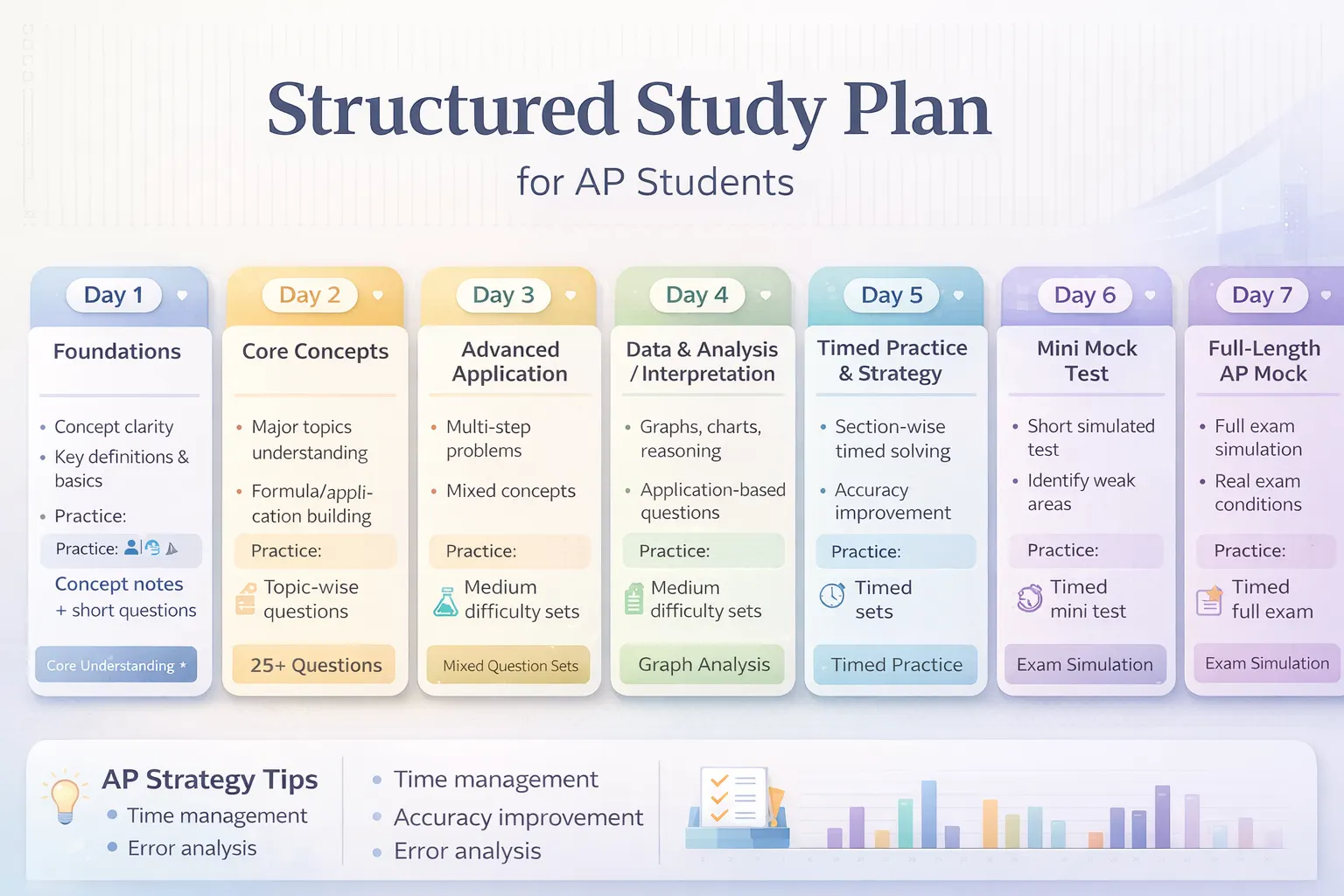
A week-by-week structure helps students and parents understand how this course fits into a realistic school schedule while still moving toward visible improvement.
| Week | Main Focus | What The Student Does |
|---|---|---|
| Week 1 | Orientation And Baseline | Understand the exam structure, take a starting assessment, and map weaknesses |
| Week 2 | Function Families | Build deeper understanding of polynomial, rational, exponential, and logarithmic behavior |
| Week 3 | Graphs And Representations | Strengthen interpretation across graphs, tables, formulas, and transformations |
| Week 4 | Trigonometric Reasoning | Work on periodicity, trigonometric graphs, and mixed function interpretation |
| Week 5 | Mock Review Cycle | Use simulated tests and feedback to strengthen weak patterns and exam confidence |
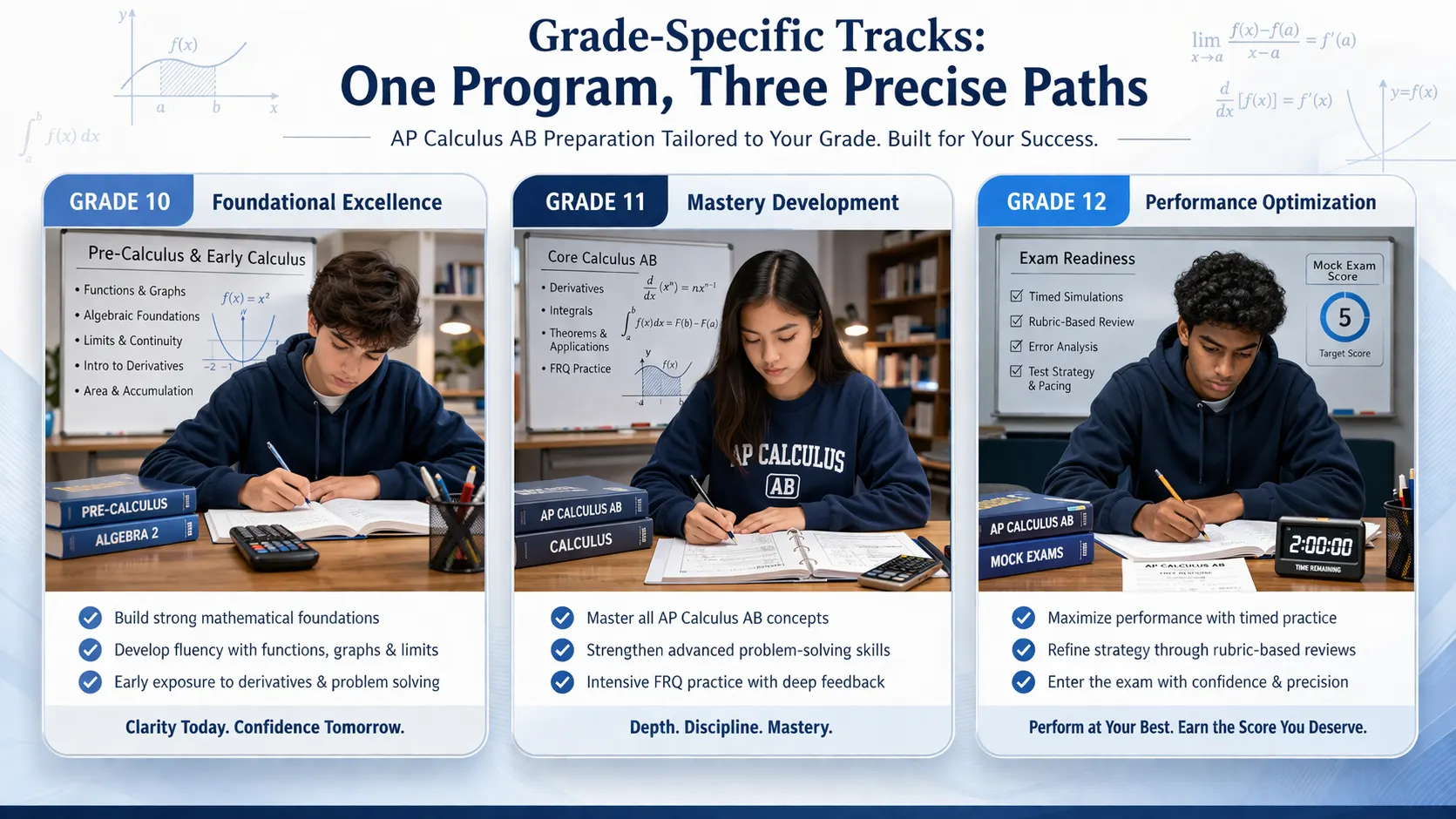
Students who want a serious AP Precalculus path without overwhelming their schedule.
Students from ambitious families who want stronger structure and better performance stability.
Students who need a program that fits around demanding coursework while still producing results.
Students who understand some topics but struggle to translate that into confident test performance.
Students who want to build a stronger bridge into future AP Calculus coursework.
Parents who want structure, accountability, and a measurable academic roadmap.
Indian American students in the U.S. often balance rigorous academics, extracurriculars, and college planning, making AP Precalculus an important foundation for future success.
A structured program provides clarity, efficiency, and confidence, helping students prepare effectively without adding extra stress.
One of the biggest advantages of a focused AP Precalculus cycle is that the student is not only preparing for one exam date. They are also building stronger mathematical maturity that carries into later AP Calculus work and college-ready quantitative thinking.
The habits developed here - connecting representations, reading graphs accurately, interpreting model behavior, and solving mixed-format questions carefully - continue to matter in future mathematics, economics, science, and data-heavy coursework.
That is why strong AP preparation does not only improve scores. It improves how students think, how they review mistakes, and how they approach challenging math with discipline and confidence.
Parents usually want to know whether their child is actually improving or simply spending time in sessions. This program answers that through repeated checkpoints, simulated tests, and rubric-based feedback.
Families can understand whether the student needs algebra support, graph reasoning reinforcement, or more AP-style question practice. That makes the course feel measurable and serious rather than vague.
This program is best for students in Grades 10, 11, and 12 who want a focused, structured AP Precalculus preparation system. It is especially useful for students who want stronger concept mastery, graph confidence, AP-style question practice, and visible progress in a manageable number of hours.
20 hours is designed as an efficient but meaningful preparation structure. With 15 hours of core instruction across 10 sessions and 5 AP-style simulated tests, students get time to build concepts, practice intelligently, and review errors without an overloaded schedule.
The core academic instruction component is 15 hours delivered across 10 live interactive sessions. All sessions include recorded access so students can review at any time. The performance-test series consists of 5 one-hour simulated AP-style tests with AP rubric-based feedback. The complete program is 20 hours total.
Yes. That is one of the most common student profiles this program is designed for. It helps convert school-level understanding into AP exam performance through graph-based reasoning, structured practice, simulated tests, and honest correction.
Yes. A strong AP Precalculus foundation makes later AP Calculus learning more stable and less stressful. Students leave with better function understanding, cleaner algebra, and stronger mathematical maturity.
Yes. With simulated tests, structured feedback, and visible checkpoints, families get clearer insight into whether the student is improving consistently and where support is still needed.
The AP Precalculus Preparation Program — 20 hours total, 15 hours of core instruction across 10 live sessions, 5 simulated tests, live + recorded access, and AP rubric-based feedback — is built for families who want structure, efficiency, and visible academic direction. This program helps students strengthen function mastery, graph interpretation, AP-style performance, and long-term readiness for future AP math courses.

Copyright © 2024 CounselKart Educational Services Pvt. Ltd.. All Rights Reserved