Schedule Your Free Exam Readiness Analysis Session!

Hi, I’m TestprepKart.
Your Partner In Exam Preparation
Quick answer for U.S. families: Typically, the U.S. MD/DO route presents the quickest way into postgraduate studies within the United States. In contrast, an MBBS degree from India allows for early entrance into medical school straight out of high school. However, in the event that an Indian MBBS graduate chooses to pursue postgraduate studies in the United States, they become an IMG.
| Decision factor | USA: MD or DO | India: MBBS |
|---|---|---|
| Entry point | Usually after undergraduate premedical study | After Grade 12 or equivalent and NEET qualification |
| Entrance exam | MCAT usually required for U.S. medical-school entry | NEET-UG for MBBS entry |
| Medical degree | MD (allopathic) or DO (osteopathic) | MBBS |
| Typical study pathway | About 4 years college + 4 years medical school | About 4.5 years study + 1 year compulsory internship |
| After medical degree | U.S. residency and licensure requirements | Indian registration requirements; postgraduate training as needed |
| If the goal is U.S. practice | U.S. graduate residency route | IMG eligibility, ECFMG certification, residency application and Match |
| Cost comparison | Undergraduate cost plus 4-year medical school cost | Government merit, state-private NRI or deemed NRI fee depends on seat |
The most crucial issue is not where medical school appears to be cheaper. It is where your child wants to do residency and become a doctor. There are three different paths that need to be compared before taking any further steps.
Fits well for those who are dedicated to staying and practicing in the US. Needs a competitive undergraduate preparation program and a separate application process for medical schools; it is not an automatic eight-year admission package.
One of the options that can be considered by students eligible in accordance with Indian criteria, ready to write NEET, and who can make their medical careers in India. The cost depends greatly on the nature of the allotted seat (government, private or deemed-university NRI).
If the educational institution and graduation year meet the criteria of the ECFMG. The student needs to pass the required exams and get residency. Being a citizen of the United States does not negate the status of IMG.
MBBS, MD and DO are medical degrees, but they belong to different training systems. Students in India generally enter MBBS after Grade 12 and NEET. Students pursuing a U.S. MD or DO usually complete undergraduate premedical coursework and then apply to medical school. U.S. MD and DO graduates both pursue physician licensure through postgraduate training.
Mostly they join after 12th standard and are eligible for NEET and counseling. They receive their professional medical education as well as internships and become eligible for registration.
To start off, they fulfill their pre-requisites, apply to MD schools, complete four years of study at such institutions, and finally compete for residencies.
An alternative route for doctors in the U.S. is DO. The osteopathic education program has the same requirements as the other medical schools, which include the MCAT.
An American family should not dismiss an Indian MBBS as an unrecognized medical qualification. The critical question is whether the particular Indian medical school and graduation year meet ECFMG requirements when the student later pursues a U.S. pathway. ECFMG eligibility and acceptance into residency are separate matters.
U.S. families often compare 5.5 years for an Indian MBBS with eight years for U.S. college plus medical school. That comparison stops too early. The timeline to clinical practice also includes postgraduate residency, certification, exams and licensing. The stages below show the typical route, not a guaranteed completion date.
| Stage | Illustrative duration | What the student does |
|---|---|---|
| High school | Grades 9-12 | Build strong science academics and relevant experiences |
| Undergraduate / premedical study | Usually 4 years | Complete prerequisite courses, experiences and applications |
| MD or DO medical school | Usually 4 years | Study medicine, complete clinical rotations and examinations |
| Residency | Typically 3-7 years, specialty-dependent | Enter supervised graduate medical education |
| Fellowship, if chosen | Varies | Further subspecialty training after residency |
| Stage | Typical duration | What the student does |
|---|---|---|
| Grade 12 + NEET-UG | School completion and admission cycle | Meet academic, age, nationality and counselling requirements |
| MBBS academic course | 4.5 years | Medical studies and clinical training under the college curriculum |
| Compulsory rotating internship | At least 12 months | Complete the required Indian internship and registration steps |
| If practicing in India | Depends on career | Meet registration requirements; seek NEET-PG or other applicable postgraduate pathway if desired |
| If pursuing U.S. residency | Additional, variable | Check school eligibility, exams and ECFMG requirements, apply through U.S. residency systems |
Planning MBBS admission in India from the USA, UAE or another country? Download the TestPrepKart NEET guide designed to help NRI students and parents understand eligibility, documents, NEET preparation and MBBS admission planning.
Useful for NRI, OCI and Indian-origin students and parents planning NEET and MBBS admission in India.
The fact that one gets a high school diploma in America does not guarantee automatic eligibility to study MBBS in India. Similarly, completing high school in America does not qualify the students to pursue an MD or DO degree in the U.S straight away. Please compare requirements and procedures for each case.
| Requirement | USA medical-school route | India MBBS route |
|---|---|---|
| Previous education | Undergraduate-level premedical coursework, typically bachelor's degree | Grade 12 or equivalent with required science subjects and English |
| Entrance test | MCAT for most MD and DO programs | NEET-UG |
| Academic profile | College GPA, science prerequisites, test, experience and school fit | NEET rank, qualifying school education and counselling eligibility |
| Nonacademic factors | Clinical exposure, service, recommendations, interviews, personal narrative | Counselling documents and any eligibility requirements in official notices |
| NRI / OCI status | U.S. citizenship, residence and school rules can affect tuition/admission | NRI/OCI categories vary by MCC, state, institute and allotted seat |
With regard to the student who is enrolled in a high school in the U.S., check if their science courses satisfy the new NEET equivalency requirements and find out if any other documents/credits are required and at which location he has to write his NEET exam. With regard to the U.S. pre-med track, find out each school’s policy regarding AP credits and foreign credit courses.
Review the document requirements and NEET eligibility route before selecting colleges.
NEET and MCAT are taken at different stages and serve different purposes.NEET-UG is utilized in India for MBBS admissions at the undergraduate level, whereas for the vast majority of MD/DO applications in the United States, the MCAT is taken after adequate premed education. None of these tests supersedes the other, and a person completing MBBS in India does not take the MCAT.
| Comparison | NEET-UG (India) | MCAT (USA) |
|---|---|---|
| When students take it | For undergraduate medical admission after school | Usually during or after undergraduate premedical preparation |
| What it is used for | MBBS counselling eligibility and rank-based admission | Admissions evaluation at most U.S. MD and DO schools |
| Main academic preparation | Physics, Chemistry and Biology | Biological sciences, chemical/physical foundations, psychology/sociology, critical analysis |
| What the score means | NEET score and rank are central to counselling | One factor alongside GPA, experiences, interviews and recommendations |
| Is it enough by itself? | Qualifying NEET does not guarantee a medical seat | A strong MCAT does not guarantee medical school admission |
Select college classes for premedical courses; find out when you will take your MCAT and whether you will apply through AMCAS or AACOMAS.
Refer to NTA NEET-UG eligibility criteria, equivalence, category type as NRI or regular, and college seats matrix.
Make a proper plan of studies. Preparing for NEET while being in high school is not similar to MCAT preparation in university.
Compare the full pathway, not one year of tuition. Medical education in the United States normally covers the cost of college prior to med school. Indian MBBS fees start at Grade 12 and differ greatly among government merit seats, private NRI seats and deemed universities. The living expenses, scholarship, currency fluctuation, exam fees, and even post-graduate plans may alter the final family budget.
| Cost item | U.S. training budget | India MBBS budget |
|---|---|---|
| Before medical school | 2025–26 undergraduate average budgets: $30,990/year public in-state; $50,920/year public out-of-state; $65,470/year private nonprofit (College Board). | NEET preparation, exam costs and any equivalence / document expenses |
| Medical-school tuition and fees | AAMC class-of-2026 median four-year MD cost of attendance: $297,745 public (in-state); $408,150 private. These are not annual tuition charges. | Published 2026 fee examples: Kerala government MBBS ₹23,150 regular-seat fee; private Kerala NRI ₹21,65,720 or ₹22,74,006/year; Amrita Kochi US$225,000 total NRI tuition. |
| Housing, food and transport | U.S. living costs through undergraduate and medical years | Indian hostel/mess, local travel and international travel for NRI families |
| Exams and applications | MCAT, medical-school applications, licensing tests and residency applications | NEET, counselling, potential Indian postgraduate entrance, or U.S. exams if targeting USA |
| Funding and currency | Financial aid and loan eligibility depend on individual status | Some NRI seats invoice USD tuition while other charges are in INR |
Compare the two countries in the same row. The U.S. figures show published average or median total student budgets, while Indian examples show the applicable seat-category tuition. Read the fee basis before comparing amounts.
| Comparison factor | 🇺🇸 Medicine in the USA (MD / DO pathway) | 🇮🇳 Medicine in India (MBBS pathway) |
|---|---|---|
| Entry before medical degree | Four-year undergraduate study usually comes first. College Board 2025–26 average annual student budgets: $30,990 public in-state; $50,920 public out-of-state; $65,470 private nonprofit. Includes tuition and living-cost budget. | Direct MBBS entry after Grade 12 and NEET-UG. No separate four-year bachelor’s degree is normally required before MBBS. |
| Government / public route | $297,745 is the AAMC class-of-2026 median four-year cost of attendance at a U.S. public MD school for in-state students. This does not include undergraduate study. | ₹23,150 is the published 2026 Kerala regular government MBBS seat fee. It is not an NRI quota fee or a full-programme cost; check the applicable payment period. |
| Private medical school | $408,150 is the AAMC class-of-2026 median four-year cost of attendance at U.S. private MD schools, excluding undergraduate study. | P. K. Das Institute: ₹21,65,720/year and KMCT Medical College: ₹22,74,006/year under the provisional 2026–27 Kerala private NRI fee schedule. Accommodation and other charges may be extra. |
| Deemed university / NRI-specific route | There is no single U.S. equivalent of the Indian MBBS NRI quota. Admission rules and charges vary by school and residency or citizenship status. | Amrita School of Medicine, Kochi (NRI, 2026–27): US$50,000 for each of the first four years, plus US$25,000 as the fifth installment: US$225,000 total tuition for the 4.5-year course. |
| Illustrative combined education budget | $421,705 = 4 × $30,990 public in-state undergraduate budget + $297,745 public MD four-year cost of attendance. This is an eight-year budgeting calculation, not an individual student’s fee quote. | No single India-wide full-course price. For example, the above Amrita US$225,000 covers tuition only; other colleges use different seat-category and installment fees. |
| Extra charges and what the totals cover | College Board annual student budgets and AAMC four-year MD cost of attendance already include living-cost allowances; do not count the same expenses twice. Aid, loans and actual charges differ. | At Amrita, separately published first-year NRI hostel/mess: US$1,600; other fees: ₹1,81,250; processing: ₹5,000. Other Indian colleges set their own hostel, mess and deposit charges. |
The examples below make the arithmetic explicit: four undergraduate years at the 2025–26 annual average budget , plus AAMC's class-of-2026 four-year MD-school median cost of attendance . They are illustrations, not forecasts . Actual tuition inflation, aid, state-residency status, scholarships, admissions and individual living costs will change the bill. The public medical-school median is an in-state reference, which is not automatically available to an out-of-state undergraduate student.
| Illustrative U.S. pathway | Four-year undergraduate budget calculation | Four-year MD school cost of attendance | Combined eight-year example |
|---|---|---|---|
| Public in-state college + public MD school | $30,990 × 4 = $123,960 | $297,745 | $421,705 |
| Public out-of-state college + public MD school | $50,920 × 4 = $203,680 | $297,745 | $501,425 |
| Private nonprofit college + private MD school | $65,470 × 4 = $261,880 | $408,150 | $670,030 |
However, a student of NRI category cannot apply the government merit fee as the fee for his/her quota because the student must have got the regular seat in order to do so. Below are the private NRI and deemed university NRI statistics which cannot be averaged.
| Seat route / named institution | Published amount | Fee year and category | Complete-course status |
|---|---|---|---|
| Kerala government MBBS seat | ₹23,150 | 2026 published government-seat fee, not an NRI quota fee | Not a published complete-course quote; confirm applicable annual/term charges |
| P. K. Das Institute of Medical Sciences (NRI) | ₹21,65,720/year | 2026–27 provisional Kerala private NRI tuition | Annual figure only; no claimed full-course total |
| KMCT Medical College (NRI) | ₹22,74,006/year | 2026–27 provisional Kerala private NRI tuition | Annual figure only; no claimed full-course total |
| Amrita School of Medicine, Kochi (NRI) | US$50,000 for each of first four years + US$25,000 fifth installment | 2026–27 published programme tuition | US$225,000 tuition total , extras excluded |
| Scenario | Calculate these costs | Avoid this mistake |
|---|---|---|
| U.S. college + U.S. MD or DO | Undergraduate 4-year estimate + medical school 4-year COA + applications and moving | Counting medical school alone |
| India MBBS + plan to practice in India | Applicable allotted seat tuition + hostel + internship living costs + postgraduate planning | Using a government merit fee when applying under NRI quota |
| India MBBS + try for U.S. residency | India tuition/living + ECFMG/USMLE/OET as required + ERAS, travel and possible gap period | Assuming a U.S. residency match is guaranteed |
Use the detailed guide to compare government merit, private NRI and deemed-university NRI fees without mixing seat categories.
The reputation of the college is important, but one can also make a logical comparison after considering admission requirements, clinical training, cost, location, and regulations to practice in the particular country. For studying medicine in India, compare government merit seats to state-private and deemed universities NRI seats. If studying in the USA, then compare MD and DO programs.
| College / institution type | Why families consider it | Key admission and fee check |
|---|---|---|
| U.S. public MD school | Potentially different in-state and out-of-state fees, clinical networks | State residency, prerequisites, school tuition and admission selectivity |
| U.S. private MD school | Programs with varied curricula and affiliations | COA, aid, prerequisites and clinical opportunities |
| U.S. DO school | Full U.S. physician training route | AACOMAS admission requirements, MCAT and residency options |
| Indian government medical college | A regular merit seat can be far less expensive | NEET rank, eligible category, MCC/state route; NRI quota not universal |
| Indian private medical college | Additional MBBS options including some state NRI seats | State seat matrix, fees, sponsor criteria, recognized institution |
| Indian deemed medical university | Some colleges offer MCC NRI categories | MCC seat matrix, published USD/INR fees and ECFMG school checks |
Check category-specific seats, tuition, campus details and the appropriate counselling route.
Yes, graduates of eligible Indian MBBS programs can pursue U.S. residency. These individuals typically gain entry via the IMG route. The crucial difference lies in the place where the individual obtained their medical training, not whether he or she is an American national. An American who graduates from Indian medical school is still classified as an IMG applicant.
| Step | What an India-trained graduate must check |
|---|---|
| 1. Confirm school eligibility | Check the school and relevant graduation year in the World Directory; read the ECFMG Sponsor Note. |
| 2. Begin ECFMG application | Follow the current application and identity / credential verification requirements. |
| 3. Pass medical science examinations | The 2026 ECFMG requirements include passing USMLE Step 1 and Step 2 CK. |
| 4. Meet clinical and communication requirements | Complete a valid ECFMG Pathway and OET Medicine requirements where applicable, or another accepted qualifying route. |
| 5. Prepare residency applications | Research specialties and programs, experience requirements, timing and application procedures. |
| 6. Apply through the residency system | Submit eligible applications and take part in interviews and the Match process. |
| 7. Complete U.S. residency and licensure | Licensing steps vary by state and postgraduate program; certification is not a license by itself. |
However, if the student intends to specialize in one of the specialties in the United States, he/she should check whether there is enough competition for the specialty and learn about the type of experience that is valued in such a specialty before choosing the overseas medical school.
The National Resident Matching Program (NRMP) reports U.S. residency outcomes by applicant group. Its 2026 figures show that U.S. MD/DO seniors and international medical graduates have different Match outcomes. These are PGY-1 Match rates among active applicants, not the probability that a particular high-school student will become a doctor.
| Applicant group in 2026 Main Residency Match | Active applicants (2026) | PGY-1 Match rate | How to interpret |
|---|---|---|---|
| U.S. MD seniors | 20,934 | 93.5% | Current senior applicants from U.S. MD programs |
| U.S. DO seniors | 8,503 | 93.2% | Current senior applicants from U.S. DO programs |
| U.S.-citizen international medical graduates | 4,210 | 70.0% | U.S.-citizen IMG applicants, including qualifying graduates of medical schools outside the USA |
| Non-U.S.-citizen international medical graduates | 11,944 | 56.4% | Non-U.S.-citizen IMG applicants with varied immigration and sponsorship situations |
The take-home message would be to maintain options in your careers. In case you still consider the United States as your likely destination, then think about licensing, experience, and competition for postgraduation positions. However, if India becomes your chosen destination, then you must think in terms of the registration process in India.
A student should confirm his intended medical college of India in the World Directory of Medical Schools before he pays any deposit and intends to pursue residency in America. Merely being listed in the directory does not suffice. The student's eligibility for ECFMG rests on having the correct Sponsor Note and graduation years.
| Checklist question | Correct action |
|---|---|
| Is the college in the World Directory? | Find the exact school and campus listing, not just an institution with a similar name. |
| Is there an ECFMG Sponsor Note? | Open the Sponsor Notes tab; the ECFMG note must indicate eligibility. |
| Is my graduation year included? | Check the years specified by the Sponsor Note and any restrictions. |
| Does the school meet Indian recognition requirements? | Verify current recognition through relevant Indian authorities as well. |
| Could eligibility rules change? | Recheck the live listing and ECFMG instructions before relying on them. |
Either one is not necessarily the better option out of the two. The education in America would be easier to relate to because it could be pursued in the same time frame when the plan is to settle in America. However, there is the advantage of pursuing the Indian MBBS after Grade 12.
| USA medical education | Advantages | Trade-offs |
|---|---|---|
| U.S. MD / DO route | Direct preparation within U.S. physician training and residency ecosystem | Longer premedical pathway; medical-school admission and expenses can be substantial |
| Stay near family in USA | Continuity of schooling and local experiences for U.S.-based students | School and residency locations are not necessarily close to home |
| Funding and future flexibility | Some students qualify for loans, aid or scholarship programs | Aid and loan terms differ greatly by school and individual eligibility |
| India medical education | Advantages | Trade-offs |
|---|---|---|
| MBBS after Grade 12 | Earlier entry into medical curriculum after NEET-based admission | Requires preparation for Indian exam and counselling; school equivalence must be checked |
| Range of college categories | Possible government merit, state private and deemed institutions | Published NRI category fees can be high and seat categories vary by state |
| Potential U.S. career later | IMG route may be available for eligible school graduates | ECFMG, USMLE, application, Match and potential relocation hurdles |
A low-cost government merit MBBS seat could make all the difference to the financial bottom line. The same goes for a hefty scholarship in a U.S. university. However, expensive NRI tuition in U.S. dollars in India followed by years of preparation for U.S. residency might not end up being that economical after all.
These are fictional but realistic planning situations. They are designed to show the questions to ask, not to predict admissions, eligibility or future earnings.
Aarav goes to high school in San Jose and desires a long-term career in the USA. His initial strategy is a U.S. premed education, whereas his parents look into financial aid and undergraduate programs. Indian MBBS is still one option provided that IMG requirements are analyzed first.
Ananya resides in Texas, while her family can provide her help from Kerala. The family will conduct research regarding NEET eligibility, authentic NRI or merit-seat procedures, accommodation fees, and if she feels comfortable studying medicine in India.
Rohan’s family can go back to India in five years. The option remains open until they consider the OCI eligibility, recognition of their degree, expenses, ECFMG school requirements, and the residency risk when going to the US.
Use the following as a conversation tool with your child. The answers point to a route worth investigating; they are not admission or visa advice.
| Question to answer | If your answer points toward USA | If your answer points toward India |
|---|---|---|
| Where do you want to practice? | Primarily in the United States | Primarily in India or flexible |
| At what stage do you want to start medicine? | Comfortable completing U.S. undergraduate study first | Wants direct post-Grade-12 MBBS entry |
| Can your family support the full training budget? | U.S. college + MD/DO costs, adjusted for aid | Specific Indian merit/NRI tuition plus extras |
| Which entrance preparation is a better fit? | College premedical prerequisites and MCAT | Grade 11-12 PCB preparation and NEET |
| How much postgraduate uncertainty is acceptable? | Still competitive, but U.S. graduate training pathway | If targeting U.S. after India, accepts IMG Match risk |
| Where can you build support and clinical exposure? | U.S. school, clinical settings and residency networks | Indian medical college, internship and family support |
For each row, give each pathway a score from 1 (poor fit) to 5 (strong fit), then discuss the two largest differences. The purpose is not to force a numerical verdict. It helps parents identify whether the disagreement is about money, timing, clinical career plans or the student's preferences.
We can help you organize NEET eligibility, documents and India college considerations alongside your U.S. education plans.
The most effective strategy for Indian students in American high schools comes well before Grade 12. The next best move would depend on whether the student wishes to pursue a career in medicine in America or India, or both.
| Student stage | If leaning toward U.S. medicine | If considering Indian MBBS |
|---|---|---|
| Grades 9–10 | Build science foundations, writing and sustained service; explore colleges with prehealth advising. | Plan Physics, Chemistry, Biology and English coursework; understand NEET syllabus differences from U.S. classes. |
| Grade 11 | Research U.S. undergraduate costs, premed support, aid and student status. | Confirm academic eligibility and foreign-school documents; start a structured NEET study plan if appropriate. |
| Grade 12 | Select affordable undergraduate options and understand the later, separate MD/DO application process. | Check current NEET registration, exam location, MCC/state seat rules and the exact NRI/OCI documentation requirements. |
| After high school | Complete undergraduate prerequisites, develop clinical experience and plan MCAT timing later. | Choose an appropriately recognized MBBS college; if U.S. residency remains possible, verify the World Directory ECFMG Sponsor Note early. |
Further reading: NEET eligibility for NRI students and medical college fees for NRIs in India.
Before choosing a medical school or signing a fee agreement, ask the questions that would still matter five years later. Some cannot be answered by an admission brochure alone.
| Parent question | Where to verify |
|---|---|
| If my child studies MBBS in India, can they apply for U.S. ECFMG certification? | Exact World Directory school entry, Sponsor Note and graduation years |
| Does the fee quote cover annual tuition or the entire course? | Official institution fee schedule, deposits, payment installments |
| Does my child actually qualify for the NRI seat category? | State/MCC prospectus and sponsorship requirements |
| What happens if my child does not match into U.S. residency? | Alternative career plans, time and financial buffer |
| Will a U.S. undergraduate degree qualify for every school we are considering? | Each U.S. MD/DO school's admission requirements |
| Who is helping the student with academic and emotional support abroad? | Family resources, campus support services and practical logistics |
| What are the costs beyond tuition? | Hostel, airfare, insurance, bank exchange-rate costs, examinations |
It is necessary to maintain records regarding the recognition of the medical college, the fees order, the counseling notice and the date of checking eligibility in ECFMG. This is useful in case there are any changes in the requirements between the initial years of study and applying for postgraduate training.
AIIMS preparation from the USA and elsewhere is a combination of school, different time zones, NEET preparation based on NCERT, and NEET counseling. These videos by students demonstrate how these students prepared themselves for NEET from other countries and developed the discipline required to achieve their objective.
The following student’s experience is useful for NRIs who need to learn how to manage NEET preparation while attending school in the United States. The useful experience for the AIIMS aspirant would include the following – consistency, NCERT revision, practice questions and mock tests.
Watch Student StoryThe overseas-student success story presented here reveals the process of preparation behind a good NEET score. The MBBS program in India versus the U.S. alternative is what many parents consider, and the additional preparation that is needed during high school when considering Indian MBBS admissions.
Watch Success StoryCandidates who are looking to pursue MBBS from India as foreign candidates have to get prepared for NEET along with their school curriculum. The preparation can be done according to the class of the candidate, Physics Chemistry Biology knowledge, and time left for NEET syllabus preparation.
Course hours and listed prices are planning references from the current course block. Confirm live course details before enrolment. No preparation course can guarantee AIIMS admission.
These are NEET results boards for TestPrepKart students, some of whom prepare for NEET from other countries. These boards can aid AIIMS-preparing families in realizing how well overseas students can perform after NEET training, but these boards are not the list of AIIMS allotment.
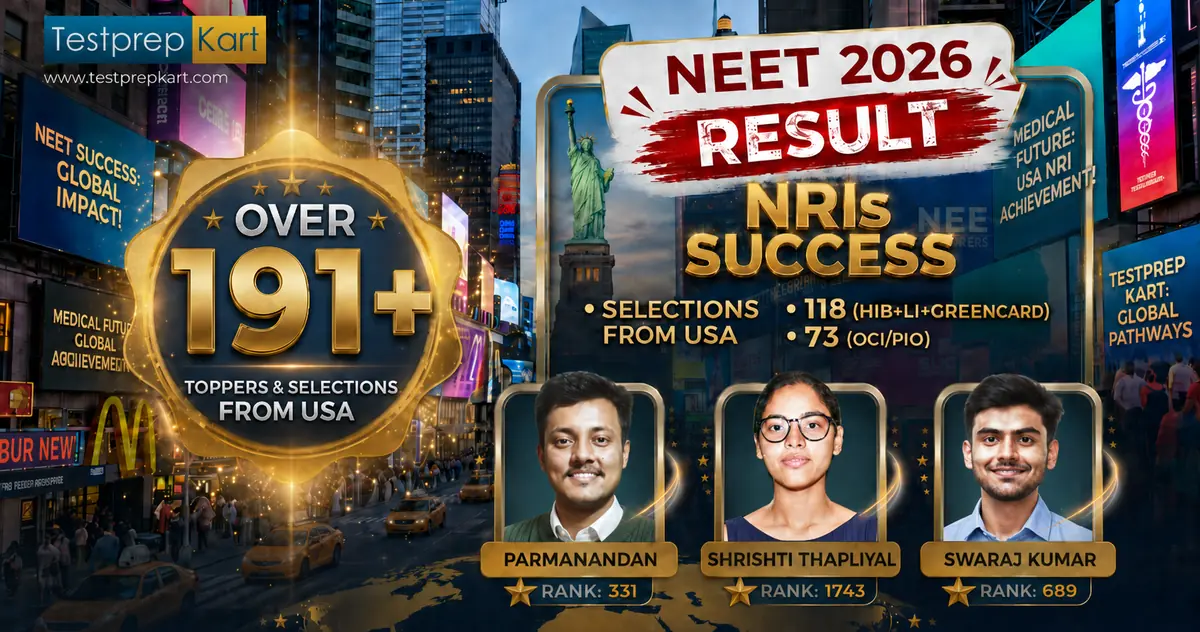
Review the 2026 result board to see student outcomes. For AIIMS planning, compare the student's actual AIR and category with the relevant AIIMS campus and the latest MCC counselling round rather than relying only on marks.
View 2026 Results
Previous-year results can provide useful preparation context, but they should not be converted directly into an AIIMS prediction. Marks-to-rank movement and AIIMS closing ranks can change significantly from one year to another.
View 2025 ResultsThis article compares two different education systems rather than claiming that one medical qualification automatically transfers into the other. The cited U.S. cost figures represent published budgets and medians; Indian fees represent named seat categories. Information reviewed: 30 October 2026.
There is no universal answer. A U.S. MD/DO route is often more direct for students committed to practicing in the USA, while Indian MBBS offers direct entry after Grade 12 for eligible NEET candidates. Costs and residency plans can change the decision.
Potentially yes, subject to NEET and the current nationality, academic, category and counselling requirements. Citizenship alone does not guarantee an NRI seat.
They may pursue the IMG route if their school and credentials meet ECFMG requirements, exams and other steps are completed, and they secure U.S. residency and licensure. It is not automatic.
They are different qualifications in different education systems. For U.S. residency, an eligible Indian MBBS graduate is generally evaluated as an international medical graduate.
NEET-UG is the Indian MBBS admission exam. MCAT is used by most U.S. MD and DO programs after premedical study. An Indian MBBS graduate seeking U.S. residency follows ECFMG/USMLE requirements rather than taking MCAT for residency.
A common path is about four years of undergraduate study, four years of medical school and a specialty-dependent residency lasting approximately three to seven years. There are exceptions and combined programs.
A typical pathway includes 4.5 years of academic MBBS training and a minimum 12-month compulsory rotating internship, followed by applicable registration.
It depends on the actual allotment category. Kerala notified ₹23,150 for its government MBBS fee in 2026, which is not an NRI quota fee; its selected private NRI fees include ₹21,65,720 and ₹22,74,006 per year. Amrita Kochi published US$225,000 total NRI tuition for 2026–27. AAMC class-of-2026 four-year MD-school cost-of-attendance medians were $297,745 public (in-state) and $408,150 private, before adding undergraduate college costs. Compare the full path, separate extras and residency plans.
Citizenship affects some visa and application circumstances, but it does not turn a graduate of an Indian medical school into a U.S. medical graduate or guarantee residency placement.
Look up the exact college in the World Directory of Medical Schools. Verify the ECFMG Sponsor Note and that the intended graduation year is included.
No. NRI quotas are college- and state-specific. Many regular government merit seats have no separate paid NRI category.
OCI students may be eligible under applicable current rules, but the exact category, counselling route and documents need verification for the admission cycle.
It is not automatic. The applicant must verify India's current rules for foreign medical qualifications, registration, examinations and any required internship or training.
Keep both possibilities in view, but check both Indian admission eligibility and U.S. IMG consequences early. Revisit the decision before paying a nonrefundable college deposit.
Copyright © 2024 CounselKart Educational Services Pvt. Ltd.. All Rights Reserved