


Hi, I’m TestprepKart.
Your Partner In Exam Preparation
Cracking the NEET exam does not depend only on Biology and Physics-Chemistry also plays a very important role. Topics like Organic and Inorganic Chemistry can significantly improve your overall score.
It is not enough to rely only on the NEET syllabus, practice tests, or sample papers. To strengthen your preparation, you should also study advanced reference books. One such highly recommended book for Inorganic Chemistry is Problems in Inorganic Chemistry for NEET by V. K. Jaiswal.
Download the Problems in Inorganic Chemistry for NEET by V. K. Jaiswal PDF (Free Download) and start improving your Chemistry performance for the NEET exam.
| Book | Resource |
| Problems In Inorganic Chemistry For NEET By VK Jaiswal PDF Free Download | Download PDF |
Problems in Inorganic Chemistry for NEET by V. K. Jaiswal is a helpful reference book for NEET students who want to improve their Inorganic Chemistry. The book is written by V. K. Jaiswal, a well-known Chemistry teacher, is specially made for the NEET exam pattern.
This book is best used along with NCERT and is especially useful for NRI students preparing for NEET from the USA or Middle East, as it provides extra practice and clarity in Inorganic Chemistry to score higher marks.

| Units | Chapters |
| Unit 1 – Periodic Table & Bonding | 1. Classification of Elements and Periodicity |
| 2. Chemical Bonding and Molecular Structure | |
| Unit 2 – Hydrogen & s-Block | 3. Hydrogen |
| 4. s-Block Elements | |
| Unit 3 – p-Block Elements | 5. p-Block Elements (Group 13-14) |
| 6. p-Block Elements (Group 15-18) | |
| Unit 4 – d- and f-Block Elements | 7. d-Block Elements |
| 8. f-Block Elements | |
| Unit 5 – Coordination Chemistry | 9. Coordination Compounds |
| Unit 6 – Metallurgy | 10. General Principles and Processes of Isolation of Elements |
| Unit 7 – Environmental Chemistry | 11. Environmental Chemistry |
Choosing a dedicated Problems in Inorganic Chemistry for NEET book helps students focus on important scoring topics like the Periodic Table, Chemical Bonding, Coordination Compounds, and p, d, f Block elements.
These books follow NCERT closely, provide many MCQs and previous year questions, explain difficult points clearly, and include short tricks and mnemonics for quick revision. This gives an advantage over students who ignore Inorganic Chemistry, even though it is a highly scoring section.
1. High Weightage in NEET:- Inorganic Chemistry contributes around 10–15 questions in NEET, so strong preparation can increase your overall score.
2. Strictly NCERT-Based:- These books are fully aligned with NCERT, covering all important facts, reactions, and details asked in NEET.
3. Easy Understanding of Tough Topics:- Difficult chapters like p-block, d-block, and coordination compounds are explained in a simple and clear way.
4. More Practice:- Includes MCQs, assertion–reason questions, and previous year NEET questions to improve speed and confidence.
5. Helpful Memory Tricks:- Mnemonics, shortcuts, and quick revision notes help students remember facts easily.
6. Saves Exam Time:- Inorganic Chemistry needs less calculation, so mastering it helps save time during the exam.
7. Gives a Competitive Advantage:- Many students avoid Inorganic Chemistry thinking it is hard. If you prepare it well, you can score higher than others.
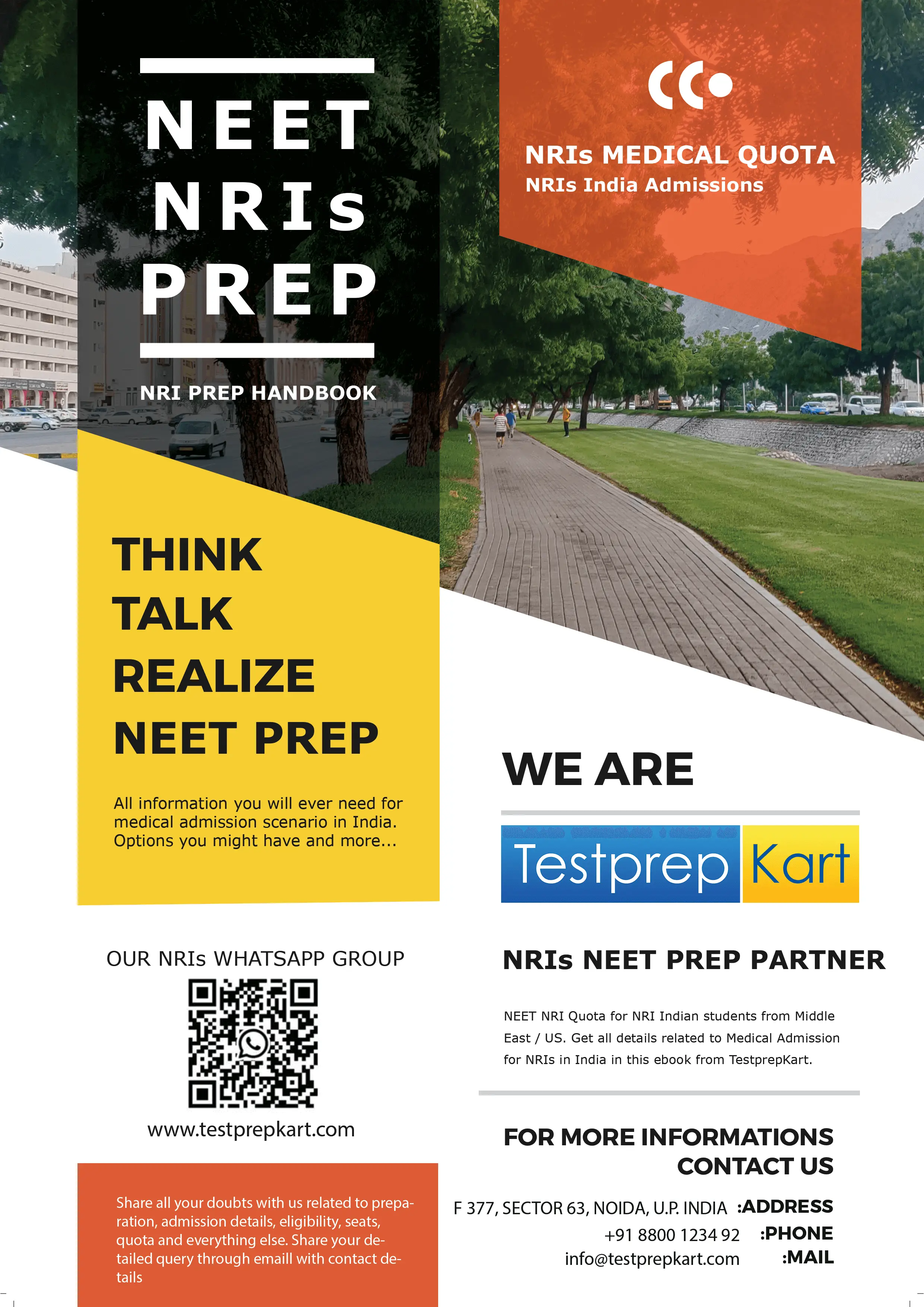
NEET NRI Preparation eBook is specially designed for the NRI students which will help students to clear some of the basic question related the NRI Quota, Preparation and others. Download the NRI NEET Prep eBook from the download button below.

| Books Name | Author | Resource |
| Physical Chemistry by O.P. Tandon | O.P. Tandon | Download PDF |
| Physical Chemistry by N. Awasthi | N. Awasthi | Download PDF |
| Concise Inorganic Chemistry by J.D. Lee | J.D. Lee | Download PDF |
| Elementary Problems in Organic Chemistry for NEET | M.S Chauhan | Download PDF |
| Books Name | Author | Resource |
| NEET Objective Physics (Volumes 1 and 2) | D.C. Pandey | Download PDF |
| MTG Objective NCERT at Your Fingertips Physics | MTG Editorial Board | Download PDF |
| Concepts Of Physics | H.C Verma | Download PDF |
| Fundamentals of Physics (1st edition) | David Halliday and Robert Resnick | Download PDF |
| Books | Author | Resource |
| NCERT textbooks class 11th and 12th biology | NCERT | Download PDF |
| Dinesh Objective Biology for | K.N. Bhatia, K. Bhatia | Download PDF |
| Pradeep’s a Text book of Biology | P.S. Dhami, Dr. G. Chopra, and Dr. H.N. Srivastava. | Download PDF |
| MTG 38 Years NEET Biology | MTG Editorial Board | Download PDF |
| Objective NCERT at your Fingertips Biology | MTG Editorial Board | Download PDF |
1. What is Problems in Inorganic Chemistry for NEET by V. K. Jaiswal?
This book is a dedicated Inorganic Chemistry practice guide created specifically for NEET aspirants. It provides NCERT-aligned multiple-choice questions and structured exercises that help students strengthen weak areas and improve exam-level accuracy.
2. Is this book useful for NEET 2025 and NEET 2026?
Yes, the book remains highly useful for NEET 2025 and NEET 2026 because it is strictly based on the NCERT syllabus, which continues to be the foundation for NEET Chemistry question papers every year.
3. Which chapters of Inorganic Chemistry are included in this book?
The book covers all major NEET Inorganic Chemistry units such as Periodic Table, Chemical Bonding, s-Block, p-Block, d-Block, f-Block, Coordination Compounds, Metallurgy and Environmental Chemistry, matching the official NEET syllabus.
4. Is this book suitable for NRI students preparing for NEET from abroad?
Yes, this book is extremely helpful for NRI students studying in the USA, Middle East, or other countries because it provides NCERT-style problem practice that is often not covered in IB, IGCSE or American curricula.
5. Can this book replace NCERT for Inorganic Chemistry preparation?
No, NCERT should always be the primary source for Inorganic Chemistry. This book should be used after studying NCERT to practice questions, revise concepts and test how well factual information has been retained.
6. How many questions from Inorganic Chemistry appear in NEET?
Inorganic Chemistry contributes around ten to fifteen questions in the NEET exam, which means a strong command over this section can significantly improve a student’s overall Chemistry score.
7. Does this book include NEET-type and previous year questions?
Yes, the book includes NEET-pattern multiple-choice questions, assertion-reason type problems, and practice sets based on previous year trends, helping students become familiar with how questions are framed in NEET.
8. Is this book helpful for difficult topics like p-block and coordination compounds?
Yes, this book is especially useful for challenging chapters such as p-block elements, d-block, f-block and coordination compounds, which often confuse students due to heavy memorization and conceptual connections.
9. Why is Inorganic Chemistry considered a high-scoring area in NEET?
Inorganic Chemistry is considered high-scoring because most questions are directly based on NCERT facts and definitions, and once learned properly, they require very little calculation, saving time during the exam.
10. How should students use this book to get the best NEET results?
Students should first study the NCERT textbook carefully and then solve problems from this book chapter-wise. This approach helps improve recall, accuracy, and confidence in answering Inorganic Chemistry questions in NEET.





Copyright © 2024 CounselKart Educational Services Pvt. Ltd.. All Rights Reserved


Post a Comment