


Hi, I’m TestprepKart.
Your Partner In Exam Preparation
Hello and welcome to the TestprepKart channel as you may already know the topic by know, we will stress on the requirement of writing NEET for NRI students, let’s see what all we are going to cover in this topic.
So, here is a detailed “requirement & Roadmap for NRI Students based in the US or Middle East etc. ” who plan to write NEET-UG and aim for MBBS admission under NRI quota. Use this as a checklist + timeline. Subscribe to TestprepKart to get the latest update on any NRI related updates and information and most importantly the NEET Preparation. Over 500+ NRI students are actively preparing for NEET with TestprepKart .

By the way also, always cross-check with the latest NEET / Medical Counselling Committee (MCC) / state rules, because regulations change.
When students are studying under a US curriculum (or IB, A-Level, or any foreign board), certain additional conditions and equivalencies come into play.
Nationality Status:
Understanding your citizenship status is the first and most important step before registering for NEET or applying for MBBS under the NRI quota.
You must belong to one of the NRI, OCI or PIO categories to be eligible for NEET under the NRI or equivalent quota. Let me try and give you an example of each one for better clarity.
| Category | Explanation |
| NRI (Non-Resident Indian) | An Indian citizen residing abroad for employment, education, business, or other purposes for more than 183 days in a financial year. |
| OCI (Overseas Citizen of India) | A foreign citizen of Indian origin who holds an OCI card issued by the Government of India. |
| PIO (Person of Indian Origin) | A foreign citizen (other than of Pakistan or Bangladesh origin) whose parents or grandparents were Indian citizens. This category has now been merged with the OCI category. |
1. Let’s understand the NRI category – An Indian citizen residing abroad for employment, education, business, or other purposes for more than 183 days in a financial year.
Example suited in this condition can be a student born to Indian parents working in the USA, UAE, Singapore, etc. Such students often hold Indian passports but live overseas. This category we are calling as NRI category.
2. Now let’s understand about the OCI (Overseas Citizen of India) category. OCI is a foreign citizen who is of Indian origin and holds an OCI card issued by the Government of India.
An example of this condition can be a student, let’s say he/she was born in the US to Indian-origin parents who holds a US passport and an OCI card. Such candidates will come into the OCI category. I hope this is clear. Do comment in the comment section below in case you have doubt, we will reply back to you with clarity. Now quickly move on to the 3rd one which is the PIO category.
3. PIO category was previously a standalone category but now it is merged with the OCI category. Let’s understand this – Let’s say A foreign citizen (other than Pakistan or Bangladesh origin) who, or whose parents/grandparents, were Indian citizens under the Constitution of India is called PIO category candidate. For this category example would be a US citizen of Indian heritage without an Indian passport but with proof of Indian ancestry. If you can prove an Indian ancestry, you will be categorised as a PIO candidate.
So, if you belong to any of these categories I just explained, you are eligible for NEET in terms of Nationality Status.
Age Status:
This criteria is simple and straightforward – The candidate should be of minimum 17 years of age by 31st December of the admission year. There is no upper age limit for the student in case of NEET age eligibility.
Educational Qualification:
Now, this one is super important and complex in a few cases. Let’s understand the requirement first and then evaluate how NRIs will be able to comply with it if they are from a different curriculum.
| Criteria | Explanation |
| Class / Grade Requirement | Must complete Grade 12 (10+2) before admission, results can be updated later. |
| Subject Requirement | Must study PCM/Biotechnology & English in Grades 11 & 12. |
1. First one is class / grade requirement – So, the basic requirement is that the student should have completed 10+2, for 12th grade your result can be updated later by the time of admission if that is not available at the time of writing NEET paper.
2. Subject requirement is the second thing that you need to comply with – students need to have 3 science subjects in grade 11th and 12th which are Physics, Chemistry and you can choose among Biology or Biotechnology plus English. This is mandatory for NEET eligibility. Now, this is easy for students in India ofcourse and also kind of sorted for majorit y of the students in middle eastern countries like UAE, Oman, Qatar, Saudi Arabia etc. as many Indian schools are there which are CBSE affiliated. So, no issues there.
But this becomes are challenge for NRI students from the US or students who are from the different boards like IB, A Levels or American.
So, basically we are taking about 2 major challenges for NRI students:
| Challenge | Explanation |
| Subject Eligibility | Many NRI students from IB, A-Level, or US boards can’t take all three science subjects needed for NEET. |
| Equivalency Certificate | Students from foreign boards need an AIU certificate to match India’s 10+2 standard. |
Solutions for both of these problems are already worked on by TestprepKart and it is explained in detail. we leave a link in below for you to download our NEET NRI eBook to go over it and a video link which covers this topic extensively.

Minimum Marks / Score Requirement:
So, meeting academic eligibility is just as important as qualifying NEET itself. For NRI students coming from the US, IB, or other international curriculum, the rules can seem confusing due to differences in grading systems and subject combinations — but let’s simplify it.
| Minimum Marks Requirement | Students must have at least 50% aggregate in Physics, Chemistry, and Biology in Grade 12, as per NMC. Some colleges may ask for 60%. |
| For International Boards | Students pursuing American High School Diploma, IB, or A-Level must convert their grades to Indian percentage format through an AIU (Association of Indian Universities) Equivalency Certificate. |
| AIU Grade Conversion | The AIU certificate translates GPA or letter grades (e.g., A = 85–90%, B = 70–79%) into Indian percentage equivalents. |
Primarily you need to have 50% aggregate in Physics, Chemistry and Biology in your grade 12th. Many portals mention the minimum score should be 60% which is not true. Official score requirements as per the NMC for NEET is 50% only. A 60% score is required by few colleges only when NRIs are targeting them, this is an individual college specific policy. This is not the NEET score eligibility requirement
Let me know talk about a little bit about students pursuing American High School Diploma, International Baccalaureate (IB), or Cambridge (A-Level) — here’s what you must ensure to comply with your Grade / Marks Conversion
Since most US or international boards follow a GPA or letter-grade system (A, B, C, etc.), you must obtain an equivalency certificate stating your marks percentage equivalent to the Indian 10+2 system. The AIU which is (Association of Indian Universities) is the official authority for issuing equivalence certificates. We have covered this in our ebook and you can download it from the description link.
The AIU certificate typically converts your grades to Indian percentage equivalents (for instance, A = 85–90%, B = 70–79%, etc.). Without this document, Indian universities and NEET authorities may not recognize your foreign transcript. So, this is super important.
Document Requirement:
You as a student or as a parent both should have the list of documents which will be required. Download checklist PDF is available for download.
| Point | Explanation |
| NEET Qualification | NRI or foreign students must qualify NEET-UG like Indian students to apply under the NRI Quota (AIQ). |
| Extra Requirements | Some states or colleges may ask for domicile, NRI proof, or sponsorship documents. |
| State / College Rules | A few states may not offer NRI quota in government colleges — always check rules before applying. |
Important Notes / Caveats:
Read More For Complete NRI NEET Document Required

So, to get admission in medical college you must write NEET and also qualify for NRI quota cut off and your admission will be done on merit basis. Let’s understand how much you should score to qualify for NEET now. Before we know the NRI Quota cut off let’s understand what is it for Indian students so get the perspective right.
As of recent years:
| Category | Qualifying Percentile |
| General / EWS | 50th percentile qualifies for NEET counseling (college allotment depends on score and category). |
| SC / ST / OBC | 40th percentile required for NEET qualification. |
| PwD (General Category) | 45th percentile required to qualify NEET. |
Now lets understand this percentile with an example of the actual score of NEET 2024. In NEET 2024 the cut off marks were 164 out of 720. So to be on a safer side you should try and keep your score above 200 minimum to safeguard your chances.
Now, let’s talk about the NRI Quota specific cutoffs.
| Point | Explanation |
| Seat Allocation | NRI seats are given by merit after NEET, based on state or college rules. |
| Competition | NRIs compete only with NRI students, making it fair. |
| Cutoff Trend | Some got seats with 167/720, but it varies by college. |
| Target Score | Aim for 300+ to increase admission chances. |
| Tip | Don’t depend on low cutoffs — score higher for better options. |
Last year itself we at TestprepKart succeeded in getting 200+ NEET NRI results with an average score of 490+ and highest being 670. If you wish to know your NEET potential, schedule your free NEET analysis session with TestprepKart which will help you know your potential for NEET exam, time needed for you to prepare and many more.
Coming back to the topic, trends show that scoring above 300+ will improve your chances of getting preferred college under NRI quota in your desired state.
If you wish to explore cutoffs for NEET 2025 – We have compiled them all for Admission Round 1, round 2 and 3 PDFs and they are available in the description below for you to download.
So, in my opinion you should not rely too much on very low cutoffs — in sought-after colleges, competition can push the effective required scores much higher. And therefore, your target score should be well above the minimum cutoff.
Read More About NEET NRI Cut-off 2025
So, there are few key dates and deadlines which you should know in advance and plan your preparation early. Let me try and give you a month wise breakdown of NEET events. The actual dates vary year to year, so always refer to the official NEET / NTA / MCC announcements. For this year We have included the NEET official brochure in the below. This description section is actually playing an important role here I guess.

| Stage / Event | Explanation |
| Information Bulletin Release | NEET brochure released in Jan–Feb with syllabus and exam details. |
| Last Date for Application | Deadline in March to complete registration, uploads and payment. |
| Admit Card Download | Available two weeks before exam on NTA portal. |
| NEET Exam Date | Held in May. Check the official schedule for exact date. |
| Answer Key and Result | Released in June with scores and ranks. |
| Counseling and Seat Allotment | Conducted by MCC in July through the MCC portal. |
| College Reporting and Classes | MBBS or BDS classes start in Aug–Sep depending on the college. |
| Tip for NRI Students | Keep extra time for documents and embassy verification. |
So, the first stage is “Announcement of NEET UG / Information Bulletin” – This is officially released by NTA authority and this will help you immensely as it would include all required information that you are looking for. This generally gets released in the month of January or February. This bulletin will include information like eligibility criteria, NEET syllabus, exam dates and more.
The second stage is “Last Date for NEET Application”. Before this date you should submit your NEET application, if you miss the deadline, you will not be able to write a NEET paper for this particular year. This generally gets over by late March every year. It will involve your NEET application completion, documents upload process and NEET exam registration fee. This will set you for your upcoming NEET exam.
Now, as you are done with the NEET Application registration process, it’s time now for you to download your NEET Admit Card – without this admit card, you will not be allowed to write NEET paper. So, admit cards can be downloaded 2 weeks before the exam date. This NEET admit card can be downloaded from your NTA portal where you created your application.
Now, comes the exam day – NEET exam generally happens in the first week of May or it can happen in the 2nd week of May also. So, this depends on the NEET brochure of the particular year.
So, this also brings my attention to the NEET Exam centers for the students in the USA who are afraid of travelling out and for the students in the Middle East. Please connect with us for this topic and we will share an update on this with you as this is a topic in itself.
Now, when you have given the NEET exam, the exam result and answer key is likely to be released in the month of June. When you can tally your score and expected to get your NEET Rank and Marks also if the result is announced.
Next is – The counseling and seat allotment process – This will happen in the month of July. Soon after the result within a week MCC will release the counselling and seat allotment date. Remember that you need to register separately on the MCC portal for getting admission in your preferred college. Previously you registered on NTA portal for writing NEET but now you need to register on MCC portal for getting admission in medical college based on your NEET scorecard.
So, as soon as this counseling process get done, you will be allotted your college and your MBBS / BDS classes will start from August or September depending on the college.
So, this was all about the timeline that you need to keep in mind. Do check if you have overlapping exams coming over so that you can prepare a plan or get our help in managing it.
Be extra cautious here because NRIs candidates may have to coordinate cross-border documentation (e.g. embassy certificates), it’s vital to build buffer time for those processes.
Read More About NEET Important Dates And Deadlines

Now, for NRI students from the US the exam preparation will have some potential challenges which you are likely to face soon. First is NEET syllabus mapping with your ongoing curriculum, competitive environment when it is compared with Indian students. Your preparation will have some unique constraints which is what we will try to help you manage it. For US students at the end of this topic included some important preparation tips.
| Stage / Time Before Exam | Strategy Overview |
| 18–24 Months | Start early with PCM. Build conceptual clarity. Take IB/AP/Honours science courses if possible. Join TestprepKart Foundation Course in Grade 10–11. |
| 12–18 Months | Begin full syllabus coverage. Identify weak areas through topic-wise tests. Use an integrated approach across all three subjects. |
| 6–12 Months | Practice full-length mock tests and previous NEET papers. Focus on speed, accuracy, and time management. Access free material from TestprepKart NEET section. |
| 3–6 Months | Intensify revision. Attempt frequent mocks. Analyze mistakes and improve exam stamina under timed conditions. |
| 1 Month | Focus on final revision, formula sheets, light mock practice, and rest strategy. Avoid new topics. |
| Last 2 Weeks | Keep revision light, stay calm, ensure exam logistics and document readiness. |
First of all – Those who are watching this video and are in grade 10th should start focusing on NEET information right away, this will help you start your preparation immediately as soon as you get into grade 11th. To build your NEET foundation, students can also join TestprepKart NEET foundation course in grade 10th itself, this will bridge the curriculum gap as we discussed.
For now let’s start with our first timestamp
Which is 18 to 24 month before the exam – This is an Ideal time to start your NEET preparation. Where you begin your deep study of Physics, Chemistry, Biology as per the NEET syllabus. Build a strong conceptual foundation. If still in US high school, take IB / AP / honors science courses. Testprepkart can also help you by preparing for NEET with guaranteed success.
Second – 12 to 18 months before the exam – Initiate comprehensive syllabus coverage, including topic-specific assessments to pinpoint areas for improvement. Implement an integrated study approach covering physics, chemistry, and biology.
Third – 6 to 12 months before the exam – To improve your performance, concentrate on increasing practice with full-length mock tests, timed exercises, and past year NEET papers. This will help enhance both your speed and accuracy. Interestingly most of the free material is already available on TestprepKart NEET section.
Fourth – 3 to 6 months before the exam – Intensify your revision. Frequent mock tests. Review mistake logs and take full NEET-format tests under exam conditions.
Fifth – 1 month before the exam – It’s time for your final revision, formula sheets, small mocks, rest strategy. Avoid learning new heavy topics and just focus on consolidation.
Sixth and the last one is – last 2 weeks before the exam – There should be a light revision only, relax, ensure exam logistics (travel, documents, rest).
Great, so We completed the broad timeline of your NEET preparation and now some tips for a US-based NRI student for their NEET preparation.

| Competition Type | Explanation |
| First Competition | NRI quota seats are limited but competition is high — over 5000+ Middle East students appear for NEET under this quota every year. |
| Second Competition | In private and deemed colleges, NRI seats are highly sought-after with higher cutoffs. TestprepKart students solve 7000+ questions through consistent daily practice — consistency is key. |
| Third Competition | Some states have few or no NRI seats in government colleges. In such cases, students must compete with Indian applicants, so aim for higher scores. |
First – Let’s understand it, while NRI quota seats may have relatively fewer applicants compared to the general pool, you are still competing with other NRIs worldwide who are targeting the same colleges and seats.This figure may look small, but trust us it is huge. There are approximately 5000+ students alone from the middle east who will be writing NEET under NRI quota, we have been actively preparing NRI students worldwide so we can say this number is more than you expect it to be.
Second – In some prestigious private or deemed colleges, NRI seats are highly sought-after, pushing the required cutoff high so, do not benchmark low cut off scores as your target score. On an average TestprepKart NEET NRI student gets to solve approximately 7000 questions before they write NEET. This may sound huge but on an average daily basis they solve just 15 to 20 question. Which if they will do, will be able to solve more than 7000 questions. So, this is all about being in a system and our system is adaptive to students’ engagement that at the end they end up being prepared for NEET in any case. So, consistency is the key!
Third – Some states may offer few or no NRI quota seats in government colleges, making competition in private / deemed colleges tougher. This means in cases where you do not have access to NRI quota – You will have to compete with Indian students only. NRI quota cut off will not help you, therefore right from the beginning keep your target cut offs higher.
So, the strategy should be to aim high, not just cross minimal thresholds. This brings me to my 6th section of this video which is

Now trust me this is again a tutorial in itself. I have my video available on this topic in detail and it is approximately 20 minutes long, So, I see less value in repeating it again here. But, since we are talking about the process. Let me go over the steps involved quickly and for details you already know where you will find it.
| Step | Explanation |
| Counselling Registration | Register on the MCC website to participate in NEET-UG counselling and receive updates. |
| Merit List & Seat Allotment | An NRI-specific merit list is prepared. Seats are allotted based on NEET rank and college preferences. |
| Document Verification | Submit passport, visa, NRI certificate, embassy letter, sponsor documents, and proof of relationship for validation. |
| Fee & Seat Confirmation | Pay the NRI category fee within the deadline to confirm your seat, or it may be cancelled. |
| College Admission | Report to the allotted medical college and begin your MBBS program like any other student. |
First is the Counselling Registration process – Register on MCC website and get further updates.
Second – Merit List & Seat Allotment – An NRI-specific merit list is drawn among all NRI applicants. Based on your NEET rank (or score) and preference of colleges, seats are allotted.
Third – Document Verification & Proof of NRI Status – You must submit valid documents: passport, visa, sponsor documents, proof of relationship (blood relation), NRI certificate, embassy certificate, etc.
Fourth – Fee Payment / Seat Confirmation- Once verified, you pay the prescribed NRI fee (which is usually much higher) and confirm the seat. Failure to do so in time may lead to cancellation.
Fifth – Join the Medical College – After admission, you begin your MBBS program. Note that once admitted, you are treated like any other student in terms of academics, exams, etc.
Finally I’m happy to reach my last step which is
Read More About Complete Medical Admission Process For NRI Students
Based on our prior experience I would like to share a few points with you that you should keep in mind.
| Point | Explanation |
| 1. Equivalence & Credential Recognition | Get your AIU equivalence certificate early to ensure your foreign school marks are valid in India. |
| 2. Documentary Delays | Start embassy and NRI document verification early — it may take weeks or months. |
| 3. State / College Selection | Check state-wise NRI policies — some states allow NRI quota, others don’t. |
| 4. Financial Planning | Plan ahead for tuition, travel, accommodation, and documentation expenses. |
| 5. Backup Options | Keep alternative study plans ready like medical schools abroad or related programs. |
| 6. Stay Updated | Regularly follow NEET, MCC, and state websites for new notifications or rule changes. |
| 7. Health & Logistics | Prepare early for travel, visa, hostel, and medical fitness requirements. |
First is – Equivalence & Credential Recognition: Ensure your foreign high school / board certificates will be accepted by Indian institutions; get equivalence from AIU early. If you do not know about it, get in touch with us as soon as possible.
Second – Plan for Documentary Delays: Embassy / consulate certification, proof of NRI status, sponsor documents, etc., can take time — start at least months in advance.
Third – Choose Your States or Preferred Colleges: Some states have more liberal policies for NRI quotas; some don’t allow at all. Research state-wise rules.
Fourth – Financial Planning: Along with the tuition fee also budget for travel, lodging, documentation costs.
Health & Logistics: Consider migration, hostel, travel, visa, medical fitness, etc., well in advance.
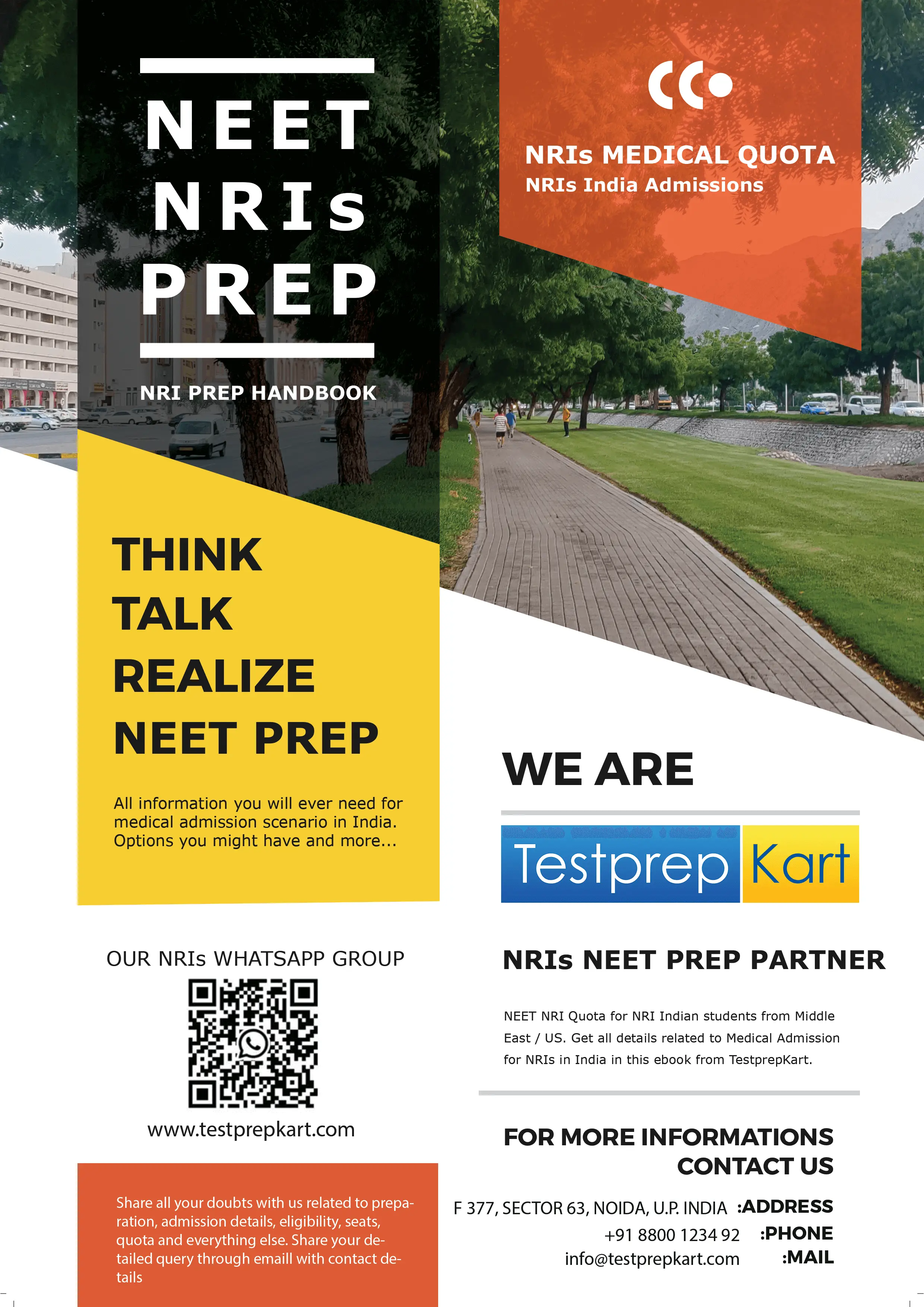
NEET NRI Preparation eBook is specially designed to the NRI Students. It helps answer more questions related to the NRI quota, preparation tips, eligibility, foreign curriculum management and more. Click the button below to download.







Copyright © 2024 CounselKart Educational Services Pvt. Ltd.. All Rights Reserved

Post a Comment