Domicile rules influence state quotas, eligibility, and counseling pathways. The content below explains whether a domicile certificate is required, why domicile matters, how NRIs can prove domicile, and a structured format for domicile certificates. It also provides a state-wise framework for the 2025 NEET UG cycle and practical steps to verify information with official sources. TestprepKart supports US/UAE time zones with live guidance and dedicated admissions assistance to help NRIs plan and execute effectively.
Is a Domicile Certificate Required for the NEET Application?
Purpose and scope. A domicile certificate is a government-issued document that proves physical or permanent ties to a specific state. In NEET, domicile proofs may influence state quotas, reservations, and eligibility for certain seats. The necessity varies by state and by the candidate’s status (resident Indian vs. NRI). Some states require domicile proofs even for NRIs under certain quotas, while others accept alternative proofs if actual residency is not possible.
NRIs and domicile basics. For NRIs, domicile status is often interpreted through parental or family ties to a state where admissions will be allocated. The interpretations and acceptance of documents differ across states; what works for one state may not be acceptable in another. Always verify with the state medical education board and counseling portal for the current cycle.
Official guidance and exceptions. Many states publish specific disclaimers about documents required for NRIs and non-resident students. In some cases, NEET eligibility can be determined by the candidate’s actual state of schooling, last residence, or parent’s domicile, rather than the student’s own domicile. There are exceptions and exemptions that may apply during counseling and seat allotment.
What you’ll learn. By the end of this section, you’ll know whether a domicile certificate is mandatory in your case, what alternative proofs may be accepted, and how to prepare a robust set of documents in advance.
What you’ll learn in this section: When a domicile certificate is mandatory, how to assess your NRI status, and how to prepare alternative evidence if needed. We’ll also note typical timelines and verification steps to prevent last‑minute surprises.
Why NEET Domicile Criteria Important
State quotas and eligibility. Domicile status directly affects eligibility for state quotas, management seats, and reservation categories. NRIs should plan early to understand which states provide domicile-based seats and how those seats are allocated in the counseling process.
Fees and funding implications. In some states, domicile status can influence tuition fees, scholarships, and financial aid. NRIs may encounter different fee structures for state quota seats versus all-India or private seats across states.
Counseling and application strategy. Domicile determines the sequence of counseling rounds, the visibility of state portals, and the likelihood of securing a seat within preferred channels. A clear domicile plan can reduce confusion during choice filling and verification.
What readers gain. A practical, proactive plan to align domicile status with NEET goals—reducing last‑minute stress and improving the odds of admission under the best-fit state quotas for NRIs.
Note: Domicile rules are state-specific and can change. We will highlight typical patterns, provide verification steps, and offer guidance on how to navigate possible changes across cycles. Always cross-check with the latest official notifications before decisions.
Proving Domicile For NEET By NRIs
Common proof categories. NRIs often rely on documents that demonstrate ties to a state, such as parental residence, schooling location, state of issue on passports, visa details, local lease or ownership proofs, utility bills, and school transfer records. States may prefer a combination of proofs to establish domicile.
Step-by-step evidence compilation. Create a reusable checklist:
(a) verify the state to be claimed;
(b) collect domicile-related documents;
(c) obtain translations (if required);
(d) ensure dates align with admission cycles;
(e) maintain consistent spellings across documents.
Presentation of proof. Present the evidence coherently in NEET forms or counseling portals. Organization matters: use a single file or clearly linked set of documents with an index for easy verification.
Verification and challenges. Authorities may verify documents through portals or sampling checks. Common challenges include inconsistencies in spellings, mismatched addresses, or timing gaps between proofs. Prepare explanations and supporting documents to address these gaps.
What readers gain. A concrete, step-by-step plan to assemble domicile evidence tailored for NRIs, with a timeline aligned to NEET cycles and state counseling dates.
Practical note: While NRIs use multi-national documents, emphasis remains on state-aligned evidence and consistency across official records. This section provides examples, a reusable checklist, and practical timing to minimize errors and strengthen credibility during verification.
NEET Domicile Certificate Format
The certificate format section presents the core fields typically required on a NEET-relevant domicile certificate. It’s designed for readability and quick reference when you prepare documents. Use the table as a checklist while commissioning or collecting the certificate from the issuing authority.
Field
Details / Examples
Notes
Certificate Type
Domicile Certificate (for NEET / State Quota)
State-specific naming may vary; confirm exact nomenclature.
Issuing Authority
State Revenue / Tehsildar / Deputy Commissioner or equivalent
Ensure jurisdiction matches the domicile state claimed.
Applicant
NRIs: Child’s name (as in NEET form) with parent’s residence details
Consistency with passport and school records is crucial.
Residence Proof
Address, duration of stay, country of residence
May require utility bills, lease deeds, or school address proofs.
Validity
Typically valid for a set period or cycle; verify cycle validity
Documentation validity can be tied to admission cycle dates.
Language
State official language or English translation if required
Translation requirements vary by state.
Notarization / Attestation
Notarized copies or attested true copies may be required
Check state-specific attestation norms.
What you’ll learn in this section: The exact fields and validations that typically appear on a NEET-relevant domicile certificate. We’ll provide a ready-to-use template and a checklist to ensure all required data is present and correctly formatted.
State Wise NEET Domicile Criteria 2025
This comprehensive guide compiles the state-wise NEET domicile criteria for NRIs (US/UAE/GCC time zones) for the 2025 admission cycle. It draws from official counselling frameworks and user-provided details, and it’s designed to help families plan domicile proofs, understand quota allocations, and navigate state-level counselling. Remember: state rules can change per cycle; always verify on the official portal before finalizing applications.
Andaman and Nicobar
Must be a domicile holder of this Union Territory for state quota MBBS/BDS admission.
Andhra Pradesh
Seats: 85% local, 15% unreserved.
Local areas:
AU area: Srikakulam, Vizianagaram, Visakhapatnam, East Godavari, West Godavari, Krishna, Guntur, Prakasam.
Local candidates can compete for both 85% local and 15% unreserved seats.
Non-local candidates: only eligible for 15% unreserved seats.
Arunachal Pradesh
85% state quota eligibility:
80% seats reserved for APST.
20% seats for Non-APST, including: Children of State/Central Govt./PSU employees; Those who lived in Arunachal Pradesh for at least 3 years and passed Class 12 from a school in the state.
Assam
Family must have resided in Assam for over 20 consecutive years.
Candidate must have studied from Class 7 to 12 in any recognized school in Assam.
Bihar
Parent resident of Bihar or settled as a refugee there.
Parent from another state but employed by Bihar Govt.
Parents employed before Jharkhand’s formation with transferable service between Bihar/Jharkhand.
Parent is employee of State Govt., Central Govt., or PSU residing in Bihar.
Chhattisgarh
Born in Chhattisgarh or holding domicile.
Completed Class 12 from Chhattisgarh Board or any board recognized by the state.
Parent is employee of Central Govt. or Chhattisgarh Govt. residing in the state.
Delhi
Completed Class 12 in a Delhi-NCR school affiliated with CBSE, ICSE, or JMI boards.
Goa
Resided in Goa for at least 10 years.
If parent/grandparent born in Goa: must show 5 years consecutive residence.
Must have passed higher secondary from Goa-recognized school board.
Gujarat
Must be Indian/OCI.
Born in or holding domicile in Gujarat.
Completed Class 10 and 12 from any of 5 boards (Gujarat Board, CBSE, CISCE, ISB, NIOS) with schools in Gujarat.
Parent in All India Services/Gujarat Govt./Defense with Gujarat domicile but posted outside are eligible.
Candidates born outside Gujarat but with Class 10 and 12 in Gujarat need domicile proof.
UTs of Dadra, Nagar Haveli, Daman & Diu exempt from domicile proof.
Students of JNVs up to Std. 8 and Std. 12 in/outside Gujarat are eligible.
Haryana
Must have lived in Haryana for at least 10 years.
Completed Class 12 from a recognized school in Haryana.
Parents must be bonafide residents of Haryana.
Jharkhand
Local/permanent residents with certificates from competent authority.
Domicile holders who completed Class 12 from Jharkhand Board.
Karnataka
Completed Class 12 in Karnataka school affiliated with state/Central Govt.
Minimum 7 years residence, or studied in Karnataka with one parent residing there 7 years.
Must know Kannada, Tulu, or Kodava.
Candidates from disputed Kannada-speaking areas must pass Kannada Language Test.
Children of Defense Personnel with 1+ year service get special provisions.
Kerala
Keralite: Full reservation and fee concessions.
Non-Keralite I (NK-I): Studied in Kerala; Parents working with Govt. of India or Kerala; Resided in Kerala during study.
Non-Keralite II (NK-II): Open quota only for management seats in private self-financing colleges.
Madhya Pradesh
Must be legal resident of MP.
Also eligible: Children of Freedom Fighters; Dependents of Defense Personnel; Children of Govt. of India employees posted in MP.
Maharashtra
Five candidature types:
Type A: Class 10 and 12 in Maharashtra; 10+ years residence/domicile or birth certificate.
Type B: Class 10 and 12 in Maharashtra; Parent holds Maharashtra domicile.
Type C: Class 10 and 12 in Maharashtra; Parent is Central Govt./Undertaking employee stationed in Maharashtra.
Type D: Class 10 and 12 in Maharashtra; Parent is Maharashtra Govt./Undertaking employee.
Type E: Class 10 and 12 from school on Maharashtra-Karnataka border; Mother tongue Marathi.
Manipur
Must be permanent resident/domicile of Manipur.
Meghalaya
Permanent resident of any of 8 NE states.
Or completed Class 11 and 12 in Meghalaya-recognized school.
Mizoram
Indian national and permanent resident/domicile of Mizoram.
Odisha
Permanent resident of Odisha.
Or child of All India Civil Services officer in Odisha cadre.
Puducherry
Indian National.
Must meet one:
Candidate/parent/guardian resided in Puducherry for 5+ years.
Completed SSLC/HSC after 5 years continuous study in recognized Puducherry school.
Child of native of Puducherry with declared hometown, Nativity Certificate.
Children of Govt./Defense/PSU employees served 3+ years in Puducherry.
Punjab
Legitimate resident.
Exceptions: Parents in Central Govt., Punjab Govt., All India Services.
Dependents of deceased Central Govt. employees posted in Punjab for 2/3 years before Class XII.
Children of deceased Defense/Para Military Personnel born in Punjab.
Defense personnel stationed in Punjab.
NRIs and Minority quota also eligible for state quota.
Rajasthan
Must meet one:
Certified resident of Rajasthan.
Parents resided 10+ years, candidate studied Class 8–12 in Rajasthan.
Parents serving/retired Rajasthan Govt. employees with 3+ years service at registration.
Child of serving/retired Defense/Para-Military personnel originating from Rajasthan.
Child of serving permanent Defense Personnel posted in Rajasthan.
Child of Rajasthan High Court Judge without similar benefit in other states.
NRIs and Minority quota also eligible for state quota.
Tamil Nadu
Bona fide resident of TN.
Class 6–12 schooling in TN with Nativity Certificate (parent’s ration card, birth certificate, SSLC/10/12 certificate, or no-graduate certificate if illiterate).
Students domiciled in TN but studied outside must submit parent’s documents.
Must confirm not applying as native of another state.
NRI/PIO under management quota only.
Other-state students studying Class 6–12 in TN considered open category.
Non-local: 7+ years residence/study in Telangana, or parents/spouse meeting similar residence/service criteria.
Tripura
Permanent resident with 10+ years parent residence.
Parents in All India Services posted outside Tripura or employed by Tripura Govt.
Not permanent residents but parent employed by Tripura Govt. for 3+ years.
Passed Class 12 in Tripura with parent/grandparent who served Tripura Govt. for 5+ years.
Children of Army/Defense personnel posted in Tripura 5+ years.
Uttarakhand
Must meet one:
Permanent resident, Class 10 and 12 in Uttarakhand.
Class 10 and 12 in Uttarakhand (non-residents get no reservation).
Permanent resident with Class 10 and 12 outside state still eligible.
Uttar Pradesh
Native of UP with father resident in UP.
Parent resided in UP 3+ years.
Parent employed by Govt. of India.
Class 10 and 12 in UP need no domicile certificate.
Class 10 or 12 in UP requires proof of parent UP residency.
West Bengal
Must meet one:
Proforma A1: Resided continuously in WB 10+ years.
Proforma A2: Passed Class 12 from WB and lived 10+ years.
Proforma B: Parents permanent residents with 10+ years residence.
Must produce domicile certificate (Proforma A1, A2, B or e-district portal) signed by authorized officers.
Must show two original ID proofs with WB address for verification.
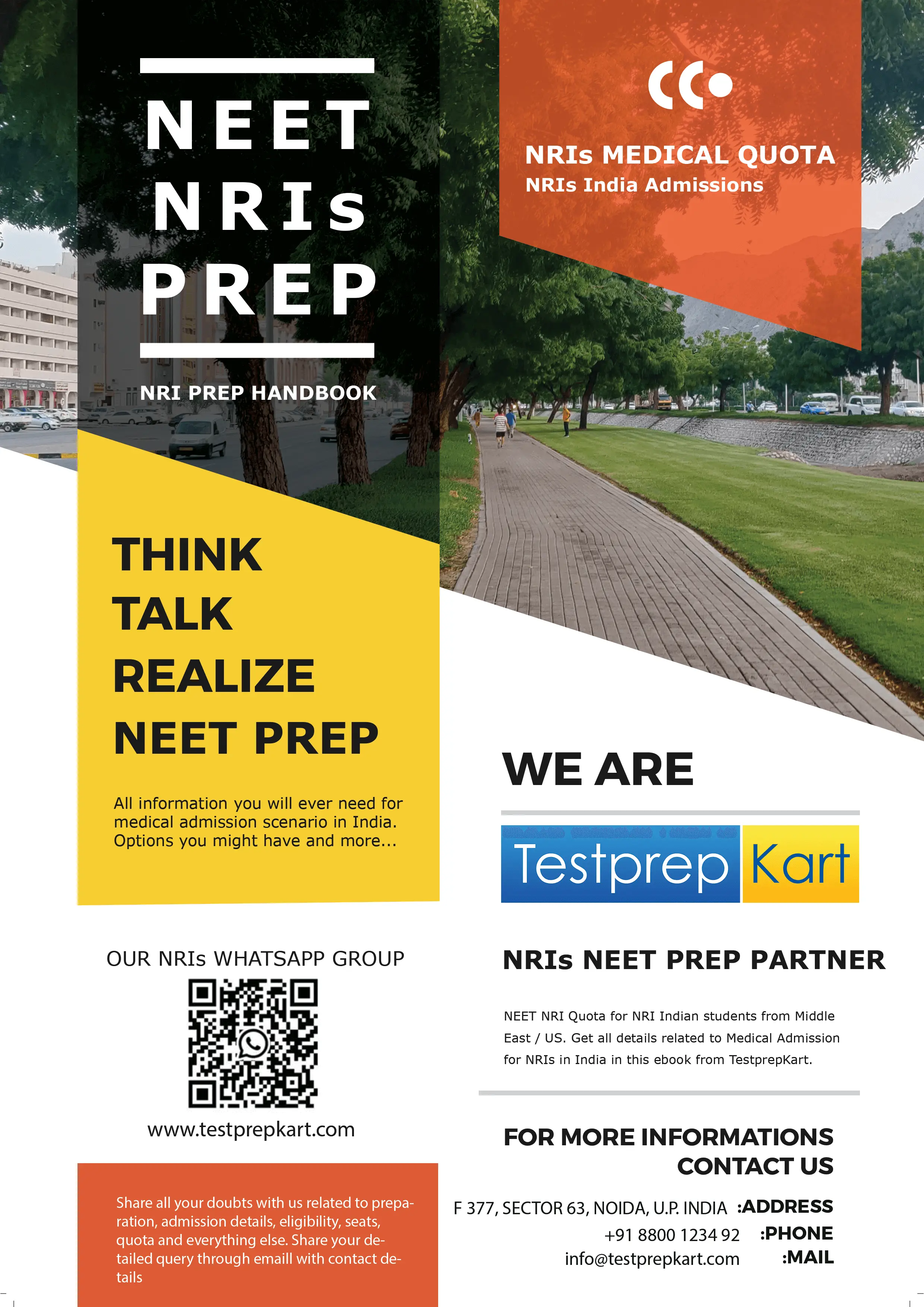
Download NEET NRI Prep eBook
NEET NRI Preparation eBook is specially designed for the NRI students which will help students to clear some of the basic question related the NRI Quota, Preparation and others. Download the NRI NEET Prep eBook from the download button below.
1. What is the NEET domicile requirement for NRI students? NRI students are required to provide proof of their NRI status and meet the domicile criteria set by the respective state or central authorities. This includes a passport, visa, or residence certificate showing that the student or their parent/legal guardian has been living abroad.
2. Can an NRI student claim domicile in India for NEET purposes? Yes, under certain conditions. If the student’s parent or guardian is an Indian citizen residing abroad, and the student has an Indian passport or OCI/PIO card, they may be eligible for the NRI quota. Each state may have slightly different requirements, so verification from the state authority is necessary.
3. What documents are required to prove NRI domicile for NEET? Commonly accepted documents include:
Passport of the student or parent/guardian
Visa/residence permit of the parent/guardian
OCI or PIO card (if applicable)
Proof of income abroad or employment certificate Some states may require additional affidavits confirming residency status.
4. Is there a difference between All India Quota (AIQ) and state domicile quota for NRIs? Yes. NRI students can apply under the All India Quota (AIQ) or the state quota, depending on the college.
AIQ NRI seats are available nationwide and often have higher fees.
State quota NRI seats may require the student to satisfy specific domicile rules for that state.
5. Can NRI students appear for NEET from abroad? No. All NRI students must appear for NEET in India at designated centers. However, registration and document verification for the NRI quota can be done from abroad, provided all domicile proofs and eligibility documents are submitted before the deadlines.












Post a Comment