


Hi, I’m TestprepKart.
Your Partner In Exam Preparation

NRI, OCI and foreign-national students can apply for NEET UG 2026, but nationality is only one part of the eligibility check. Students must also meet the minimum-age requirement, complete a recognised Class 12 or equivalent qualification with the required science subjects and English, provide evidence of practical coursework where needed, qualify NEET and follow the rules of the counselling authority handling their admission.
Parents should understand that being eligible to appear for NEET and being eligible for an NRI quota seat are two separate matters. A student may meet the academic requirements for NEET but still need additional proof of citizenship, overseas residence, sponsorship, family relationship, embassy certification or legal guardianship before the NRI category is approved during MCC or state counselling.
NRI, OCI and foreign-national candidates can appear for NEET UG 2026. The student must turn 17 on or before December 31, 2026, complete Physics, Chemistry, Biology or Biotechnology and English through a recognised Class 12 or equivalent course, satisfy the applicable marks and practical requirements, and qualify NEET. Eligibility for an NRI quota seat is examined separately during counselling.
Before starting the application, overseas students and parents should check both the standard NEET requirements and the additional documents that may be needed during MBBS counselling. The table below brings the main points together in one place.
| Eligibility Point | NEET UG 2026 Requirement | What Overseas Families Should Check |
|---|---|---|
| Nationality | Indian citizens, NRI students, OCI cardholders and foreign nationals can appear for NEET UG. | Make sure the nationality, passport and OCI details entered in the form match the student’s official records exactly. |
| Minimum age | The candidate must complete 17 years of age on or before December 31, 2026. | The date of birth should be the same on the passport, birth certificate, Class 10 certificate and other school documents. |
| Upper age | There is no upper age limit for appearing in NEET UG 2026. | Students returning after a gap year or a longer break must still meet all subject, qualification and counselling requirements. |
| Required subjects | Physics, Chemistry, Biology or Biotechnology, along with English. | Biology and Biotechnology are treated as alternatives for eligibility. The candidate is not required to study both subjects together. |
| Practical study | The qualifying programme should include practical work and practical examinations in the required science subjects wherever applicable. | Students from U.S., IB, Cambridge or other overseas systems should keep laboratory grades, course descriptions, transcripts and school-issued practical records ready. |
| Additional subjects | A required subject may be completed later as an additional subject through a recognised board, provided valid documentary proof is available. | A short online class, coaching certificate or informal course should not be assumed to meet the recognised Class 12 subject requirement. |
| Foreign qualification | The overseas qualification should be comparable in level, duration and subject coverage to an Indian Class 12 science qualification. | The counselling authority or admitting college may ask for an equivalence certificate when the qualification needs formal assessment. |
| NEET qualification | The student must obtain the qualifying percentile prescribed for the applicable category. | Qualifying NEET only allows the student to participate in counselling. It does not by itself guarantee an MBBS seat or approval under the NRI category. |
| NRI quota eligibility | Eligibility for an NRI-category seat is verified separately by MCC, the relevant state counselling authority or the admitting institution. | Families should prepare clear proof of overseas residence, sponsorship, family relationship, embassy certification and legal guardianship wherever the rules require it. |

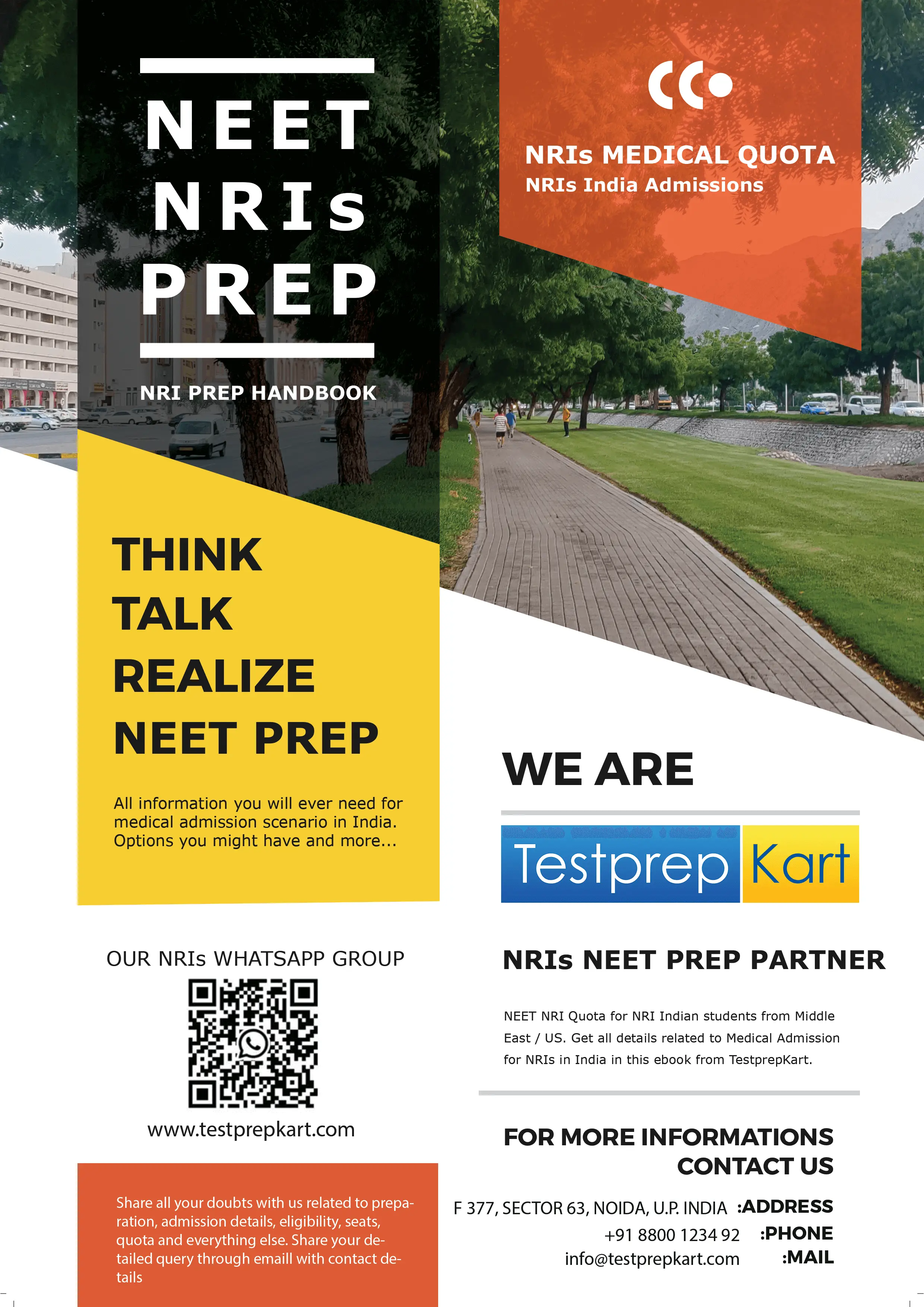
This free guide covers NEET preparation, NRI eligibility, documents, seat categories, medical colleges, fees and counselling planning for students living outside India.
Download NEET E-BookNEET eligibility is not restricted to NRI, OCI or former PIO candidates. Indian citizens residing in India and foreign nationals may also appear. The candidate’s nationality affects the identity documents used in the application and may affect the counselling routes available after the result.
| Candidate Status | Meaning | Can Appear for NEET? | NRI Seat Position |
|---|---|---|---|
| Indian Citizen in India | Indian passport holder ordinarily residing in India. | Yes. | May require an accepted NRI parent or sponsor route to claim an NRI seat. |
| NRI Candidate | Indian citizen ordinarily residing outside India. | Yes. | May apply where NRI seats are offered, subject to documentary approval. |
| OCI Candidate | Foreign citizen holding a valid Overseas Citizen of India card. | Yes. | Eligibility for NRI or other permitted seats depends on current counselling rules. |
| Foreign National | Candidate who is not an Indian citizen and may or may not hold OCI status. | Yes. | Must check foreign-national, institutional or approved sponsorship routes. |
| Former PIO Holder | Legacy PIO status now handled through the OCI framework. | Yes, under the current valid status. | Use current OCI and citizenship documents, not a presumed separate PIO quota. |
The age rule is the same for Indian, NRI, OCI and foreign-national candidates. The candidate must complete 17 years of age on or before December 31 of the examination year.
A candidate must complete a recognised Class 12 or equivalent qualification with Physics, Chemistry, Biology or Biotechnology, and English. Biology and Biotechnology are alternatives in this requirement. Students do not need to study both subjects together.
The science course should include practical tests where required. Students studying abroad should keep transcripts, laboratory records and course descriptions because a school transcript may use titles such as Life Science, Advanced Biology or Integrated Science that do not clearly show whether the required content and practical work were completed.
| Requirement | What Is Accepted | Common Overseas-School Risk |
|---|---|---|
| Physics | Recognised senior-secondary Physics with required practical work. | Only a general science course appears on the transcript. |
| Chemistry | Recognised senior-secondary Chemistry with required practical work. | Chemistry was completed before the final two high-school years without clear equivalence. |
| Biology or Biotechnology | One of these subjects with the required theory and practical components. | AP Biology is shown without the complete recognised school qualification or laboratory proof. |
| English | English at the required level in the recognised qualifying course. | Only an English-language instruction letter is submitted without a qualifying English subject. |
| Additional subjects | Required subjects completed later through a duly recognised board may be accepted with documentary proof. | The student completes a private course that is not issued by a recognised board. |
| Result awaited | A student awaiting the Class 12 result may appear for NEET. | The student does not pass the qualifying examination before the first counselling round. |
The commonly applied MBBS academic standard is based on aggregate marks in Physics, Chemistry and Biology or Biotechnology. Families should verify how the current NMC rule is applied to the student’s category and foreign or international qualification during counselling.
| Candidate Category | Commonly Applied PCB Aggregate | Important Note |
|---|---|---|
| General and General-EWS | 50% | The candidate must also pass the required subjects and meet NEET qualification. |
| SC, ST and OBC | 40% | Reservation benefits depend on valid category documents and the counselling rules. |
| General or General-EWS PwBD | 45% | Separate disability eligibility and certification rules also apply. |
| Reserved-category PwBD | 40% | The authority will verify both category and disability documents. |
Get the student’s subjects, transcript and international curriculum reviewed before planning an NRI MBBS application.
The subject must be comparable in scope and quality to Indian Class 12 science in order for students from the United States, IB, Cambridge, and other international curricula to be eligible. Nationality is not the most prevalent challenge. It is demonstrating senior-secondary equivalency, practical work, and the right combination of subjects.
| Curriculum | Main Eligibility Check | Documents to Prepare | Common Mistake |
|---|---|---|---|
| U.S. High School Diploma | The student should have completed 12 years of schooling with Physics, Chemistry, Biology or Biotechnology, English and the required practical coursework. | Keep the high school diploma, full academic transcript, science-course descriptions, laboratory records and proof of school accreditation ready. | Many families assume that a high GPA is sufficient, even when the transcript does not include one of the required science subjects. |
| International Baccalaureate | The IB subject combination must include the required sciences and English, and the final qualification should be accepted as equivalent to Class 12. | Prepare the IB Diploma, final transcript, subject and level details, internal-assessment records and evidence of practical study. | A common error is choosing only two of the required science subjects and assuming the remaining subject will not be checked. |
| Cambridge A-Level | Students should complete Physics, Chemistry and Biology or Biotechnology, including the appropriate practical components, along with acceptable proof of English study. | Keep the IGCSE and A-Level certificates, final statements of results, subject details and practical-examination records available. | Submitting only AS-Level results or an incomplete final science combination can create problems during eligibility verification. |
| Overseas CBSE | The candidate should hold a recognised CBSE Class 12 qualification with Physics, Chemistry, Biology or Biotechnology and English. | Prepare the Class 10 and Class 12 marksheets and certificates, passport copies, school records and any documents requested during counselling. | Students sometimes focus only on academic eligibility and overlook the separate passport, NRI-status and counselling-document requirements. |
| AP Courses | AP subjects can strengthen science preparation, but they do not replace the student’s complete and recognised Grade 12 or high school qualification. | Keep the high school diploma, complete transcript, AP score reports, course outlines and laboratory-work records together. | AP Biology alone should not be treated as complete proof that the student meets every NEET academic eligibility requirement. |
It is not appropriate to say that all students who have studied outside of India must obtain an equivalency certificate. The requirement varies according to the qualification and whether the counseling authority or accepting institution must formally prove that the test is comparable to Indian Class 12 science.
The candidate may be required to present a certificate from the relevant Indian university or the Association of Indian Universities in order to show equivalency. Because document repair, school verification, and transcript examination might take time, families should start this procedure as soon as possible.
These figures are often treated as if they mean the same thing, but they answer very different questions. Class 12 marks show whether the student meets the academic entry requirements. The NEET qualifying percentile confirms whether the candidate has cleared the entrance examination. A closing score or rank, however, shows the last admission made for a particular college, seat category and counselling round.
| Measure | What It Establishes | 2026 Guidance |
|---|---|---|
| Class 12 Subject and Marks Eligibility | Shows whether the student has completed the academic qualification needed for MBBS admission. | Review the subject combination, practical work, marks, board recognition and any equivalence requirement. |
| General and General-EWS NEET Qualification | Sets the minimum NEET qualifying standard for candidates in these categories. | 50th percentile. |
| SC, ST and OBC NEET Qualification | Sets the minimum qualifying standard applicable to SC, ST and OBC candidates. | 40th percentile. |
| PwBD NEET Qualification | Sets the qualifying standard according to the candidate’s applicable PwBD category. | 45th percentile for General or General-EWS PwBD candidates and 40th percentile for SC, ST or OBC PwBD candidates. |
| All India Rank | Shows where the candidate stands in the overall NEET merit list. | Use the rank along with the candidate’s category, preferred colleges, state and counselling round while planning choices. |
| College Closing Score or Rank | Refers to the score or rank of the last candidate admitted to a particular seat in a specific round. | Before relying on any closing figure, check the year, college, counselling authority, round and seat category. |
| NRI Document Approval | Confirms whether the candidate is permitted to compete for an NRI-category seat. | This verification is carried out separately from NEET qualification and Class 12 academic eligibility. |
Under the NEET UG 2026 bulletin, NRI and OCI applicants are required to upload a certificate issued by the concerned Indian Diplomatic Mission in their country of residence to support the status claimed in the application. The original certificate should also be kept safely for counselling and final admission.
Foreign-national applicants must provide valid proof of citizenship as well. This may include the relevant passport pages or a citizenship certificate issued by the competent authority. OCI candidates should keep both their current foreign passport and OCI card ready for verification.
MCC’s notice dated May 27, 2026, states that an NRI mother or father who ordinarily resides outside India may support the candidate’s NRI claim. The notice also refers to certain first-degree relatives and specified nearest blood relations in cases that meet the prescribed conditions.
Applications involving an extended relative need to be prepared with particular care. When a sponsor claims the student as a ward, MCC or another competent authority may ask for legal records showing that the person is the student’s genuine guardian. These documents may be required in addition to the sponsorship affidavit and relationship proof.
| Potential Sponsor Route | Who May Be Considered? | Main Evidence |
|---|---|---|
| Parent Route | NRI mother or father ordinarily residing abroad. | Parent passport, visa or residence permit, overseas address, NRI certificate, birth certificate and sponsorship undertaking. |
| First-Degree Relation | The notice refers to the student’s real brother or sister in addition to the parent relationship. | Relationship chain, NRI status, residence abroad and financial responsibility. |
| Nearest Blood Relation | Real paternal or maternal uncle or aunt, grandparents and first-degree paternal or maternal cousins in the circumstances described by the notice. | Family tree, relationship certificates, NRI documents, residence evidence and affidavit. |
| Ward or Guardian Case | A qualifying nearest relation who has genuinely looked after the student as guardian. | Evidence of guardianship, affidavit and legal proof showing bona fide legal guardian status. |

The final checklist changes by candidate status, counselling authority, state and round. Prepare the core identity, academic, citizenship, residence, relationship, sponsorship and equivalence records well in advance.
Use this downloadable resource as a starting checklist. Always compare it with the latest MCC, state and college document notice for the applicable counselling round.

NEET UG 2026 offered examination cities outside India, but there was no centre in the United States. U.S.-based students therefore had to plan travel to India or choose an available international examination city during registration, subject to NTA allotment.
The bulletin listed the following overseas cities for NEET UG 2026. Future years may use a different list, so students should always check the current application form rather than relying on the previous year’s centres.
| Region | NEET UG 2026 Overseas Cities | Planning Note |
|---|---|---|
| UAE | Dubai, Abu Dhabi and Sharjah | Popular options for Gulf and some U.S.-based families planning international travel. |
| Gulf Region | Kuwait City, Doha, Manama, Muscat and Riyadh | Confirm visa, flight and local reporting requirements early. |
| South and Southeast Asia | Kathmandu, Singapore, Bangkok, Colombo and Kuala Lumpur | Select the city only when it appears in the live application. |
| Africa | Lagos | Centre allotment remains subject to NTA’s final arrangements. |
| United States | No NEET UG 2026 examination city was listed in the USA. | Plan international travel, passport validity and school absence well in advance. |
Qualifying NEET does not complete the admission process. Candidates must register for the appropriate counselling authority, submit the required category documents, fill choices and report to the allotted college with originals.
| Route | Authority | Main Seats | Main Risk |
|---|---|---|---|
| MCC Counselling | Medical Counselling Committee | 15% AIQ, specified central institutions and 100% deemed-university seats, including notified deemed NRI seats. | Missing an NRI conversion or document-submission window. |
| State Counselling | Respective state or UT authority | State-controlled, private, minority and state-notified NRI seats. | Assuming one state’s sponsor and domicile rules apply in another state. |
| College Reporting | Allotted institution | Final verification of the allotted seat and candidate documents. | Expired passports, mismatched names, missing originals or unverifiable certificates. |
Get NRI-focused preparation support, document planning and structured guidance for overseas students.

A U.S.-based student had a strong high-school GPA, AP Biology and advanced mathematics. However, the final transcript did not clearly show senior-secondary Chemistry practical work. The family initially believed the overall academic profile would be enough for NEET eligibility.
The transcript, course descriptions and laboratory records were reviewed before registration. The family then confirmed the recognised subject route and began the equivalence process required for the intended counselling plan.
Key lesson: A high GPA or AP score does not replace subject-by-subject eligibility. Overseas students should review the complete transcript before the final school year whenever possible.
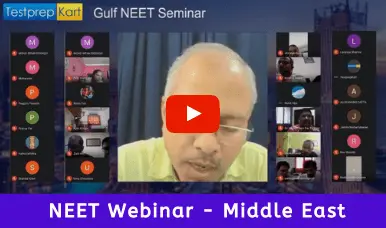
Preparing for NEET can be challenging, especially for NRI students managing different education systems and time zones. Watch this video to understand common NEET preparation challenges and learn how proper planning, expert guidance, and consistent practice can help students stay on track.
| Area of Support | What TestPrepKart Does | Why It Helps Families |
|---|---|---|
| Eligibility Review | Reviews age, subjects, practicals, marks, curriculum, passport and OCI status before the application route is selected. | Parents identify academic or document gaps early. |
| International Curriculum Audit | Checks U.S., IB, Cambridge, AP and other international records against NEET subject expectations. | Students avoid relying only on GPA, course names or AP scores. |
| NRI and OCI Document Planning | Reviews passports, visas, OCI cards, embassy certificates, relationship documents and sponsor records. | Families have time to correct expired, inconsistent or missing documents. |
| Counselling Planning | Compares MCC and state routes using eligibility, score, preferred colleges and budget. | Choice filling is based on realistic routes rather than general assumptions. |
| NEET Preparation | Provides live preparation suited to U.S., Gulf, AP, Honors, IB and international school schedules. | The student can build NCERT depth while managing school and time-zone differences. |

|

|

|

|

Begin with the student’s date of birth, passport, citizenship, OCI status and complete Class 12 subject record. Then review practical evidence, marks, equivalence, Indian Mission documents and the proposed NRI sponsor. This sequence prevents families from building a college plan around an admission category that may not match the student’s academic or legal profile.





Copyright © 2024 CounselKart Educational Services Pvt. Ltd.. All Rights Reserved




Post a Comment