Schedule Your Free Exam Readiness Analysis Session!

Hi, I’m TestprepKart.
Your Partner In Exam Preparation
Looking for Trueman Biology Class 11 Volume 1 PDF resources? Before adding another file or book to your study folder, decide what you need it to help you understand.
Perhaps you remember the names of cell organelles but struggle to connect their structures with their functions. Perhaps you can label a chloroplast but mix up where the light reactions and Calvin cycle occur. Those are specific problems a reference book can help you work through.
Trueman’s Elementary Biology Volume I is a Class 11 Biology reference book. Use it alongside NCERT to clarify difficult topics, then test your understanding with fresh questions. It should support your preparation rather than become a second textbook you feel obliged to read from cover to cover.
For students preparing for NEET from the USA, that distinction matters. Biology revision needs to fit around school assignments, other NEET subjects and time for reviewing mistakes.
Book Free NEET Demo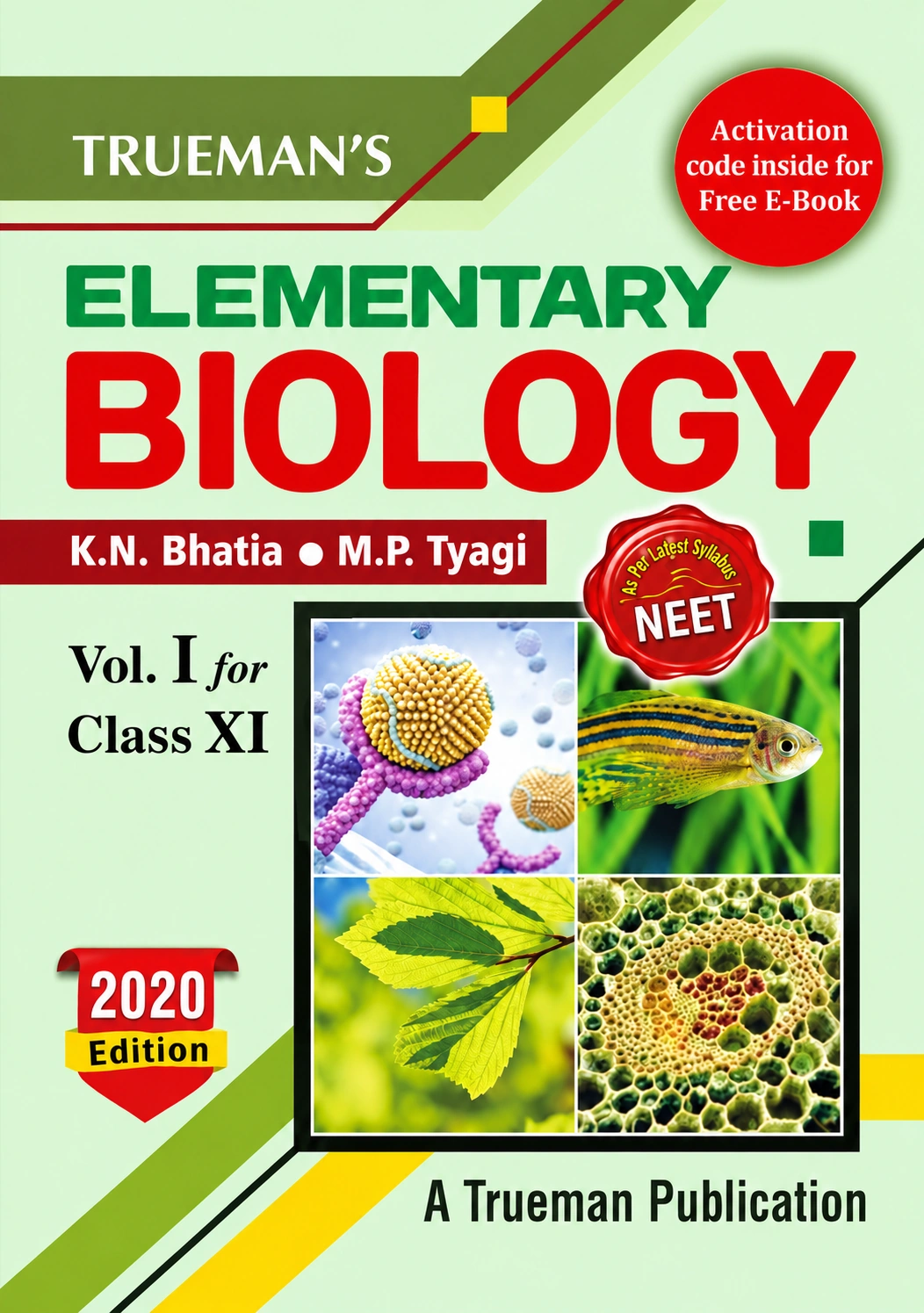
Opens the preparation-books category. Check the resource description and available file before downloading.
The publisher lists Elementary Biology Volume I for Class 11 by K. N. Bhatia and M. P. Tyagi, under Trueman Book Company, with ISBN 978-8187223788. Check these details against the copy you intend to use.
| Book detail | Information |
|---|---|
| Title | Trueman’s Elementary Biology, Volume I |
| Class | Class 11 |
| Authors | K. N. Bhatia and M. P. Tyagi |
| Publisher | Trueman Book Company |
| Publisher-listed ISBN | 978-8187223788 |
| Study role | Supplementary explanation and reference |
This Guide relies on the official book list and contents provided by the book publisher. This is not an analysis of the book itself.
Wrong. The title that appears in the list is Trueman’s Objective Biology for NEET.
In case you were searching for “Trueman Biology for NEET,” verify which series is mentioned by the supplier or the download source. Elementary Biology, Objective Biology, sample chapter, and solutions are separate documents.
A free complete PDF of Trueman Biology Class 11 Volume 1 PDFis yet to be confirmed. The links provided by TestPrepKart below are for the respective preparation resource pages.
| Resource | What it is for | Access |
|---|---|---|
| NEET preparation book resources | Explore the resources described in the category | Browse NEET Book Resources |
| Biology questions and practice resources | Find chapter-wise practice and paper resources | Explore NEET Biology Questions |
| Study-material downloads | Browse revision notes, MCQs and questions with solutions | Browse NEET Study Material |
Before selecting any exercises, ensure that you first read through the contents and the copyright pages of the textbook if you own one. Check the source, edition, integrity, and permissions of any electronic material.
On a mobile phone, a file that looks readable on a laptop might have diagram labels that could be confusing. Before relying on it for revisions, make sure to consider the small details.
For Trueman Biology solutions, Moreover, make sure that you align your version with the numbering system in the exercises. The right answers may seem wrong if the solution key is based on another version.
The below locator is based on the publisher’s contents which are available publicly. Please compare it with your copy since wording and numbering may differ in other editions.
| Chapter | Topic |
|---|---|
| 1 | The Living World |
| 2 | Biological Classification |
| 2A | Kingdom Monera |
| 2B | Kingdom Protista |
| 2C | Kingdom Fungi |
| 3 | Plant Kingdom |
| 4 | Animal Kingdom |
| 5 | Morphology of Flowering Plants |
| 6 | Anatomy of Plants |
| 7 | Structural Organisation in Animals: Animal Tissues |
| 7A | Structural Organisation in Animals: Morphology and Anatomy |
| 8 | Cell: The Basic Unit of Life |
| 9 | Biomolecules |
| 10 | Cell Cycle and Cell Division |
| 11 | Transport in Plants |
| 12 | Mineral Nutrition |
| 13 | Photosynthesis in Higher Plants |
| 14 | Respiration in Plants |
| 15 | Plant Growth and Development |
| 16 | Digestion and Absorption |
| 17 | Breathing and Exchange of Gases |
| 18 | Body Fluids and Circulation |
| 19 | Excretory Products and Their Elimination |
| 20 | Locomotion and Movement |
| 21 | Neural Control and Coordination |
| 22 | Chemical Coordination and Integration |
The contents of the book are explained on the contents page. The exam syllabus will tell you what is required from you for the exam.
The official document checked for this revision is the NEET UG 2026 syllabus. In that paper, the headings Transport in Plants, Mineral Nutrition, and Digestion and Absorption do not stand alone.
However, this does not make all associated concepts meaningless. The requirements for NEET and the requirements of schools could be different.
For NEET 2027 preparation, If available, consult the pertinent official curriculum. The exam curriculum is not set by the book cover "2026-2027."
Parents can arrange admission-planning questions independently while the student focuses on biology.
Discuss eligibility, paperwork, preparation, and medical college possibilities using the TestPrepKart NEET NRI guide as a starting point. Make a brief list of the things you need to know about your family's situation.
Pick one which will make understanding future concepts easy for you. If your school or coaching is following a good pattern, then stick to it and just fill in any gaps you might have.
| Suggested phase | Topics | First task |
|---|---|---|
| Basic orientation | The Living World | Learn naming and classification vocabulary |
| Cell foundations | Cell Structure, Biomolecules, Cell Division | Connect structures, functions and processes |
| Structure and diagrams | Plant Morphology, Plant Anatomy, Animal Structure | Identify parts and explain their relationships |
| Plant processes | Photosynthesis, Respiration, Plant Growth | Connect locations, stages, inputs and outputs |
| Human systems | Breathing, Circulation, Excretion, Movement, Coordination | Trace routes and explain regulation |
| Ongoing classification revision | Biological Classification, Plant Kingdom, Animal Kingdom | Compare groups and retrieve examples from memory |
This is not a NEET chapter-wise ranking; it is just a suggested study pattern.
Repeated classification is very essential. There is no need to wait until all chapters of the procedures are done. It will be possible for one to know the aspects that make one puzzle after conducting an exercise of comparison.
Start off with an easily understandable topic from the NCERT book. Understand the topic and study its diagram.
Now shut the book and pose a question that you ought to know the answer to.
For example:
When you can’t answer, pinpoint what is lacking. Is the term unknown to you? Is the diagram unclear? Do you confuse two processes?
Open the relevant Trueman passage for that specific problem. Read enough until you understand it, then shut both books and explain the concept once more.
In addition, make one succinct amendment to your current notes and try a new question.
| Step | What to do | What you should produce |
|---|---|---|
| Read | Study the relevant NCERT passage | A question you can try to answer |
| Diagnose | Identify the point you cannot explain | A specific learning gap |
| Clarify | Consult the matching reference section | A clearer explanation or diagram |
| Recall | Explain without looking | Evidence of what you remember |
| Apply | Attempt a fresh MCQ | A check of independent understanding |
Don't have two sets of notes with identical definitions. Revision notes should consist of helpful revisions, comparisons, and reminders.
For animals, compare the degree of organization, symmetry, germ layers, and body cavity using the same columns.
First fill the blanks of the table by memory. Don’t worry about the places that you are not sure of, then you can crosscheck them. It will help you learn much more than marking the completed table.
Explain why the most relevant alternative is not correct after each question. If you picked Cnidaria, what feature would eliminate Platyhelminthes?
If you get confused with any comparison between Monera, Protista, or Fungi, make use of the reference section.
Conceal the labels of the compulsory diagram. Recognize the structures and state their respective functions.
If you can remember the label but cannot find it in the re-drawn diagram, practice identification skills. If you are able to find it but not explain its function, improve the function.
When doing phyllotaxy, count the number of leaves in each node first before depending on an example.
Think about what makes that particular organelle unique, and which other option is similar enough to trick you.
Consider the uniqueness of that particular organelle and also the other alternative that could deceive you..
In dealing with cell division, it is important to separate chromosome number and DNA content whenever required by the question. Remember to note the phase first.
Use four prompts:
Photosynthesis should be illustrated by drawing thylakoid membrane system and stroma, and relating light reactions and Calvin cycle.
The approach is identical for respiration in arranging the needed stages and their relationship. Remain within the bounds of your syllabus in explaining.
Follow blood circulation through the heart and lungs instead of learning the vessels separately.
In excretion, trace the related activities through the nephron. In coordination, relate the signal, the target, and the response.
In case you have the principle that veins carry deoxygenated blood, the pulmonary circulation highlights the flaw in the principle since veins carry blood to the heart regardless of oxygenation levels.
There is no fixed official chapter-wise question allocation in NEET. Historical counts describe particular papers and depend on how questions are classified.
For your own study, begin with a short diagnostic set:
These are suggested session sizes, not mastery requirements.
If a long chapter contains several distinct processes, use separate diagnostic sets. Ten questions cannot reliably test everything in that chapter.
Before opening another chapter, identify the cause of the mistake.
| What happened? | Example | Next task |
|---|---|---|
| A fact was forgotten | Could not recall an organism’s characteristic | Make a short recall prompt |
| A concept was confused | Mixed up light-reaction and Calvin-cycle locations | Rebuild the labelled process diagram |
| A diagram was misread | Recognised the term but selected the wrong structure | Practise with an unlabelled diagram |
| A rule was too broad | Assumed all veins carry deoxygenated blood | Trace the pathway and correct the rule |
| The wording was missed | Overlooked “incorrect” or “except” | Underline the instruction before answering |
What would happen if you inverted the sites where the processes of photosynthesis occur?
Don’t just write the answer. Draw a chloroplast, show the stages in their right places, and connect them with ATP and NADPH. Don’t look at the book, and explain your diagram. Try another question on this topic.
This new question is important since it measures comprehension rather than memorization of the initial alternative.
These are original practice questions for this guide. They are not reproduced Trueman exercises or identified NEET previous-year questions.
An animal has tissue-level organisation, radial symmetry and two embryonic germ layers. Which group best matches these features?
A. Annelida
B. Cnidaria
C. Arthropoda
D. Platyhelminthes
A plant bears one leaf at each node, with successive leaves appearing alternately. Which phyllotaxy is described?
A. Opposite
B. Whorled
C. Alternate
D. No phyllotaxy
Which feature directly distinguishes rough endoplasmic reticulum from smooth endoplasmic reticulum?
A. A double membrane
B. Ribosomes attached to its surface
C. Its own circular DNA
D. An absence of membrane
Which pairing correctly matches a photosynthetic process with its location in a chloroplast?
A. Light reactions: stroma; Calvin cycle: thylakoid membrane
B. Light reactions: thylakoid membrane; Calvin cycle: stroma
C. Both processes: outer chloroplast membrane
D. Both processes: mitochondrial matrix
In normal adult human circulation, which vessel carries oxygenated blood from the lungs towards the heart?
A. Pulmonary artery
B. Pulmonary vein
C. Vena cava
D. Hepatic portal vein
| Question | Answer | Explanation | What to revise if you were unsure |
|---|---|---|---|
| 1 | B. Cnidaria | The combination is tissue-level organisation, radial symmetry and diploblastic development | Compare the offered groups using the same features |
| 2 | C. Alternate | Alternate phyllotaxy has one leaf at each node; opposite has a pair, and whorled has more than two | Sketch nodes and count leaves |
| 3 | B. Surface ribosomes | Rough ER has attached ribosomes and is associated with protein synthesis | Connect organelle structure and function |
| 4 | B. Thylakoid membrane and stroma | Light reactions generate ATP and NADPH used in the Calvin cycle | Draw the locations and link the stages |
| 5 | B. Pulmonary vein | Pulmonary veins return oxygenated blood to the left atrium | Trace circulation and distinguish vessels by direction |
Treat a guessed correct answer as a review item. This five-question set is a starting point, not a complete assessment of Biology readiness.
Schedule according to how your school week is. There should be time allocated for AP/IB coursework, testing at school and other extracurriculars.
Consider your current school curriculum in relation to the NEET syllabus. Even if the topic is one that you know well, some revision may be required with regards to certain vocabulary, diagrams or examples.
| Session | Main task | Useful outcome |
|---|---|---|
| First study | Read a manageable NCERT topic | List the points you cannot explain |
| Clarification | Consult the relevant Trueman passage | Correct one explanation or comparison |
| Practice | Attempt MCQs without the answer key | Record wrong and uncertain answers |
| Error repair | Revisit the cause of each mistake | Write a correction and choose a fresh check question |
| Delayed review | Recall earlier topics and attempt mixed questions | Identify what stayed clear |
Tasks, not daily hours. Take an incomplete idea to the following class rather than completing the task since the week has ended.
Parents can ask:
That gives the student room to explain progress without reducing it to page counts.
Keep Physics and Chemistry visible in the same weekly plan. A productive Biology routine should leave enough time for the other subjects.
Use simple statuses instead of a numerical readiness score.
| Status | What it means | Next action |
|---|---|---|
| Not started | The topic has not been studied | Plan the first reading |
| Explanation clear | You can explain the concept | Attempt fresh questions |
| Practice needed | Question application remains uncertain | Solve a selected set and review it |
| Recall needed | Facts or terms keep being forgotten | Schedule short recall sessions |
| Ready for review | You can explain and apply the topic independently | Include it in delayed and mixed revision |
A strong result on a small set does not make a topic permanently secure. Return to it later without notes.
Write the next task beside each weak topic. “Revise Biology” is difficult to act on. “Compare mitosis and meiosis, then attempt five fresh questions” gives you a clear starting point.
| Study need | Start with | When to use Trueman |
|---|---|---|
| First reading | NCERT and your syllabus checklist | When an explanation remains unclear |
| Diagram revision | Required diagrams and labels | To clarify a structure or relationship |
| Forgotten facts | Active recall from your core material | When the fact lacks a clear context |
| Concept confusion | Identify the precise distinction | Read the matching reference passage |
| Exam-style practice | Relevant MCQs and PYQs | Select suitable exercises where available |
If you already understand NCERT but lose marks through careless reading, another full textbook may not solve the problem. Work on question interpretation and review your mistakes first.
If the difficulty is conceptual, a targeted reference explanation can be useful. Judge the book by whether it helps you resolve that difficulty.
|
SUPPORT THAT STARTS WITH YOUR QUESTIONS
Stuck on the Same Biology Topic?Bring two or three attempted questions to a demo. Tell the teacher where you got stuck and how Biology fits into your school week. Discuss your topic gaps, suitable practice and local class timings before choosing a course. Book Free NEET Demo |
If a topic remains unclear, bring your attempted questions and working to a teacher. Explain the point where your reasoning broke down.
“I keep confusing the two photosynthetic locations” gives a clearer starting point than “I am weak in Biology.”

TestPrepKart’s portal lists app features including syllabus tracking, preparation analysis, NRI eligibility guidance and college exploration.
Keep study progress specific. “Redraw the chloroplast and retry a location question” is more useful than “Photosynthesis done.”
Parents can keep admission questions separate from the student’s revision tasks so that neither gets overlooked.
Class 11 reference material is covered in Volume I. The relevant curriculum, Class 12 themes, key study material, practice questions, revision, and testing are all necessary for your preparation.
Start with NCERT. When you are unable to connect a notion with a diagram or explain it, use the corresponding Trueman section.
First, determine the gap. A reference can be helpful if you require an additional explanation. Recall exercises and error review could be more helpful if you tend to misunderstand questions or forget facts.
No. They are distinct titles listed by different publishers. Before purchasing or utilizing a resource, make sure the series, volume, and edition are correct.
For this page, no approved free full textbook PDF has been validated. Separate preparation options are accessible through the connected TestPrepKart pages.
Compare the book with the official syllabus for your examination year. Your school may require topics beyond that checklist.
Follow your school or coaching sequence if it works. For independent study, begin with basic vocabulary and cell foundations, while keeping classification recall active throughout.
There is no fixed official chapter allocation. Use reliable analysis of identified past papers for context, not as a prediction.
No. Ten questions can reveal some gaps, but larger chapters require checks across their different subtopics, followed by delayed and mixed revision.
No. They are original examples written for this guide and should not be described as textbook extracts or actual past-paper questions.
Yes. Adapt the tasks around your school calendar and current preparation. Compare course coverage topic by topic rather than assuming complete overlap with NEET.
Name the cause, revise that point and attempt a fresh question. If the confusion continues, take your working to a teacher.
Copyright © 2024 CounselKart Educational Services Pvt. Ltd.. All Rights Reserved