Schedule Your Free Exam Readiness Analysis Session!

Hi, I’m TestprepKart.
Your Partner In Exam Preparation
You finish reading Chemical Bonding, close the book and feel reasonably confident. Then a question asks you to compare molecular shapes, and two options seem equally convincing.
That is where a practice book can help. It shows whether you can use a concept without the explanation sitting in front of you.
Problems in Inorganic Chemistry for NEET by V. K. Jaiswal is a supplementary practice resource. Study the corresponding NCERT concepts first, attempt suitable questions independently and use your mistakes to decide what to revise.
For a student preparing from the USA, the aim is to fit useful Chemistry practice around school. You do not need another book simply because someone else is using it.
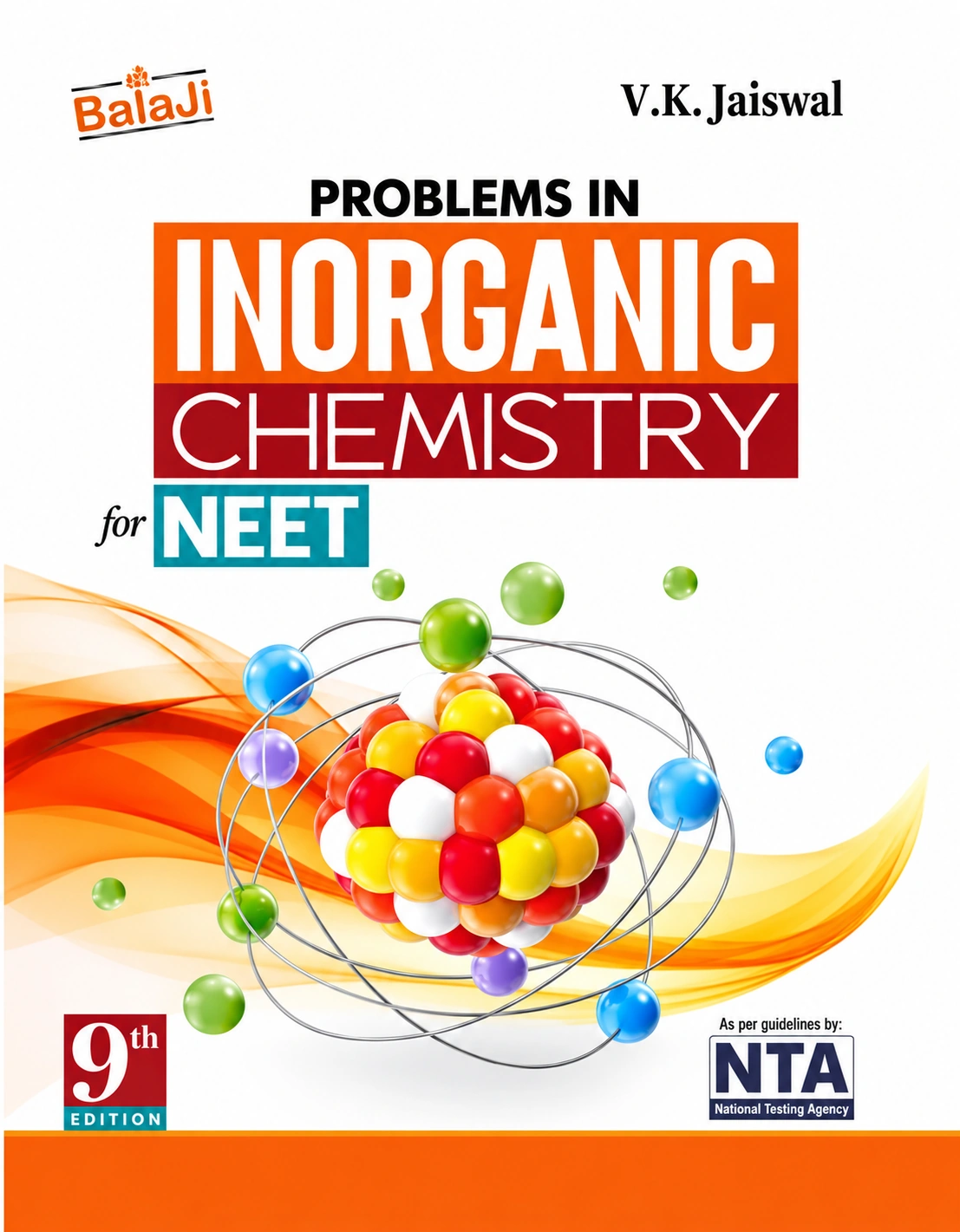
Opens the TestPrepKart NEET Preparation Books category. Check the individual resource description and available file before downloading.
Shri Balaji Publications lists a ninth-edition NEET version with ISBN 978-93-6802-279-4 and 496 pages, checked on October 12, 2026. The publisher also offers a separate JEE version.
| Before you buy | What to check |
|---|---|
| Exam version | The listing and cover should identify the NEET edition |
| Edition | Confirm the edition being supplied |
| ISBN | Match the seller’s information to the publisher’s listing |
| Contents | Look at the actual contents page |
| Answers and solutions | Check what your chosen edition includes |
| Your current resources | Decide whether you need additional practice |
The publisher describes the NEET book as NCERT-oriented. That does not mean every exercise in an older edition matches your examination-year syllabus.
If you are ordering from the USA, confirm the edition before paying for international delivery. A familiar cover or a seller’s “latest edition” label is not enough.
If you searched for a V. K. Jaiswal Inorganic Chemistry PDF, check the resource description before downloading. A review, sample chapter, answer key and complete textbook are different resources.
For a V. K. Jaiswal solutions PDF, the edition matters just as much as the author. Question numbers may differ between copies.
| Resource | Purpose | Link |
|---|---|---|
| Problems in Inorganic Chemistry by V. K. Jaiswal | Extra practice for Inorganic Chemistry | Browse Book Resources |
| TestPrepKart NEET Books | NEET preparation books and study resources | Browse NEET Chemistry Book Resources |
| NCERT Chemistry Textbooks | Build strong Chemistry fundamentals | Browse Chemistry Resources |
Before using an answer key, match its edition and question numbering to your book. If an explanation seems inconsistent, work through the question independently and ask a teacher to check it.
It can be useful if you understand a topic but need more practice applying it. It is less likely to help if you keep attempting questions without revising the reason you got them wrong.
Think about your last ten Chemistry mistakes. Were you forgetting facts, misunderstanding a concept, misreading the question or running out of time?
| What keeps going wrong? | What to do next |
|---|---|
| You forget trends and exceptions | Make short recall prompts and test yourself |
| You confuse molecular shapes | Draw structures and count electron domains |
| You mix up oxidation state and coordination number | Practise calculating them separately |
| You recognise answers but cannot explain them | Solve fresh questions without the answer key |
| You understand the concept but work slowly | Introduce short timed sets |
| Your existing question bank is unfinished | Review that resource before adding another |
A useful Inorganic Chemistry question bank gives you something to act on.
“I need to revise lone-pair effects” is a clearer next step than “I need to solve more Chemistry.”
Selected supplementary questions may help students who:
If the theory is still not completed, or the practice is nearly complete but not entirely, then any additional book will be simply an addition to the already created material, and nothing more.
In the beginning, do some small topic related to your resources. Spot the mistakes. Then you can decide whether you need more questions or explanation.
When searching for a V.K. Jaiswal Inorganic Chemistry, the results come in the two editions. The publishers have listed separate books for NEET and JEE examinations.
JEE exercise level suggestions do not have to be blindly followed in NEET books.
If you are preparing for NEET alone, opt for the one for NEET unless your teacher has advised otherwise.
If you have the JEE book, go to your teacher and find out which exercise problems are appropriate for that topic. It is unnecessary to solve some inappropriate exercises to end a chapter.
A table of contents for the ninth edition was not available in the text provided by the publisher. The following table acts as a guide to topics rather than a true representation of the chapters in the book.
It can help you find related parts in your text.
| Topic to locate | Useful practice focus |
|---|---|
| Classification of Elements and Periodicity | Trends, comparisons and exceptions |
| Chemical Bonding and Molecular Structure | Structures, shape, polarity and bonding |
| Coordination Compounds | Charges, naming, coordination number and isomerism |
| d- and f-Block Elements | Configurations and characteristic properties |
| p-Block Elements | Questions within the prescribed scope |
| Practical Chemistry or qualitative analysis | Relevant observations and chemical reasoning |
| Older sections on Hydrogen, s-Block, Metallurgy or Environmental Chemistry | Check individual topics against the applicable syllabus |
An old book can have good questions together with some other information that is not needed right now. Make notes on the parts that will be used before a big exercise.
Chemistry practice and admission planning need separate attention. Keep the student’s study routine moving while organising your family’s admission questions.
Use the TestPrepKart NEET NRI guide as a starting point. Keep a separate list of questions that need clarification for your student’s circumstances.
The syllabus that was confirmed officially through this research was NEET UG 2026 syllabus. There was no final official syllabus found for 2027. Please update your preparation list once the relevant syllabus is available.
The confirmed 2026 book covers Periodicity, p-Block, d-Block, f-Block, Coordination Compounds, and Chemical Bonding along with Practical Chemistry.
The p-Block topic concentrates on the configuration, trends, and the behavior of the first element. The topics of Hydrogen, s-Block, Metallurgy, and Environmental Chemistry do not form independent Chemistry topics; however, related topics may be included in other prescribed areas.
Prior to commencing the section:
Start off with a series that can help you understand the next concept. Periodicity and Chemical Bonding are logical starting points as these introduce concepts that will be used later on.
Next arrange the sequence based on your errors.
| Suggested order | Start here | Check yourself |
|---|---|---|
| 1. Periodicity | Compare radii and ionisation trends | Can you explain an exception? |
| 2. Chemical Bonding | Draw structures and identify geometry | Can you separate molecular shape from electron-domain arrangement? |
| 3. Coordination Compounds | Calculate charge and coordination number | Can you account for a bidentate ligand? |
| 4. d- and f-Block | Write atom and ion configurations | Are you removing the correct electrons? |
| 5. Prescribed p-Block | Compare elements within syllabus scope | Can you explain the trend? |
| 6. Relevant Practical Chemistry | Connect observations with the reaction | Can you explain why the result occurs? |
This is just an outline of how to study, but not the actual chapter order.
In case Periodicity is fine but Coordination Compounds continues to be problematic, then devote the next lecture to Coordination. The order of studies should push you further rather than limit your ability to rectify an apparent deficiency.
Chapterwise distribution is not specified. You may refer to the previous year's question paper for an idea of what topics were covered in that year; however, it will not help you determine the number of questions in the coming papers.
While interpreting NEET Inorganic Chemistry weightage chart, look out for:
The current document does not contain unconfirmed question predictions for each year. Discuss the necessary themes and employ relevant paper analysis for your revision scheduling.
To practice yourself, begin with reasonable groups.
| Topic | Suggested first practice set |
|---|---|
| Periodicity | 20 questions |
| Chemical Bonding | 30 questions |
| Coordination Compounds | 30 questions |
| d- and f-Block | 25 questions |
| Prescribed p-Block | 20 questions |
| Relevant Practical Chemistry | 15 questions |
These are just practice objectives and not what is expected on NEET exams. Distribute them throughout the sessions and make sure you have some time to check your answers.
If ten questions identify a significant conceptual gap, stop and go back to review. Attempting to complete the rest of the twenty will probably not be of much use.
Draw before you choose.
Draw the Lewis structure, determine electron domains and lone pairs. Now you can pick the molecular geometry.
NH₃ has four electron domains; hence, a tetrahedral electron geometry. One electron domain is a lone pair, hence trigonal pyramidal molecular geometry. .
If you mix up those definitions, doing additional twenty questions is going to help only if you make sure the confusion is sorted out first.
For compare questions, make sure that you explain why you picked that particular reason for the choice.Do not limit yourself to learning the arrow on the periodic table. Question what alters in nuclear attraction, shielding, or electronic structure.
If you get caught by surprise by an exception, give an explanation in one sentence. Test your explanation using another set of elements.
Divide mistakes into two categories:
The first needs recall practice. The second needs a clearer explanation.
Separate the calculations.
In [Co(en)₃]³⁺, each neutral en ligand donates through two atoms. Three ligand molecules therefore give a coordination number of six, while cobalt has oxidation state +3.
Counting ligand molecules and counting donor atoms are different steps.
Check the ion configuration.
For transition-metal cations, remove the outer ns electrons before the (n-1)d electrons.
Practise neutral atoms and their ions together. Writing Mn and Mn²⁺ side by side makes the electron-removal step easier to check.
Use a compact table with the element, oxidation state, electron configuration and relevant property. Recreate it from memory before checking your notes.
Before practising an older section, compare it with the prescribed scope. Mark questions that need a teacher’s review.
This saves you from spending an evening on material simply because it appears between two relevant questions.
Within the prescribed scope, use comparison tables to organise trends. Then close the table and explain the differences without looking.
Start with your actual week. A plan that ignores homework, school tests and activities is unlikely to last.
If you follow AP, IB or a US high-school Chemistry course, compare the topics you have studied with your NEET checklist. Familiarity with a chapter title does not establish readiness for its questions.
Try this routine for one small topic:
| Session | Suggested time | Task |
|---|---|---|
| First session | 30 minutes | Revise the concept and explain it without notes |
| Second session | 35 minutes | Attempt 15 to 20 selected MCQs |
| Short review | 20 minutes | Check wrong, guessed and slow answers |
| Weekend session | 40 minutes | Retry weak concepts and attempt relevant PYQs |
This is an example for Inorganic Chemistry, not a complete NEET timetable.
During a busy school-test week, reduce new questions and keep a short recall session. When more time becomes available, resume new practice without leaving revision behind.
Parents can ask:
The answer reveals more than a page count.
Suppose you answered 40 out of 50 correctly. That is 80% accuracy for the set. But if eight correct answers were guesses, there are still questions worth reviewing.
Use four labels:
Then identify the cause of each uncertain or incorrect answer.
| Mistake | Useful correction |
|---|---|
| Forgotten fact | Create a short recall prompt |
| Conceptual gap | Revisit the explanation and solve a fresh example |
| Misread wording | Underline words such as “incorrect” or “except” |
| Calculation error | Write each step before checking the options |
| Time pressure | Reattempt after the concept is secure |
Keep the error log brief: concept, mistake, correction and retry date.
For example:
That note is easier to use than copying a full solution you may never reread.
After a few days, attempt a fresh question testing the same idea. Getting the original question right from memory is useful, but it does not show whether you can apply the concept independently.

TestPrepKart’s NEET portal lists app features including syllabus tracking, preparation analysis, NRI eligibility guidance and college exploration.
Use your tracker to distinguish three stages:
| Stage | What it should mean |
|---|---|
| Studied | You have worked through the concept |
| Practised | You have attempted suitable questions independently |
| Revised | You have revisited mistakes and checked retention |
Reading a chapter should not automatically mark it as complete.
Keep your book practice and topic tracker connected. If Coordination Compounds causes repeated mistakes, record the specific subtopic rather than marking the entire chapter as weak.
These are original MCQs written for this article. They are not reproduced from V. K. Jaiswal’s book or labelled as actual NEET past-paper questions.
A. O²⁻
B. F⁻
C. Na⁺
D. Mg²⁺
Correct answer: D. Mg²⁺
All four species have ten electrons. In this isoelectronic series, increasing nuclear charge pulls the electron cloud more strongly.
Mg²⁺ has the greatest nuclear charge among these species, making it the smallest.
Concept to revise: Isoelectronic species and ionic radius.
A. Linear
B. Trigonal planar
C. Trigonal pyramidal
D. Tetrahedral
Correct answer: C. Trigonal pyramidal
Nitrogen has three bonding pairs and one lone pair. The four electron domains have a tetrahedral arrangement, but the molecular shape is trigonal pyramidal.
Concept to revise: Electron-domain arrangement versus molecular shape.
Here, en is neutral bidentate ethane-1,2-diamine.
A. +3 and 3
B. +3 and 6
C. +6 and 3
D. 0 and 6
Correct answer: B. +3 and 6
Three chloride ions balance the +3 coordination entity. Because en is neutral, cobalt has oxidation state +3.
Each en ligand supplies two donor atoms. Three bidentate ligands therefore give a coordination number of six.
Concept to revise: Oxidation state, ligand denticity and coordination number.
A. 1
B. 3
C. 5
D. 7
Correct answer: C. 5
The ground-state configuration of manganese is [Ar] 3d⁵ 4s².
Removing the two 4s electrons gives Mn²⁺ the configuration [Ar] 3d⁵. Hund’s rule gives five unpaired electrons.
Concept to revise: Transition-metal ion configurations.
A. Boron has a lower nuclear charge
B. Boron’s outer electron occupies a higher-energy 2p orbital
C. Beryllium has a larger atomic radius
D. Boron has a completely filled 2p subshell
Correct answer: B.
Beryllium has a filled 2s subshell. Boron’s outer electron occupies a higher-energy 2p orbital and is easier to remove.
Concept to revise: Exceptions to ionisation-enthalpy trends.
Review guessed answers even when they were correct. Five questions are a starting point for revision, not a complete chapter test.
Chemistry practice and admission planning need separate attention. Keep the student’s study routine moving while organising your family’s admission questions.
Use the TestPrepKart NEET NRI guide as a starting point for preparation and admission planning. Keep a separate list of questions that need clarification for your student’s circumstances.
Download Free NEET NRI eBookAsk for help when the same mistake keeps returning after you have tried to correct it.
Bring a few questions, your working and a short error log. Explain where you became unsure.
“I cannot decide which electrons to remove” gives a teacher a clear starting point.
“I am weak in Inorganic Chemistry” is much harder to act on.
If you are exploring NEET preparation for NRI students in the USA, discuss your school schedule and current topic coverage alongside the questions you find difficult.
Ask how the available support would help you:
Discuss the concepts behind wrong answers, rather than checking only the correct option.
Ask how practice is selected for your current understanding and the applicable syllabus.
Compare what you have studied in school with the concepts you still need for NEET.
Discuss local class timings, homework commitments and how missed topics will be revisited.
Solving one MCQ may not indicate that your explanations are complete. Before proceeding to another V. K. Jaiswal exercise, answer four related questions on the same compound.
Answering one question may not always reflect the completeness of your explanation. Prior to solving another problem set by V. K. Jaiswal, answer four other questions about the same compound.
Use this compound:
Here, en is neutral bidentate ethane-1,2-diamine.
1. Coordination-entity charge: +3. Three chloride ions outside the brackets contribute a total charge of -3. The coordination entity must therefore have charge +3 to make the compound neutral.
2. Cobalt oxidation state: +3. Each en ligand is neutral. If cobalt’s oxidation state is x, then x + 3(0) = +3.
3. Ligand molecules: 3. The subscript indicates three en molecules.
4. Donor atoms: 6. Each en molecule binds through two nitrogen donor atoms. Three bidentate ligands provide 3 × 2 = 6 donor atoms, so the coordination number is six.
| If you answered... | Check this distinction | Your next task |
|---|---|---|
| The entity inside the brackets is neutral | Whole-compound charge versus coordination-entity charge | Write the charges of the counterions first. |
| Cobalt has oxidation state +6 | Oxidation state versus coordination number | Write a charge-balance equation before counting donor atoms. |
| There are six en molecules | Ligand molecules versus donor atoms | Use the formula subscript to count molecules. |
| The coordination number is three | Ligand denticity | Count two donor atoms for each en ligand. |
For [Co(NH₃)₆]Cl₃, find the coordination-entity charge, cobalt’s oxidation state, number of ligand molecules and coordination number. NH₃ is a neutral monodentate ligand.
The answers are +3, +3, six ligand molecules and coordination number six. Each NH₃ supplies one donor atom. Compare this with the en compound: both have coordination number six, but they contain different numbers of ligand molecules.
This is an original learning exercise, not a reproduced textbook question or a validated predictor of NEET performance. Use the step you missed to select your next revision task.
Use it along with prescribed theories, revision, and past NEET questions. Just because one completes a book does not necessarily mean that he/she is ready for the exams.
Yes. Learn the relevant theories first. Use the practice exercises to find out whether you can use them on your own.
In case the question reveals a hole in understanding, go back to the explanation before attempting another set.
There is no specific supplementary textbook that is required. If your current textbook contains appropriate questions, then there will be no need to buy another one.
Compare the topic with the syllabus for that subject and make sure that you are using the right answer key according to your textbook edition.
For preparation of NEET only, pick up the NEET version unless your teacher suggests certain questions to be done from any other version. Don’t think that the exercise pattern is the same.
Work out 15 to 20 questions as practice. You may increase or decrease the number of questions to ensure enough time for revision.
Working on fewer questions with understanding will prove more helpful than many questions done carelessly.
Yes, as additional practice. Look at your syllabus in relation to your NEET checklist and select the exercises.
Look at what you can explain and solve without depending on your school result.
This webpage contains study tips along with links to the resource webpages. This webpage does not guarantee that the full authorized book PDF is available.
Determine if you are just regurgitating questions or guessing at them without changing your conceptual base.
The fact that you have a new question on the same concept is a better way of testing your understanding. In case the same mistake persists, get the working verified by a teacher.
Also examine unclear responses along with incorrect ones. Make your corrections brief, review them at intervals, and quiz on the concept with another question.
Copyright © 2024 CounselKart Educational Services Pvt. Ltd.. All Rights Reserved