Schedule Your Free Exam Readiness Analysis Session!

Hi, I’m TestprepKart.
Your Partner In Exam Preparation
Open a topic below to jump directly to the section you need.
Options under Karnataka’s system include that for NRIs or NRI wards. Students who seek to pursue studies from KEA-participating colleges need to be eligible for NEET, register under the appropriate KEA process, opt for the right NRI category, participate in documentation verification if required, and make use of the most recent seat matrix and fee sheet while entering options.
For an NRI family, the admission process should be treated as three separate checks: Is it possible for the student to pursue MBBS in India, is the student eligible for the NRI/NRI Ward category, and which counseling body governs the targeted college? A student can satisfy one of these checks and still face difficulty if the other two are not completed correctly.
Once you have checked that the student is eligible for NEET, the subjects he needs to qualify in the exam and the relationship documentation for the NRI candidate, only then proceed with the comparison of colleges and check the college list under KEA or MCC counselling.
Share the student's country, Grade 12 curriculum, NEET status and NRI sponsor relationship.
| Admission Point | Evergreen Position |
|---|---|
| Entrance Exam | NEET UG qualification is required. |
| State Counselling Authority | Karnataka Examinations Authority (KEA) for applicable state/private/minority/NRI seats. |
| Deemed Universities | Counselling is through MCC. |
| NRI Claim | Candidate must claim the applicable NRI / NRI Ward category and satisfy document rules. |
| Fees | College-specific. Use the latest published fee sheet. |
| Seats | Round-sensitive. Use the latest published seat matrix, not an old static count. |
The table can be thought of as a routing table. KEA and MCC are not interchangeable, and the documentation process of an NRI claim is different from being an overseas student. Always keep a file that contains the updated fee structure, seat matrix, counseling notice, and NRIs’ documents of your family members.
The Karnataka counselling process for MBBS/MD courses follows a different system of seats and codes. An NRI / NRI Ward category claim is distinct from the ordinary government or general management seat. The student must fulfill the requirements of NEET eligibility criteria and also those of the additional NRI category criteria.
NRI status is not an exemption from NEET.
Choose the correct NRI / NRI Ward claim during the application process.
KEA can require in-person verification for NRI-related categories.
In Karnataka, the phrase NRI quota can be taken as meaning the allocation of seats for qualified NRI/NRI Ward candidates in institutions taking part. It does not imply that each and every private medical college has the same NRI fees, the same seat allocation, or the same counseling process.
Parents should thus not make use of a fee or a seat matrix of one college as the state standard. What needs to be done is to match the college, counselling authority and category code all at once.
Eligibility would be decided based on the nationality of the applicant student, counseling path, NEET eligibility criteria and the NRI connection/claim. Some examples of common applicants are those who themselves are NRIs, children of NRIs, eligible wards of NRIs, OCI/PIO applicants and foreign national applicants.
Residence of the candidate abroad alone cannot be considered as evidence of the candidate being eligible to get an NRI quota seat. The family needs to be prepared for providing the qualifying relationship, NRI status of the relevant individual, academic qualification of the candidate, and necessary documentary linkage. In case of any weakness at any one point, it must be sorted out before counseling.
The latest published Karnataka fee sheets show that NRI MBBS tuition is college-specific. Across participating private, minority and university-type institutions, published annual NRI charges broadly fall from the mid-₹20-lakh range to about ₹45 lakh per year, depending on the college.
The published NRI fee is just an initial step in budgeting. The families need to compute the total fee for the whole MBBS course along with estimating costs of hostels, mess, refunds and deposits, university fee, books, and local and international transportation.
When comparing two colleges, use the same cost basis for both. Comparing one college's tuition-only figure against another college's tuition-plus-hostel amount can create a misleading impression of affordability.
Planning MBBS admission in India from the USA, UAE or another country? Download the TestPrepKart NEET guide designed to help NRI students and parents understand eligibility, documents, NEET preparation and MBBS admission planning.
Useful for NRI, OCI and Indian-origin students and parents planning NEET and MBBS admission in India.
Selected examples of the recent Karnataka fee structure are provided below in the following table. This is for reference and comparison only; the final amount is to be cross-checked with the authority’s latest notice.
| Medical College | Private (P) / Year | NRI (N) Fee / Year | Maximum Planning Amount / Year |
|---|---|---|---|
| Dr. B. R. Ambedkar Medical College, Bengaluru | ₹12,00,117 | ₹35,11,950 | About ₹35.12 lakh |
| Kempegowda Institute of Medical Sciences, Bengaluru | ₹12,00,117 | ₹43,11,950 | About ₹43.12 lakh |
| MVJ Medical College & Research Hospital, Bengaluru | ₹12,00,117 | ₹40,11,950 | About ₹40.12 lakh |
| Vydehi Institute of Medical Sciences & Research Centre, Bengaluru | ₹12,00,117 | ₹44,11,950 | About ₹44.12 lakh |
| A. J. Institute of Medical Sciences, Mangaluru | ₹12,00,117 | ₹40,11,950 | About ₹40.12 lakh |
Utilize the table to develop three budget brackets: comfortable, feasible with planning, and beyond budget. Eliminate colleges whose cost lies above the family’s realistic cap prior to ranking preferences. This prevents a scenario whereby the student ends up with an allocation that cannot be paid by the family.
It is important that you always go through the current fee table of the respective institution before paying because the fee sheet may be revised between admission periods.
The NRI tuition figure should not be treated as the full cost of studying MBBS. Families should separate core tuition from living and institutional expenses before making a choice.
The major annual academic fee shown in the fee structure.
May be separate depending on institution and authority.
Usually separate and institution-specific.
Books, deposits, transport or university items may be extra.
Find out from the college or counseling body what the mentioned amount is for in actuality. Specifically, distinguish the tuition fee from the one-time payment as well as other costs. The annual fee can be similar in two colleges whereas the first year cost is very much dissimilar.
For overseas families, also budget for currency conversion and transfer timing so that the required amount can be paid within the reporting window after allotment.
The latest main KEA provisional MBBS matrix lists 67 medical colleges and 11,625 MBBS seats across all applicable categories. That total is not the NRI-seat count. NRI availability must be read from the relevant NRI column or category code for each college and can change between rounds.
A seat matrix is a snapshot for a particular counselling stage.Seats may decrease post-allocation, appear again following failure to report, or move during subsequent allocations as per the guidelines. Thus, use the latest matrix to fill choices and use the previous matrices only for the purpose of demand analysis.
Because the user intent is evergreen, this page should not freeze an old NRI seat count into every college row. Instead, use the current KEA matrix at the time of choice filling. The table below shows how to organise a college-wise NRI seat check.
| College | NRI Seat Check | What Parents Should Record |
|---|---|---|
| Dr. B. R. Ambedkar Medical College | Check latest NRI column | Round-wise NRI seats + latest fee |
| Kempegowda Institute of Medical Sciences | Check latest NRI column | Seat count + closing allotment trend |
| M. S. Ramaiah Medical College | Check current authority matrix | Authority, seat category and fee |
| Vydehi Institute of Medical Sciences | Check latest NRI column | Round 1 vs later-round movement |
| A. J. Institute of Medical Sciences | Check latest NRI column | Seats, fee and reporting logistics |
NRI seat numbers in colleges can be used most effectively when combined with information on fees and previous allocation trends. A college that has a higher number of NRI seats does not necessarily have a higher chance of being allocated to a candidate because of high demand, and vice versa.
Build a broad option list rather than depending on one or two colleges. This gives the student more protection against sudden seat movement between rounds.
Get help comparing latest published NRI fees, seat availability, college location, counselling route and your student's NEET profile before preparing the final college preference list.
Do not identify an NRI seat only from the college's ownership label. Karnataka's published fee and seat documents may show different seat categories for different institutions. The safest method is to read the current matrix and fee row together.
| Institution Type | Counselling Check | NRI Planning Rule |
|---|---|---|
| KEA-participating state/private/minority institutions | KEA | Use the latest KEA category and fee columns. |
| Deemed universities | MCC | Use MCC's NRI eligibility, seat matrix and allotment process. |
The most important distinction is not simply “government versus private.” Families must identify the institution type and counselling channel.The private institutions which are enrolled in KEA and also the deemed universities which are enrolled in MCC can provide the seats for MBBS course but their procedure of enrollment and fee payment differs.
| Point | KEA | MCC |
|---|---|---|
| Typical Scope | Karnataka state/private/minority/NRI seats under state counselling | Deemed universities and other MCC-controlled UG seats |
| NRI Verification | KEA-specific NRI / NRI Ward document process | MCC NRI candidature verification process |
| Choice Filling | KEA option entry | MCC choice filling |
Families considering both KEA colleges and deemed universities may need to follow two parallel counselling calendars. Do not assume registration with one authority automatically creates eligibility with the other.
Keep separate checklists for registration, security payments, uploading documents, and choice filling/reporting for each authority. This will lower the chances of missing a deadline when waiting for another one.
Must satisfy the applicable NEET qualifying requirement.
Physics, Chemistry, Biology/Biotechnology and English as required.
Complete the minimum age required for MBBS admission in the admission year.
Meet the NRI / NRI Ward documentation rules for the authority used.
Eligibility must be ascertained in layers. The first layer would be the academic eligibility for MBBS and the NEET qualification of the student. Second layer is to ascertain the validity of the NRI/NRI Ward claim. Third and final is the eligibility for the specific college/seat category under consideration in the counselling process.
This layered check is particularly important for students educated outside India because equivalence, transcript format and subject naming can require additional review.
Parents should separate two questions: Has the student qualified NEET? and Is the student eligible to claim an NRI seat? Both must be satisfied.
NRI status is not an alternative to NEET. It is imperative that the student meets the requisite requirement of NEET for getting admitted to the MBBS program. It is therefore suggested that parents arrange both NRI documentation as well as NEET preparation simultaneously.
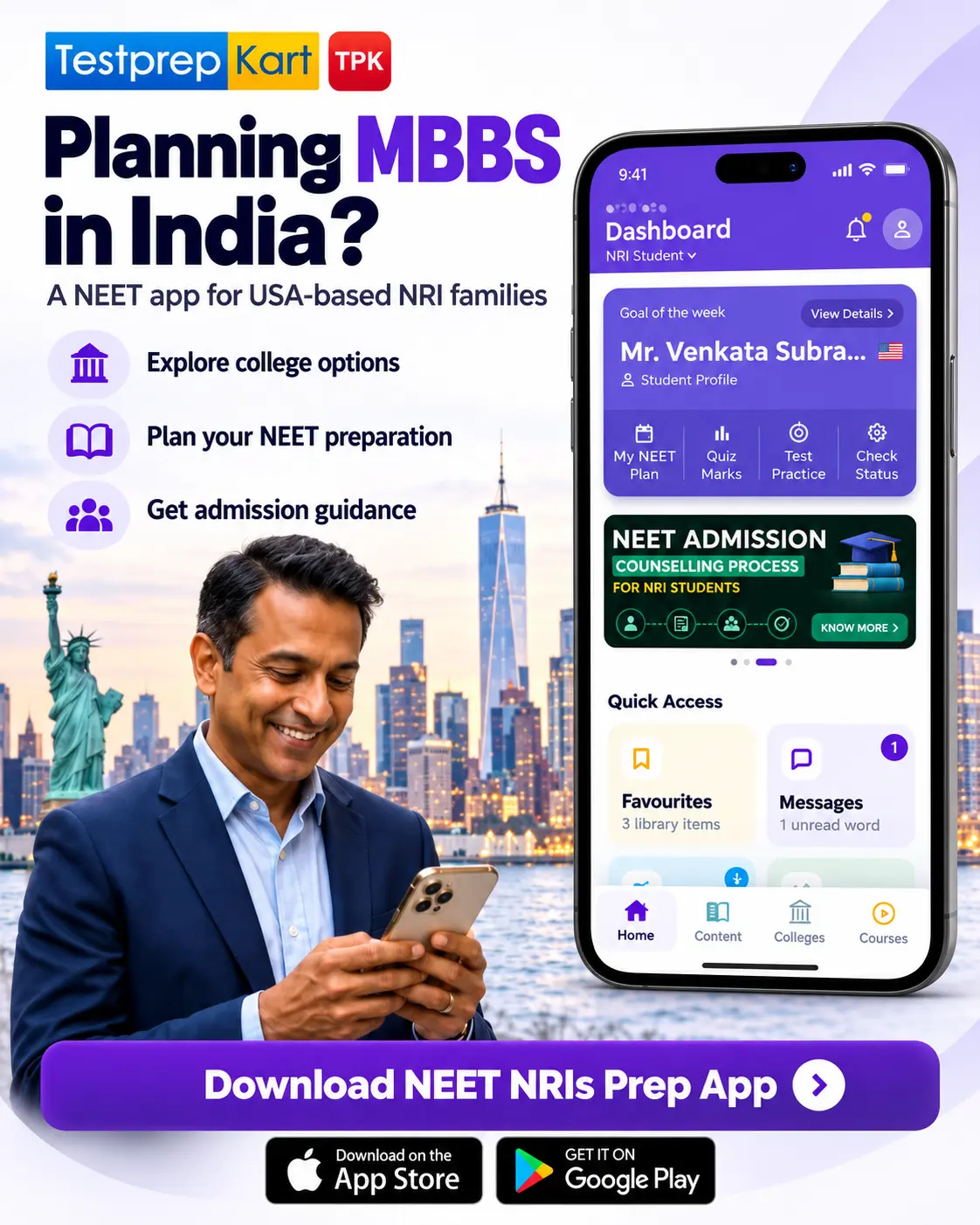
The TestPrepKart app helps students and parents keep preparation, performance and admission planning in one place. It is particularly useful for families managing NEET preparation from the United States or another country.
The student should complete 17 years of age on or before 31 December of the admission year and satisfy the qualifying-examination rules for Physics, Chemistry, Biology/Biotechnology and English. Overseas qualifications may require additional equivalence review.
The review process for foreign students should not only include their subjects of study but also how the subjects show up on the transcripts. For any American institution that integrates science, or uses honor classes or any unconventional way of naming their classes, it is important to get the course descriptions early on.
Do not wait until the reporting stage to discover that a required academic document must be reissued or authenticated.
Karnataka counselling distinguishes among NRI, NRI Ward, OCI/PIO and foreign-national applicants. The candidate should claim the correct status and follow the corresponding verification route rather than assuming all overseas categories use the same documents.
Check direct NRI status and applicable supporting records.
Requires relationship and sponsor proof under KEA rules.
Follow the specific authority instructions and verification requirements.
NRI, OCI and foreign-national labels describe different legal or residency situations. They should not be treated as interchangeable during counselling. The candidate should use the exact status applicable to them and prepare the documents requested for that status rather than relying on a generic “overseas student” file.
For an NRI Ward claim, the sponsor relationship must be supported by the prescribed KEA documentation. The key point is not simply that a relative lives abroad; the relationship must be proved in the form KEA accepts.
Prepare the ward certificate, government-issued family tree and sponsor's NRI/OCI records together. Do not rely only on a self-declared affidavit.
Before naming a sponsor, check whether the relationship is acceptable under the current counselling rules and whether the relationship can be documented clearly. The strongest file is one where the sponsor's NRI status, relationship to the candidate and financial-support role can all be traced through consistent documents.
The latest KEA guidance for an NRI Ward claim requires a family tree signed by the Tahsildar. A family tree signed only by a notary or a standalone relationship affidavit is not accepted for this purpose.
Relationship proof can become one of the most time-consuming parts of an NRI application if names differ across passports, birth records or family documents. Parents should compare spellings, initials and surnames across the entire file and resolve obvious mismatches before document verification.
✓ KEA application / confirmation page
✓ NEET score card
✓ NEET hall ticket / admit card
✓ Class 10 / SSLC record
✓ Class 12 / 2nd PUC or equivalent marks
✓ Identity and photograph documents
✓ Other certificates applicable to the candidate
✓ Prescribed NRI Ward certificate where applicable
✓ Tahsildar-signed family tree
✓ Sponsor embassy certificate
✓ Sponsor passport
✓ Sponsor visa / resident visa
✓ Sponsor NRI/OCI bank proof
Keep one folder for the student's academic and identity records and a second folder for NRI/sponsor evidence. Use clear filenames and keep both PDF scans and original documents ready. This makes online upload, verification and college reporting much easier.
Overseas families should also keep a travel-ready set of originals because reporting windows can be short after allotment.
Sponsor documents should tell one consistent story: who the sponsor is, where the sponsor resides, how the sponsor is related to the student and how the sponsor will support the student's education. Missing one of these links can delay or weaken an NRI claim even when several individual documents are present.
KEA's NRI Ward documentation requires an embassy certificate of the sponsor signed by the Indian Consulate General with embassy seal. The latest instructions also specify that this embassy certificate should be recent, and not merely notarized.
Indian Consulate General + embassy seal.
Sponsor identity and travel-status proof.
Supports overseas residence/status claim.
Use the bank document specified by the current authority rules.
Embassy or consular documentation can require lead time, especially when families are coordinating records across two countries. Start this process early and keep digital copies of every certificate, passport page, visa/residence proof and sponsorship declaration submitted.
If a document is renewed during the admission cycle, retain both the old and new versions so that dates and identity details can be reconciled if questioned.
Some students who completed school outside India may need equivalence or eligibility confirmation for their foreign qualification. This depends on the board, school system and current admission rules.
Students who completed school outside India should not assume that a foreign high-school diploma will be interpreted automatically. Check the latest equivalence requirements early, especially if the school follows a U.S., IB, British or other international curriculum. Processing time can become a bottleneck if the requirement is discovered only after NEET results.
Share your student's Grade 12 curriculum, NEET status, country of study and NRI sponsor details. Get help understanding academic eligibility, NRI/NRI Ward documentation and the correct counselling route before registration.
For KEA-participating seats, the process generally moves from registration and NEET linking to category/document verification, eligibility listing, option entry, allotment and college reporting. Deemed-university NRI seats follow MCC's separate counselling process.
Counselling is not a single form submission. It is a sequence of eligibility checks, category verification, option entry, allotment and reporting. Missing one stage can make later stages irrelevant even if the student has a competitive NEET score.
Parents should track each round with a simple spreadsheet containing the notice date, option-entry window, result date, reporting deadline and documents/payment required.
Treat every step as a checkpoint. Do not move from registration to option entry until the candidate's category and documents are visible correctly in the portal or verification record. A small error at the registration stage can affect which seats appear during choice filling.
KEA may require NRI, NRI Ward, OCI and foreign-national applicants to book a verification slot and appear for document verification at the KEA office when notified. This is different from ordinary applicants whose data may be verified through other routes.
Document verification is where the paper trail behind the NRI claim is tested. Carry originals in the order used in the application and keep one indexed set of photocopies. If the authority asks for a clarification, note exactly which document is deficient rather than replacing unrelated documents.
For U.S.-based families, one parent should remain responsible for India-side document coordination so that courier, notarisation or travel decisions can be made quickly.
Choice filling should be based on genuine preference, not only on the number of NRI vacancies visible in one round. Families should compare the latest fee, hospital exposure, location, travel access and total budget before ranking colleges.
Choice filling should reflect the student's true order of preference, not a prediction of which college will allot. Put the preferred affordable college above a less-preferred “safer” option if the student would genuinely choose it when both are available.
Before locking options, review four filters for every college: affordability, location, clinical environment and willingness to join if allotted.
Seat availability can change materially between rounds because of joining, surrender, upgradation and newly added seats. Always use the round-specific matrix and the current rules for acceptance, cancellation and eligibility to continue.
Broad first opportunity using initial seat availability.
Vacancies and movement after first-round outcomes.
Use only the latest matrix and current eligibility rules.
Later rounds should not be treated as automatically better or cheaper. Vacancies can improve, but the rules around resignation, upgradation, security amounts and reporting can become more restrictive. Read the notice for the specific round instead of assuming the previous round's rules continue unchanged.
Once a seat is allotted, families should immediately verify the college name, category, fee amount, payment deadline, reporting location and original-document list. Do not make a large payment based only on a screenshot or forwarded message; use the allotment record and current counselling instructions.
Compare latest published fees, NRI seat availability and college fit before option entry.
For NRI admission planning, “cutoff” should mean the latest allotment closing position for a specific college, category and round, not only the NEET qualifying percentile. The closing rank can move significantly from one round to another.
Determines whether the student is qualified to participate.
College, quota and round-specific; use the latest published allotment list.
For NRI seats, a “cutoff” is best understood as an allotment outcome, not a fixed qualifying score promised in advance. Closing ranks can move substantially between colleges and rounds because the number of eligible candidates, fees and option preferences all influence demand.
Use the latest published allotment lists to build a range of realistic, stretch and safer options rather than relying on one past closing rank.
An evergreen cutoff table should be refreshed from the newest allotment result rather than showing a stale year in the heading. Use the structure below when you update the live page.
| College | Latest NRI Closing Rank | Round | Planning Note |
|---|---|---|---|
| Dr. B. R. Ambedkar Medical College | Update from latest allotment | Latest available | Use with current NRI seat count and fee. |
| Kempegowda Institute of Medical Sciences | Update from latest allotment | Latest available | Do not compare a different quota's rank. |
| Vydehi Institute of Medical Sciences | Update from latest allotment | Latest available | Track movement across rounds. |
When comparing closing-rank trends, make sure the category and counselling round match. A later-round NRI closing rank should not be compared directly with an early-round management or general seat. The useful question is not “What was the last rank?” but “How did this exact NRI category move across successive rounds?”
There is no single “best” NRI medical college for every student. A sensible shortlist balances academics and clinical exposure with the family's budget, location preference and current NRI-seat availability.
Useful for families prioritising major-city connectivity.
Compare teaching hospitals, fees and travel access.
May offer a different balance of cost, seat movement and location.
For NRI students, “best” should be defined around fit. Families may value a large teaching hospital, urban connectivity, a campus near relatives, lower total cost or a college with a long-established clinical ecosystem. These priorities can point to different shortlists.
Create a scorecard with five columns: clinical exposure, total cost, location, institutional comfort and current NRI availability. This produces a more defensible choice order than ranking colleges by brand name alone.
Review teaching-hospital workload and training environment.
Compare current published fee, not an old blog value.
Consider airport access, city costs and family support.
Check current institutional and course status.
Review latest round, not only initial seats.
The student should be comfortable joining that college if allotted.
Visit or independently review the teaching hospital, hostel situation, travel access and student support before paying a high NRI fee. A college that appears attractive on a fee table may be a poor personal fit if the student is uncomfortable with the city, campus or clinical environment.
With annual NRI tuition commonly in the ₹25-lakh to ₹45-lakh range in the latest published fee schedules, the full MBBS budget can become substantial. Families should estimate the entire course cost before placing a high-fee college near the top of the option list.
| Annual Tuition Example | Five-Installment Tuition Planning | Other Costs |
|---|---|---|
| ₹30 lakh | About ₹1.50 crore | Hostel, mess, travel, deposits and other permitted charges extra |
| ₹40 lakh | About ₹2.00 crore | Additional living and institutional costs extra |
| ₹45 lakh | About ₹2.25 crore | Use as planning math, not an invoice |
These are simple budgeting calculations, not official total-course quotations.
A useful family budget has three layers: admission-year cash requirement, recurring annual cost and full-course exposure. The first-year requirement is often the most urgent because tuition, deposits, hostel and travel may fall within a short reporting window.
Families earning in USD or another foreign currency should also keep a buffer for exchange-rate movement rather than calculating the budget at a single conversion rate.
Core college-specific annual academic fee.
Authority or institution-specific charges may be separate.
Depends on room type and institution.
Important for overseas families and parent visits.
Ask for a written component-wise breakup before final payment. Tuition, university charges, caution deposits, hostel, mess and other permitted institutional charges should be understood separately. This makes it easier to compare colleges and identify which payments are recurring, refundable or one-time.
A Grade 12 student in the United States should plan Karnataka MBBS admission across four tracks at the same time: NEET preparation, academic eligibility, NRI documentation and counselling logistics.
AP/Honors courses do not automatically match the NEET/NCERT syllabus.
Review Physics, Chemistry, Biology and English on the transcript.
Prepare sponsor and family-tree paperwork before verification.
Allotment can create short travel timelines for original-document reporting.
The biggest planning mistake for a U.S.-based student is waiting until senior spring to connect the American school pathway with NEET and Indian admission rules. Grade 11 and early Grade 12 are better used to map the NCERT gap, confirm subject eligibility and begin collecting overseas documents.
Families should also plan who will travel to India for document verification or reporting if the student is still in school in the U.S. A clear travel plan can matter just as much as the academic plan once counselling begins.
Use this checklist before application season, not after. If Physics, Chemistry, Biology or English is missing or appears under an unusual course title, get the issue reviewed while the school can still provide transcripts, letters or course descriptions. This is much easier than resolving a curriculum question during a short counselling window.
Consider a fictional Grade 12 student in Texas whose family wants to explore Karnataka MBBS admission through an NRI / NRI Ward route. The example below shows how the family can reduce last-minute counselling risk.
They assume NRI status plus a qualifying NEET score is enough. They have not yet checked transcript eligibility, Tahsildar family-tree requirements, embassy paperwork or the difference between KEA and MCC counselling.
The strongest NRI plan is built before option entry. Eligibility, NEET preparation, sponsor documents, authority selection and budget should be handled in parallel.
Case study note: This is a fictional planning example and does not represent a guaranteed admission outcome.
The value of the case study is the sequence: verify eligibility first, prepare documents early, set a budget before choice filling, and then rank colleges by genuine preference. The exact college and allotment outcome will differ for every student, but this decision framework remains useful across counselling rounds.
Mixing KEA and MCC routes.
Using last year's fee table instead of latest published values.
Assuming first-round seats are still available later.
KEA requires the prescribed government-signed family-tree route for NRI Ward proof.
Waiting until verification week to obtain sponsor proof.
Ranking by vacancy alone instead of genuine preference.
Most counselling mistakes are avoidable when the family separates eligibility, documentation, money and preference strategy. Do not let one parent focus only on NEET rank while another assumes the documents will be handled later. Create one shared checklist with a named owner and deadline for every task.
Parents can turn this checklist into a simple traffic-light tracker: green for complete, amber for in progress and red for unresolved. Anything still red before option entry, especially eligibility, sponsor proof or budget approval, should be treated as a priority rather than postponed.
NRI families need preparation and admission planning to move together. TestPrepKart can help students organise NEET study, eligibility review, document readiness, college comparison and counselling preparation.
For NRI families, preparation and admission planning work best together. TestPrepKart can help students identify NCERT/NEET learning gaps while families organise eligibility, document and college-planning questions. The aim is to reduce last-minute decisions after NEET results and make counselling choices with a clearer academic and financial plan.
Share your NEET score, NRI status, preferred budget and target colleges. Get help understanding KEA vs MCC, realistic NRI college options, latest fees, documents, choice filling and the next counselling step.
Yes. Karnataka medical counselling includes NRI / NRI Ward pathways in applicable institutions and seat categories. The exact college and authority must be checked in the latest seat matrix.
Yes. NRI status does not exempt a student from qualifying NEET.
The latest published fee structures are college-specific and broadly run from the mid-₹20-lakh range to around ₹45 lakh per year for many NRI seats. Always use the exact current college row.
KEA handles applicable Karnataka state/private/minority/NRI seats. Deemed-university MBBS counselling is conducted through MCC.
It is a category for eligible children/wards of NRIs who satisfy the prescribed relationship and sponsor-document requirements.
No. The current KEA guidance requires the family tree to be signed by the Tahsildar for the NRI Ward claim.
KEA guidance calls for a sponsor certificate signed by the Indian Consulate General with embassy seal, along with the other prescribed NRI documents.
Potentially yes, if the student meets NEET, academic, age, overseas-qualification and NRI-category requirements.
No. Seat availability can change between rounds. Use the current round-specific matrix.
No. Compare latest fee, hospital exposure, location, total cost and the student’s willingness to join.
Deemed-university MBBS seats are handled through MCC counselling, so families should not mix them with KEA option entry.
Start with NEET eligibility, transcript review, NRI relationship proof, sponsor documents, authority identification and a realistic fee budget.
Use the FAQs together with the latest fee sheet, seat matrix and counselling notice. If two sources appear to conflict, give priority to the newest applicable notice for the exact authority, college and counselling round rather than relying on an older summary.
A good NRI admission decision is not simply finding an available seat. It is choosing an eligible, affordable and suitable college through the correct counselling route.
Get Karnataka NRI MBBS GuidanceCopyright © 2024 CounselKart Educational Services Pvt. Ltd.. All Rights Reserved