Free MAP diagnostic demo
Bring the latest Family Report if you have it. We read Math RIT and instructional areas, then leave you a written gap plan for the next window.
Book the free demo →TestPrepKart Math Prep · United States · Interim assessment
A counselor-style parent guide: what the test is, who takes it, how RIT works, what each grade is probing, and how we turn the Family Report into a weekly plan.

MAP prep is not a separate product. It is our Grades 3-10 Math Prep ladder, aimed at the gaps your Family Report already named. Pick the format that fits your week; every path starts with a free diagnostic demo.
Bring the latest Family Report if you have it. We read Math RIT and instructional areas, then leave you a written gap plan for the next window.
Book the free demo →English lessons on US pacing with Indian faculty who know MAP language. Published USD rates live on each grade hub (Grade 3 1:1 is about $18/class on the 12-month plan).
See Grade 3 1:1 details →A fixed weekly slot with peers at a similar level. Useful when you want structure and a lower per-class rate than 1:1 (Grade 3 group is about $14/class).
See group course details →Short packs when one instructional area is dragging the RIT (fractions, ratios, linear functions). Hours and menus sit on each grade’s topic-pack page.
Browse topic packs →We translate RIT and instructional-area bars into weekly practice, not generic worksheets. Parents get plain English updates before the next MAP window.
See how we prepare →Every MAP grade tab links into that grade’s Math Prep hub and course details. Use this exam page as the homepage; go deeper by grade when you enroll.
Open the grade guide →Real screenshots from live TestprepKart math classes. Students and faculty on the call, with the lesson board open.
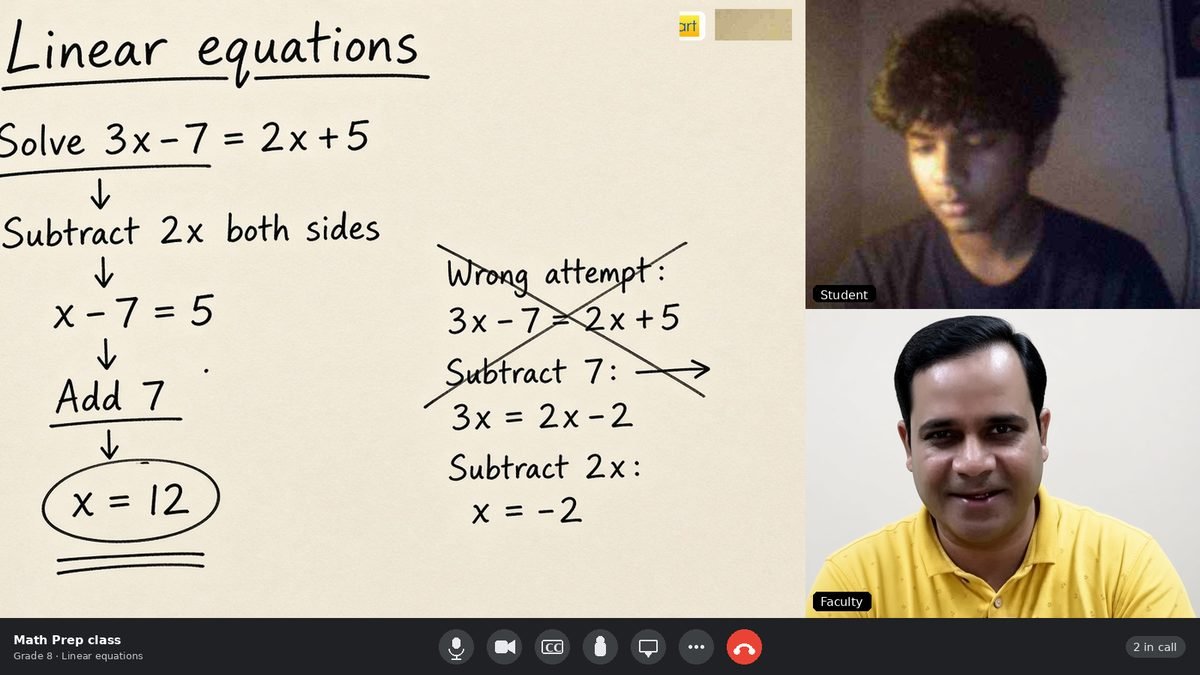


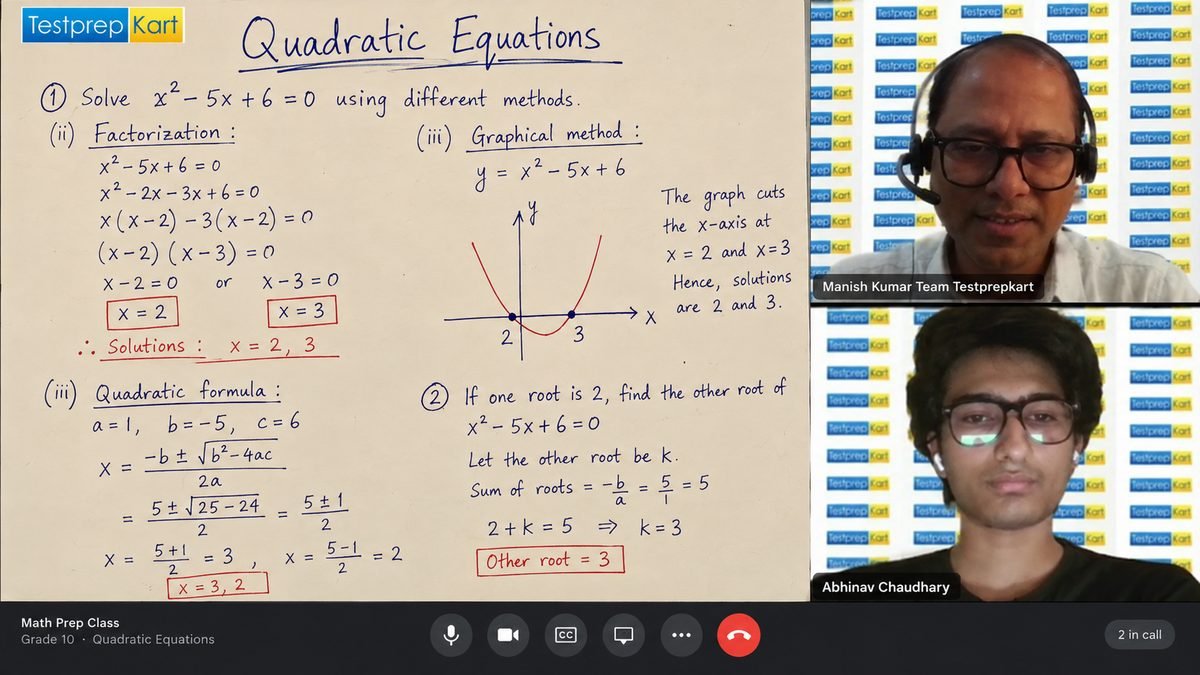

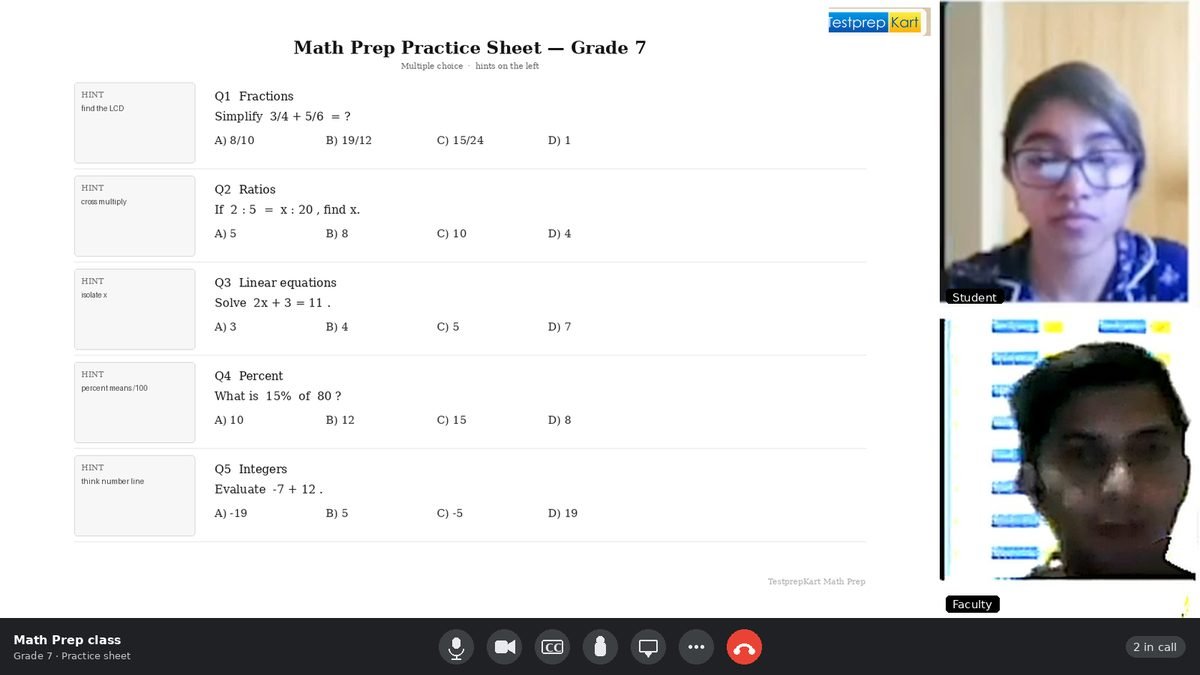
See how live Math Prep sessions run. These three clips are the same on every exam and grade page.
Scan this before the long read. Details for registration, fees, and grade skills sit in the sections below.
| Full name | MAP Growth Math by NWEA (Northwest Evaluation Association) |
|---|---|
| What it is | Computer-adaptive interim math assessment (not the state accountability test) |
| Who takes it | Students in schools/districts that license MAP Growth (typical public/private roster) |
| Parent registration | None for standard school windows. School schedules and rosters students. |
| Parent test fee | None to NWEA for typical school administrations. Tutoring fees are separate. |
| Grades (NWEA) | K-12 overall; TestPrepKart coaches Grades 3-10 |
| Format | Adaptive · about 43 Math items · untimed (often 45-55 minutes) |
| Windows | Fall · Winter · Spring (summer optional). Exact dates come from your school. |
| Score reported | Overall Math RIT, percentiles, instructional-area RITs / ranges |
| Languages | English; Spanish Math available where the district enables it |
Sources for format and scale: NWEA family guidance and MAP Growth Math fact materials. Always confirm your district’s calendar and which Math form your child is assigned.
Schools use MAP Growth Math as a growth check across the year. It estimates what your child knows now and how much they grew since the last window, on a scale that works above and below grade level.
If you are hunting for a parent checkout page on NWEA, you are usually in the wrong place. Use this table, then ask your school portal for the exact window.
| Eligibility | School-enrolled students in a district or school that licenses MAP Growth. English and Spanish Math options exist on the NWEA side; your school chooses what appears. |
|---|---|
| How to register | No parent self-registration for standard school testing. The school/testing coordinator assigns students. Homeschool or private programs that offer MAP will give you their own signup link. |
| Fees | Typical public-school MAP Growth: no parent test fee to NWEA. Private programs may bundle assessment costs into tuition. TestPrepKart tutoring is optional and priced on each grade hub in USD. |
| Primary grades (K-2) | MAP Growth K-2 Math with audio support for emerging readers. We do not currently sell a separate K-2 product page; contact us if you need early-elementary coaching. |
| Grades 2-5 and 6+ | Standard adaptive Math forms. Some high schools also assign course MAP (Algebra 1, Geometry, Algebra 2, Integrated Math). Always confirm the form name. |
| Our coaching band | Grades 3-10 US students, including NRI and Indian-origin families, with Indian faculty teaching US curriculum in English. |
NWEA family materials describe roughly 43 questions for MAP Growth Math in grades 2-12, often 45-55 minutes though the clock is not the point. Item types include multiple choice and technology-enhanced formats.
RIT (Rasch Unit) is an equal-interval scale. Ten points means the same growth step low or high on the scale. Percentiles compare your child with same-grade peers in the national norms sample for that term.
| You see on the report | Counselor question to ask | How we use it in tutoring |
|---|---|---|
| Overall Math RIT | How does this compare with fall / last spring? | Set a growth conversation, not a panic target |
| Achievement percentile | Typical, ahead, or catching up among grade peers? | Balance enrichment vs foundation repair |
| Instructional areas | Which band is lowest this term? | Order the next 4-6 weeks of live lessons |
| Projected / comparative growth | What growth is typical from this starting RIT? | Check whether the plan is ambitious but realistic |
NWEA does not recommend using MAP alone for grade skipping or high-stakes accountability. We treat it as a compass alongside grades and your state test.
| Official NWEA / school covers | What TestPrepKart adds |
|---|---|
| School windows, roster, testing platform, Family Report, RIT and instructional-area bars. | Grades 3-10 tutoring mapped to those instructional areas, in English, with Indian faculty. |
| Adaptive design and national norms on NWEA family materials. | Calm coaching so parents read RIT and growth instead of raw percent correct. |
| District calendar and which Math form your child is assigned. | A written gap plan after a free diagnostic demo, tied to the next MAP window. |
Start with your school portal and NWEA family guidance. Then book our demo for a human Math plan.
Pick a grade. You get the instructional areas, the skills we expect, how we prep, and links into that grade’s Math Prep hub and course details. Deeper standalone MAP-by-grade pages can follow; these links are the path.
Times tables, equal groups, fractions as numbers, area, and early data.
Instructional areas (MAP Math 2-5)
Skills we expect to see
Multi-digit operations, fraction equivalence, angles, and place-value depth.
Instructional areas (MAP Math 2-5)
Skills we expect to see
Fraction operations, decimals, volume, and the coordinate plane.
Instructional areas (MAP Math 2-5)
Skills we expect to see
Ratios, rational numbers, expressions, and early statistics.
Instructional areas (MAP Math 6+)
Skills we expect to see
Proportional relationships, rational operations, equations, probability.
Instructional areas (MAP Math 6+)
Skills we expect to see
Linear functions, systems, transformations, Pythagorean theorem.
Instructional areas (MAP Math 6+)
Skills we expect to see
Traditional Pathway Algebra I: linear, exponential, quadratic ideas.
Instructional areas (Math 6+ or Algebra 1 course MAP)
Skills we expect to see
Traditional Pathway Geometry after Algebra I: proof, similarity, trig, circles.
Instructional areas (Math 6+ or Geometry course MAP)
Skills we expect to see
MAP prep is not a separate product from school math. It is your child’s grade ladder, aimed at the gaps the Family Report already named.
Free demo: open Math RIT, percentile, and instructional areas together.
Pick two or three bands that will move the needle before the next window.
1:1 or group tutoring in English on US pacing, with homework rescue when it matches.
Brief practice for stamina and calm. Mistake review beats volume.
Plain notes before the window: what improved, what still wobbles, how to talk about MAP at home.

A useful MAP story is a clear chart: where fall started, what grew by winter, and which instructional areas still need work before spring state testing or the next grade.

Many MAP families are Indian-origin or NRI households balancing US classroom language with high expectations at home. We keep instruction in English and explain RIT the way a counselor would at conference night.
Live 1:1. Bring your latest Family Report if you have it. Leave with a written gap plan for the next window.
Usually no. MAP Growth is licensed by the school or district. Families do not buy a seat from NWEA the way they might for Math Kangaroo or AMC. Your cost, if any, is school-related (none at most public districts). Tutoring fees are separate if you hire TestPrepKart.
You do not register on an NWEA parent portal for the standard school administration. The school schedules the window, assigns the roster, and shares the Family Report afterward. If your child is homeschooled or in a private program that offers MAP, ask that program for their signup steps.
NWEA bills institutions, not individual parents, for typical school MAP Growth. We will never invent a parent MAP fee. Our demo is free; ongoing tutoring uses published Math Prep USD rates on the grade hubs.
No. MAP is an interim adaptive check. STAAR, CAASPP, NJSLA, and similar exams are separate accountability tests. Many schools use fall/winter/spring MAP to aim instruction before the spring state test.
There is no single pass mark. Schools look at RIT, national percentile for the grade and term, and growth since the last window. Bring the Family Report to your demo so we plan from instructional areas, not a vanity number.
On an adaptive test, landing near 50 percent correct is normal. The engine is finding the difficulty where your child is right about half the time. Read the RIT and skill bars, not the raw percent correct.
TestPrepKart Math Prep coaches Grades 3-10 in the US, including NRI and Indian-origin families. MAP itself is K-12 on the NWEA side. Use the grade guide on this page, then open that grade hub for syllabus depth.
Four to eight weeks of steady work is common when the last report showed clear gaps. If the window is sooner, we still start with the highest-leverage skills instead of cramming the whole grade.
No. Growth depends on school instruction, attendance, and the adaptive form. We can strengthen the instructional areas on the Family Report and rehearse the adaptive feel.
It depends on the Math form and tools your school enables in the testing platform. Many upper-grade forms include an on-screen calculator for some items. Ask the school what your child will see, then practice with the same rule.
If MAP season is on your school calendar, start with a calm diagnostic demo. We will say honestly whether tutoring should focus on foundations, enrichment, or a mix.