Free diagnostic demo
Bring the last scale score / level report if you have it. Leave with a written gap plan for CAT and PT work.
Book the free demo →TestPrepKart Math Prep · Consortium states · Summative assessment
Counselor-style guide: CAT + performance task, Levels 1-4, what each grade is probing, and what we offer if you want preparation.

State portals already publish blueprints, score guides, and local brand names (for example CAASPP). Our job is different: turn your child’s Math level report into a weekly CAT + performance-task plan you can book.
Bring the last scale score / level report if you have it. Leave with a written gap plan for CAT and PT work.
Book the free demo →English lessons with Indian faculty on US pacing. Published USD rates sit on each grade hub (Grade 3 1:1 about $18/class on the 12-month plan).
See 1:1 course details →Fixed weekly slots when you want peer energy and a lower per-class rate (Grade 3 group about $14/class).
See group details →Short packs when one claim or domain is dragging Level 2→3 movement (fractions, ratios, linear functions, reasoning).
Browse topic packs →We translate Levels 1-4 and claim bars into concrete practice, not a second copy of the consortium site.
See after-the-test guidance →Every grade tab links into that grade’s Math Prep hub and course details.
Open the grade guide →Real screenshots from live TestprepKart math classes. Students and faculty on the call, with the lesson board open.
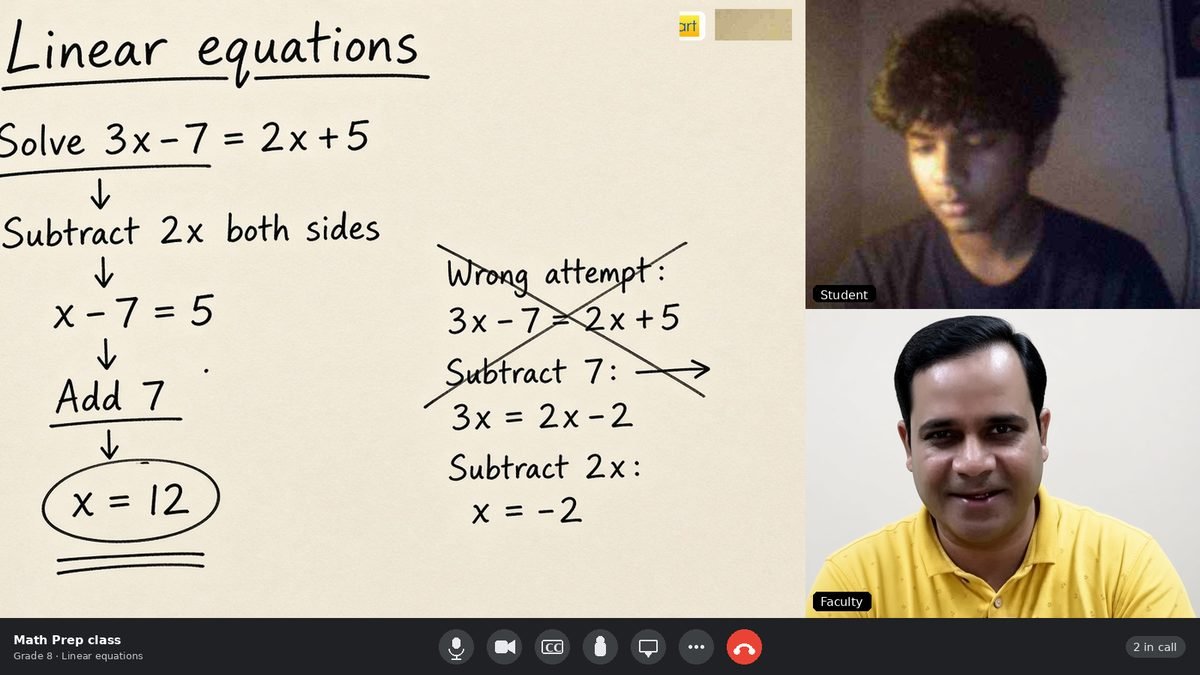


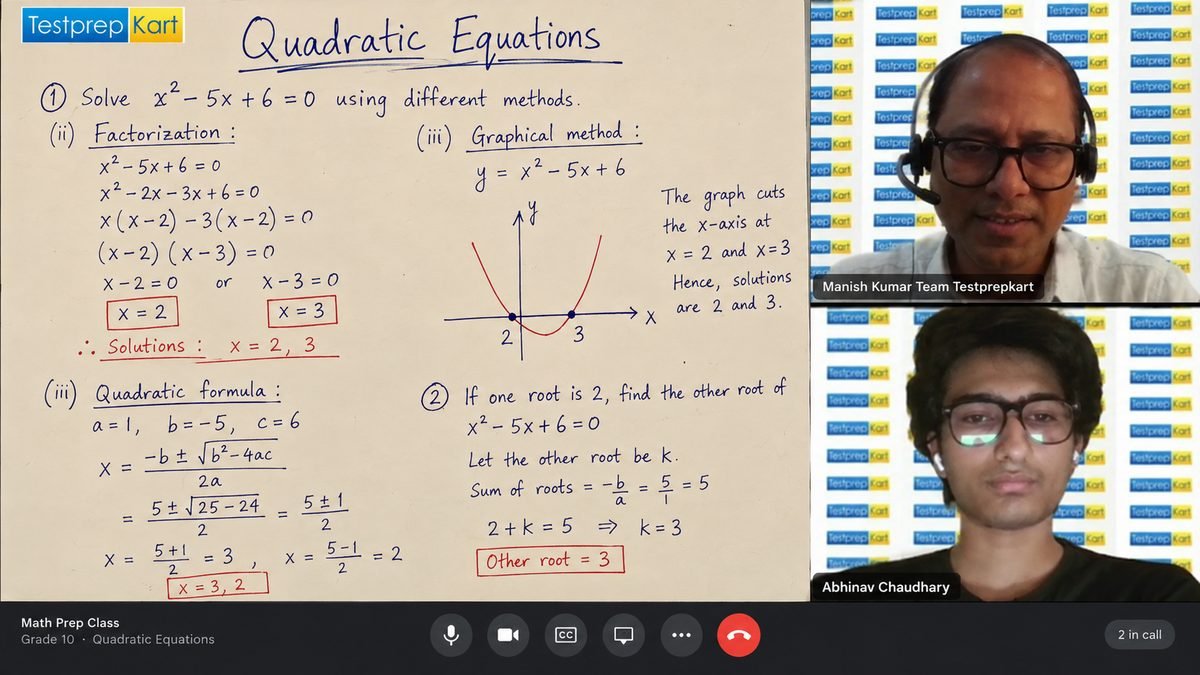

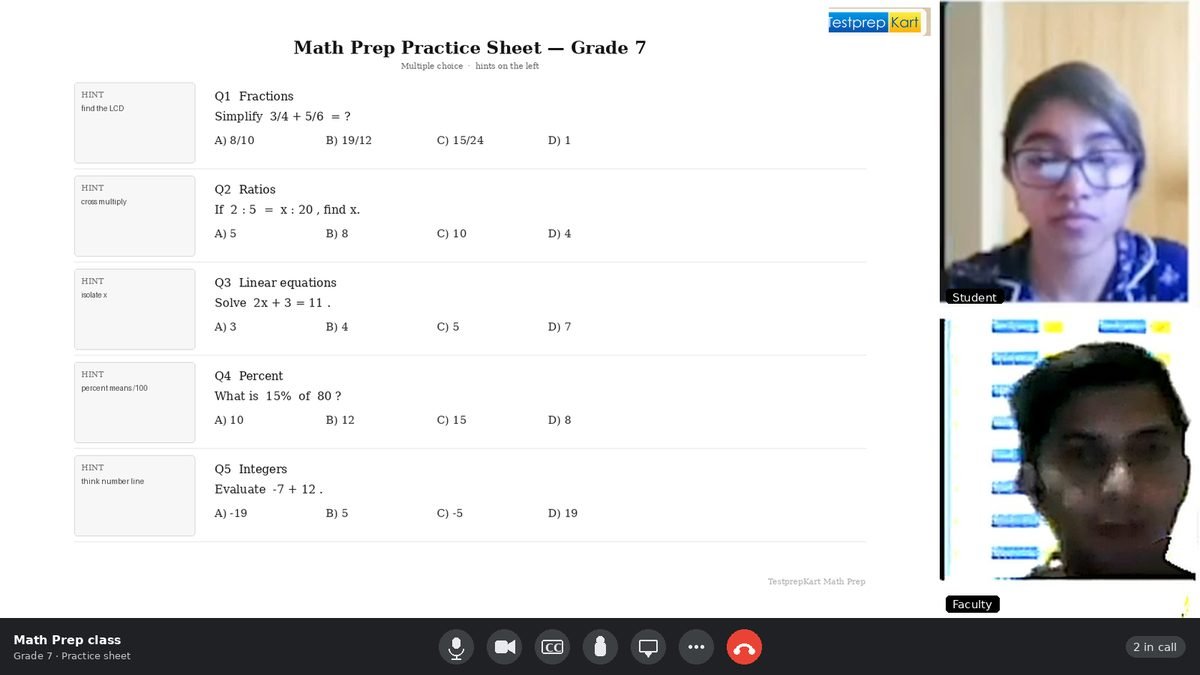
See how live Math Prep sessions run. These three clips are the same on every exam and grade page.
Scan this before the long read. Registration, fees, and grade skills sit below.
| Full name | Smarter Balanced Assessment Consortium Mathematics Summative |
|---|---|
| What it is | State summative Math test used by consortium members (often branded locally, e.g. CAASPP in California) |
| Who takes it | Students in participating states/districts, most often Grades 3-8 Math (high school rules vary by state) |
| Parent registration | None for standard school windows. School schedules and rosters students. |
| Parent test fee | None to the consortium for typical public-school administrations. Tutoring fees are separate. |
| Format | Computer adaptive test (CAT) + performance task (PT); untimed estimates about 2.5-3 hours for Grades 3-8 Math |
| Windows | Primarily spring. Exact dates come from your state/district calendar. |
| Score reported | Scale score (about 2000-3000 band) + Achievement Levels 1-4; claim scores may also appear |
| Our coaching band | Grades 3-10 US families, including NRI and Indian-origin students |
Sources: Smarter Balanced scoring and blueprint materials; estimated times from consortium documentation. Confirm your state’s brand name and calendar.
States in the consortium use shared blueprints. Your parent portal may say CAASPP or another local label while the Math design still follows Smarter Balanced claims.
If you are hunting for a parent checkout page on the consortium site, you are usually in the wrong place.
| Eligibility | Students in consortium member states/districts that administer the Math summative (commonly Grades 3-8). |
|---|---|
| How to register | No parent self-registration for standard school testing. The school assigns the roster. |
| Fees | Typical public-school administration: no parent test fee to the consortium. TestPrepKart tutoring is optional and priced on each grade hub in USD. |
| Local brand names | California families often see CAASPP. Other states keep Smarter Balanced naming. Ask the school which label appears on the report. |
| High school | Some members test Grade 11; others use different EOCs. Confirm before assuming a Grade 9-10 SBAC Math day. |
| Our coaching band | Grades 3-10 US students, including NRI and Indian-origin families, with Indian faculty teaching in English. |
Consortium estimates for full Math blueprints are about 2 hours 30 minutes in Grades 3-5 and about 3 hours in Grades 6-8, split across CAT and PT. Tests are designed as untimed.
Smarter Balanced and state sites (including CAASPP in California) own blueprints, practice tests, and score explanations. Parents still need a calm Math plan afterward. That is our lane.
| Topic | What official sites cover | What we add for Math prep |
|---|---|---|
| Testing window | State / district calendars set the spring summative window. | We count backward from your window and build an 8-12 week claim-aligned plan (or a shorter triage plan). |
| CAT + performance task | Consortium blueprints describe adaptive CAT items and the fixed PT. | Practice mixes adaptive stamina with short explanation drills so Claim 3 does not surprise your child. |
| Score reports | Scale score, Levels 1-4, and often claim bars on the family report. | Bring the report to the demo. We turn weak claims into a weekly tutoring menu. |
Start with your state’s parent portal or smarterbalanced.org resources for official guides. Confirm brand name and dates with your school.
Official guides explain how to read the report. The missing piece is usually a simple next step in Math.
Overall Math sits on a continuous scale that increases across grades. Achievement levels help conferences; claim scores show where reasoning or procedures need work.
| Signal | Plain English | How we use it |
|---|---|---|
| Scale score | Overall Math number on the consortium scale | Track year-to-year growth with the school report |
| Level 1-2 | Below the Level 3 on-track band | Urgent gap plan on priority clusters |
| Level 3 | On track for many state definitions | Polish multi-step and Claim 3 explanations |
| Level 4 | Advanced band | Maintain fluency; stretch carefully |
Cut scores differ by grade. We read your child’s report rather than quoting a single universal cut.
Pick a grade for claim focus, skills, prep notes, and hub links.
Operations, early fractions, measurement, and explaining reasoning on the performance task.
SBAC Math Grade 3 · Claims 1-4
Multi-digit operations, fraction equivalence, angles, and modeling.
SBAC Math Grade 4 · Claims 1-4
Fraction/decimal operations, volume, coordinates, and communicating reasoning.
SBAC Math Grade 5 · Claims 1-4
Ratios, rational numbers, expressions, and statistics modeling.
SBAC Math Grade 6 · Claims 1-4
Proportional relationships, rational operations, probability, and modeling.
SBAC Math Grade 7 · Claims 1-4
Linear functions, systems, transformations, and Pythagorean theorem.
SBAC Math Grade 8 · Claims 1-4
Many states test high school math later; we still coach Algebra I strength that feeds later summative scores.
High school path · state may use Grade 11 SBAC or course EOCs
Geometry and advanced algebra habits that support later high-school summative and college-path tests.
Geometry / Algebra II path · state summative varies
Prep is your child’s grade ladder aimed at the gaps the last level report already named.
Open scale score, level, and claim bars if shown.
Pick the two or three clusters that will move the needle.
1:1 or group tutoring in English on US pacing.
Adaptive stamina practice plus explanation drills.
Plain notes on what improved and what still wobbles.


A useful SBAC story is which claims are solid, which need work before the next grade, and what weekly practice will change.
Many of our families in California and other consortium states are Indian-origin or NRI. Tutors teach in English and explain claim language without assuming you grew up with SBAC.
A live 1:1 session. Your child does real grade-level Math. You leave with a written plan, enroll or not.
Usually no. Member states and districts administer the summative. Families do not buy a parent seat from the consortium the way they might for a Saturday contest. Tutoring fees are separate if you hire TestPrepKart.
Through the school. Ask the campus testing coordinator or parent portal for the spring window. State branding may say CAASPP, SBAC, or another local name while still using Smarter Balanced blueprints.
Scale scores map to four achievement levels. Level 3 and Level 4 are the on-track / advanced bands many states highlight. Exact cut scores differ by grade; we read your child’s report instead of inventing a universal number.
The computer adaptive test (CAT) adjusts item difficulty as your child answers. The performance task (PT) is a fixed, longer set that often needs written explanations and modeling. Both matter for the overall score.
No. MAP is an interim adaptive check. Smarter Balanced summative is a state accountability test in consortium states. Some districts use both in the same year.
We coach Grades 3-10. Summative Math is most common in Grades 3-8; high school depends on the state. Use the grade guide, then open that grade hub.
Eight to twelve weeks of steady Common Core / claim-aligned work is common when the last level showed clear gaps. If the window is sooner, we still start with the highest-leverage skills.
No. We can show a gap plan, practice rhythm, and progress notes. Outcomes depend on starting point, attendance, and school instruction.
Use your state’s assessment portal or Smarter Balanced family resources for practice tests and score explainers. We do not host the official portal. We help you turn that report into a weekly Math plan.
In California, CAASPP is the statewide program that includes the Smarter Balanced Math summative for most Grades 3-8 students. Other states keep different brand names while using the same consortium design. Ask your school which label appears on the report.
Calculator availability depends on grade and item. The digital test provides tools when an item allows them. Ask the school what your child will see in the practice test, then match that at home.
Book a free demo or WhatsApp us with your child’s grade and last level.