Free diagnostic demo
Bring the last state Math report if you have it. Leave with a written gap plan for the spring window.
Book the free demo →TestPrepKart Math Prep · NJ · GA · IL · State assessments
One counselor-style page for three state Math tests: what they are, how scores read, what each grade is probing, and what we offer so prep is not a second DOE website.

State education sites already publish calendars, sample items, and score guides for New Jersey, Georgia, and Illinois. Our job is different: turn your child’s Math report into a weekly plan mapped to our Grades 3-10 hubs.
Bring the last state Math report if you have it. Leave with a written gap plan for the spring window.
Book the free demo →English lessons with Indian faculty on US pacing. Published USD rates sit on each grade hub (Grade 3 1:1 about $18/class on the 12-month plan).
See 1:1 course details →Fixed weekly slots when you want peer energy and a lower per-class rate (Grade 3 group about $14/class).
See group details →Short packs when one domain is dragging level movement (fractions, ratios, linear functions).
Browse topic packs →We translate each state’s level language into concrete practice, not a second copy of the DOE site.
See after-the-test guidance →Every grade tab links into that grade’s Math Prep hub and course details.
Open the grade guide →Real screenshots from live TestprepKart math classes. Students and faculty on the call, with the lesson board open.
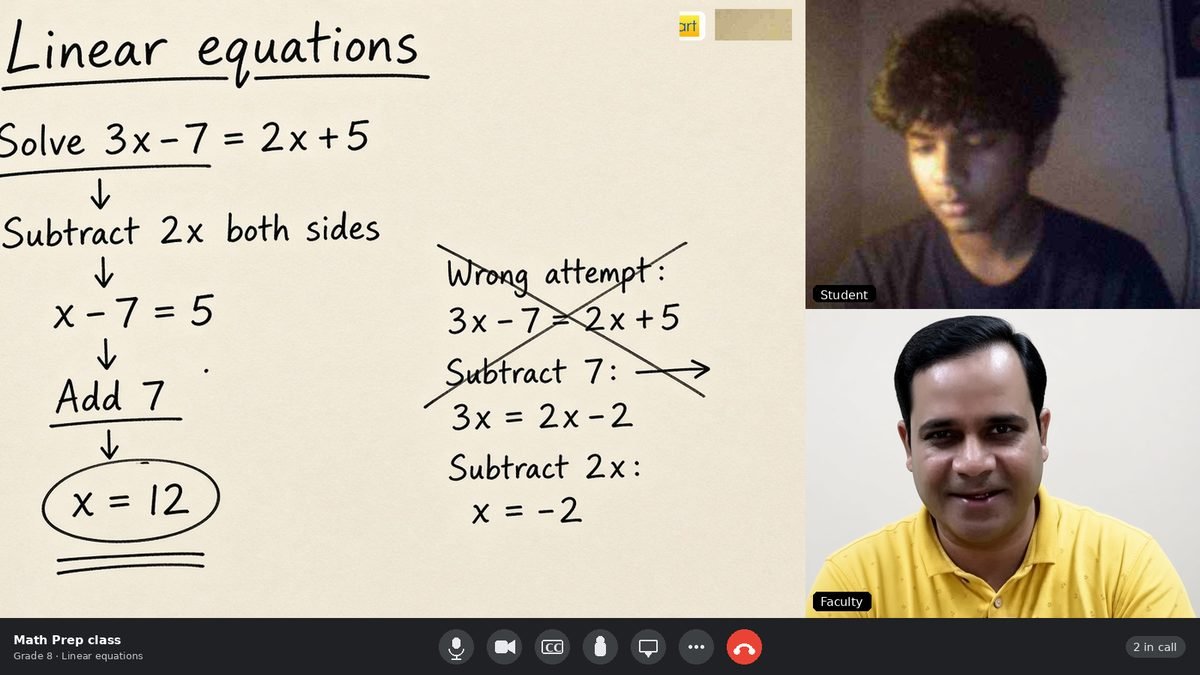


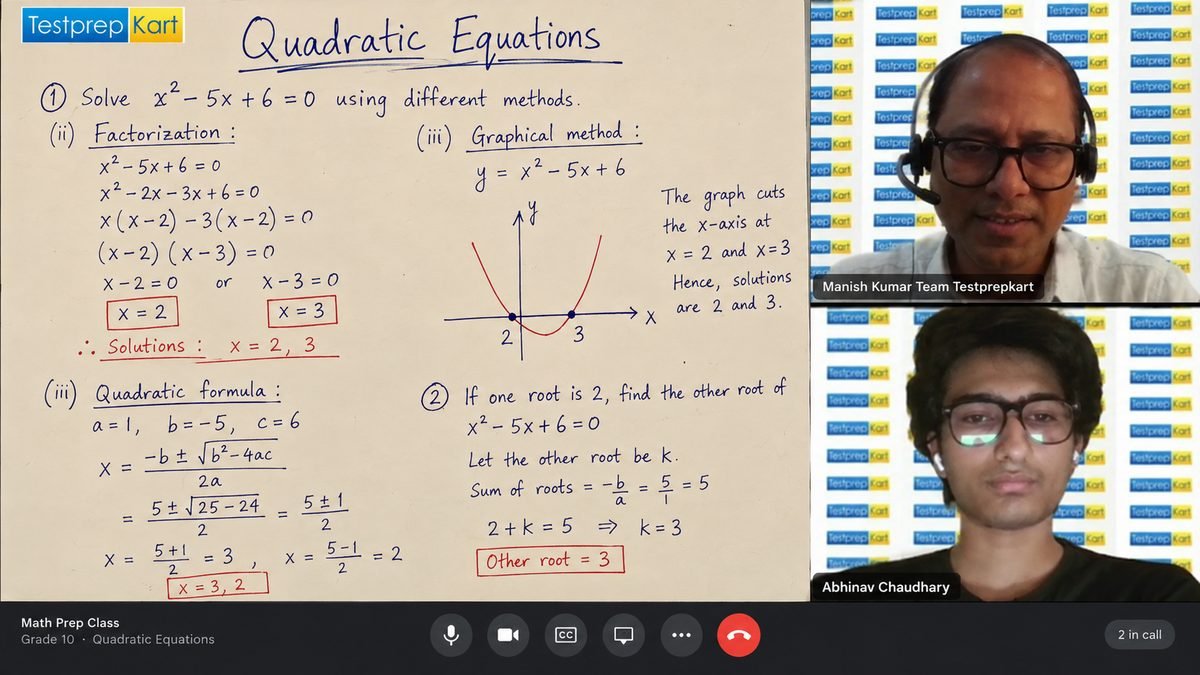

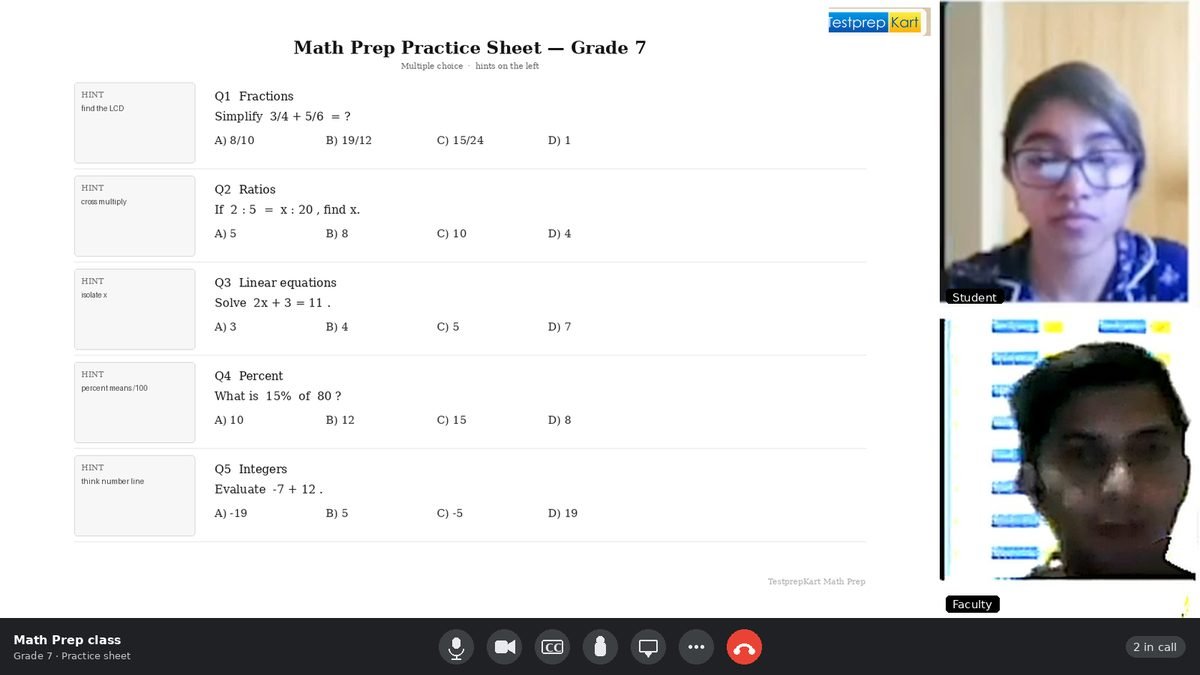
See how live Math Prep sessions run. These three clips are the same on every exam and grade page.
Scan this first. State portals own official dates and PDFs. We own the tutoring plan.
| NJSLA (New Jersey) | New Jersey Student Learning Assessment, Math Grades 3-8 (+ high-school course Math as assigned) |
|---|---|
| GMAS (Georgia) | Georgia Milestones End-of-Grade Math Grades 3-8 (EOC Math courses in high school / accelerated middle school) |
| IAR (Illinois) | Illinois Assessment of Readiness Math Grades 3-8 |
| What they are | State accountability Math tests aligned to each state’s learning standards |
| Parent registration | None for standard school windows. School schedules students. |
| Parent test fee | None to the state for typical public-school administrations. Tutoring fees are separate. |
| Typical window | Primarily spring. Exact dates come from your district. |
| Our coaching band | Grades 3-10 US families, including NRI and Indian-origin students |
We group NJSLA, GMAS, and IAR because families ask the same questions. The standards labels differ; the need for a weekly Math plan does not.
| Eligibility | Public-school students in New Jersey, Georgia, or Illinois in tested Math grades/courses (and participating programs). |
|---|---|
| How to register | No parent self-registration. The school/testing coordinator assigns students. |
| Fees | Typical public-school administration: no parent test fee. TestPrepKart tutoring is optional and priced on each grade hub in USD. |
| Our coaching band | Grades 3-10, including NRI and Indian-origin families, with Indian faculty teaching in English. |
| State test | What official sites cover | What we add |
|---|---|---|
| NJSLA (NJ) | Overview, adaptive FAQs, score interpretation, performance levels. | Translate Level 1-5 Math results into NJSLS-aligned weekly tutoring. |
| GMAS (GA) | Milestones parent Q&A, achievement level descriptors, spring EOG windows. | Plan from Beginning/Developing/Proficient/Distinguished toward the next Learner step on Georgia standards. |
| IAR (IL) | ISBE IAR pages and parent score interpretation guides (scale 650-850, Levels 1-4). | Use overall level plus subclaim H/M/L style signals to pick practice strands. |
Official starting points: nj.gov/education/assessment, Georgia Milestones parent resources (GaDOE), isbe.net/iar. Always confirm dates with your school.
Exact minutes and calculator rules differ by state and grade. We match practice to the rules your school publishes.
| State | Level language (plain English) | How we use it |
|---|---|---|
| NJSLA | Five levels: Did Not Yet Meet → Exceeded Expectations | Met / Exceeded = on track; below that = targeted strand plan |
| GMAS | Beginning / Developing / Proficient / Distinguished Learner | Move one Learner step with TEKS-free Georgia standards coaching |
| IAR | Levels 1-4: Below → Approaching → Proficient → Above | Levels 3-4 signal readiness; subclaims steer weekly topics |
We do not invent cut scores. Bring the report; we read the bands your state already printed.
Pick a grade for skills, prep notes, and hub links. Standards wording differs by state; the skill spine is shared enough to coach from one plan.
Operations, early fractions, measurement, and explaining multi-step stories.
State Math Grades 3 · NJSLS / Georgia / Illinois standards
Multi-digit operations, fraction equivalence, angles, and modeling.
State Math Grade 4
Fraction/decimal operations, volume, coordinates, and reasoning.
State Math Grade 5
Ratios, rationals, expressions, and statistics.
State Math Grade 6
Proportional relationships, rational operations, probability.
State Math Grade 7
Linear functions, systems, transformations, Pythagorean theorem.
State Math Grade 8 (or Algebra path where applicable)
Many Grade 9 students take Algebra I end-of-course style assessments (NJSLA Algebra I, Georgia Algebra EOC path).
Algebra I / course assessments (state-dependent)
Geometry or Algebra II course assessments where the state assigns them; otherwise course strength for later tests.
Geometry / Algebra II path (state-dependent)
Open the state Math level and strand / subclaim signals.
Pick the two or three strands that will move the needle.
1:1 or group tutoring in English on US pacing.
Short practice with item types your state uses.
Plain notes on what improved and what still wobbles.


A useful state Math story is which strands are solid, which need work before the next grade, and what weekly practice will change.
Many of our families in these states are Indian-origin or NRI. Tutors teach in English and explain each state’s level language without assuming you grew up with it.
A live 1:1 session. Your child does real grade-level Math. You leave with a written plan, enroll or not.
Usually no. These are school-administered state assessments. Families do not buy a parent seat. Tutoring fees are separate if you hire TestPrepKart.
Through the school. Ask the campus testing coordinator or parent portal for the spring window. Official score portals differ by state (New Jersey, Georgia, Illinois).
NJSLA Math uses five levels from Did Not Yet Meet through Exceeded Expectations. Georgia Milestones uses Beginning / Developing / Proficient / Distinguished Learner. Illinois IAR Math uses Levels 1-4 (Below / Approaching / Proficient / Above Proficient). We read your child’s report, not a universal cut score.
No. MAP is an interim adaptive check. Smarter Balanced is a consortium summative used in other states. NJSLA, GMAS, and IAR are each state’s accountability Math test (with their own portals and level names).
Grades 3-10. Summative Math is most common in Grades 3-8; high school depends on Algebra / Geometry course tests. Use the grade guide, then open that grade hub.
Eight to twelve weeks of steady standards-aligned work is common when the last level showed clear gaps. If the window is sooner, we still start with the highest-leverage skills.
New Jersey: nj.gov/education/assessment. Georgia: Georgia Milestones parent resources on GaDOE. Illinois: isbe.net/iar and the IAR score interpretation guides. We link the ideas here; we do not host those portals.
No honest tutor can. We can show a gap plan, practice rhythm, and progress notes.
They are three state summative Math programs (New Jersey, Georgia, Illinois) with different score dictionaries and portals, but the same parent problem: a spring level and a fuzzy next step. We map tutoring to each state's language without pretending they are one test.
Book a free demo or WhatsApp us with your state, grade, and last level.