Free Quantitative reasoning demo
Your child tries CogAT-style quantity relationship items. You leave with a written plan and report-reading notes.
Book the free demo →TestPrepKart Math Prep · Gifted screening · Quantitative battery
Not a contest medal hunt and not a state Math clone. CogAT Quantitative looks at how your child reasons with quantities. This page is the counselor manual: what the battery measures, how SAS/stanine language reads, and what we can honestly help with before a school window.

Districts and Riverside own the test windows and score reports. Our job is different: strengthen Quantitative reasoning habits for Grades 3-7, teach parents how to read SAS/stanine language, and stay honest that gifted identification rules belong to the school.
Your child tries CogAT-style quantity relationship items. You leave with a written plan and report-reading notes.
Book the free demo →English lessons with Indian faculty. School fluency stays warm; quantitative relationship puzzles get dedicated airtime.
See a 1:1 course example →Weekly peer energy for families who want structure without a contest-cram vibe.
See group details →Short packs when arithmetic gaps block reasoning items.
Browse topic packs →We translate SAS, percentile, stanine, and Ability Profile language into a calm next step.
See scores explained →Reasoning prep still needs school Math strength. Every grade tab links into that hub.
Open the grade guide →Real screenshots from live TestprepKart math classes. Students and faculty on the call, with the lesson board open.
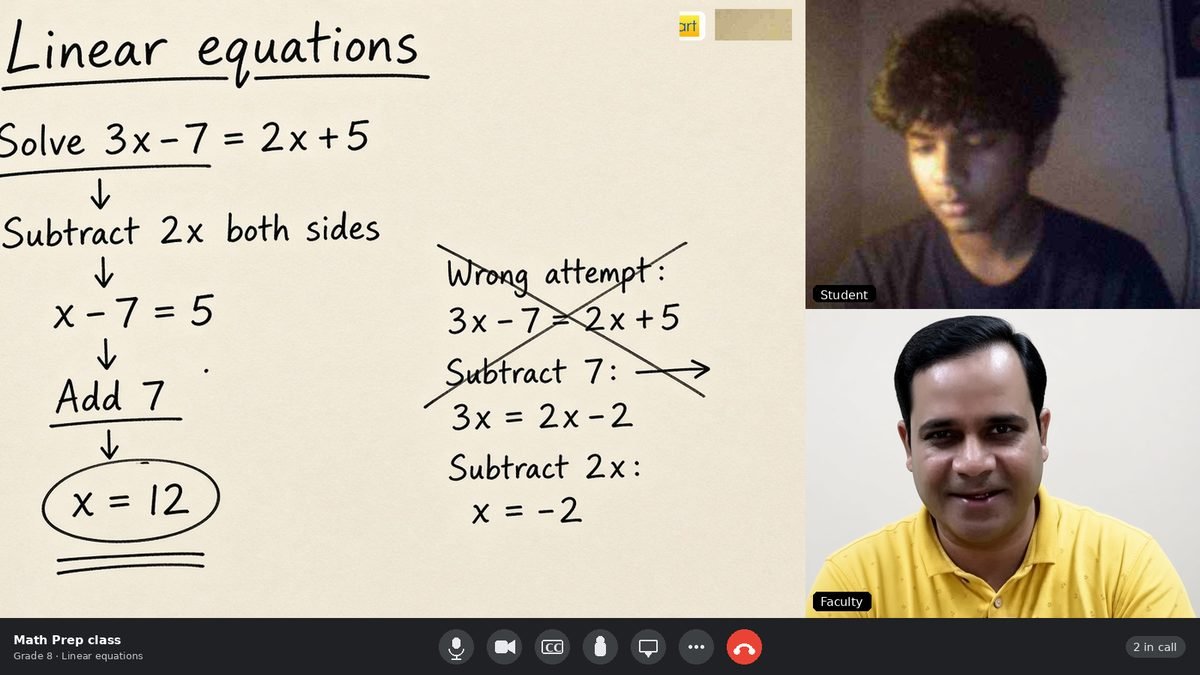


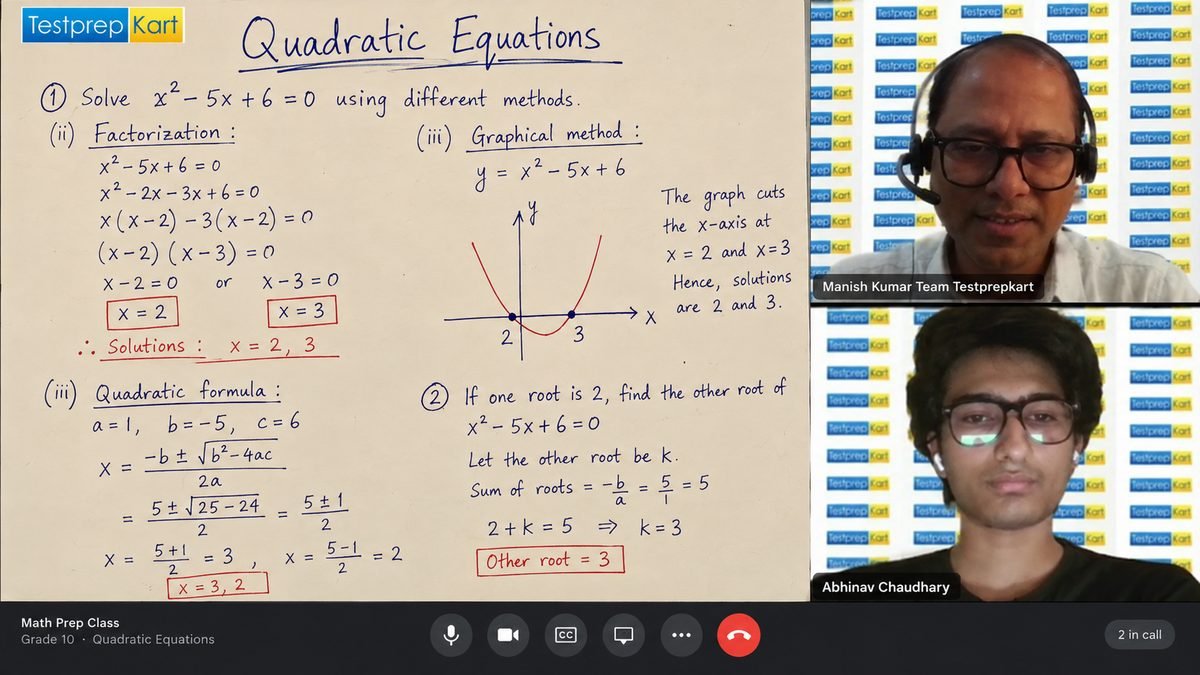

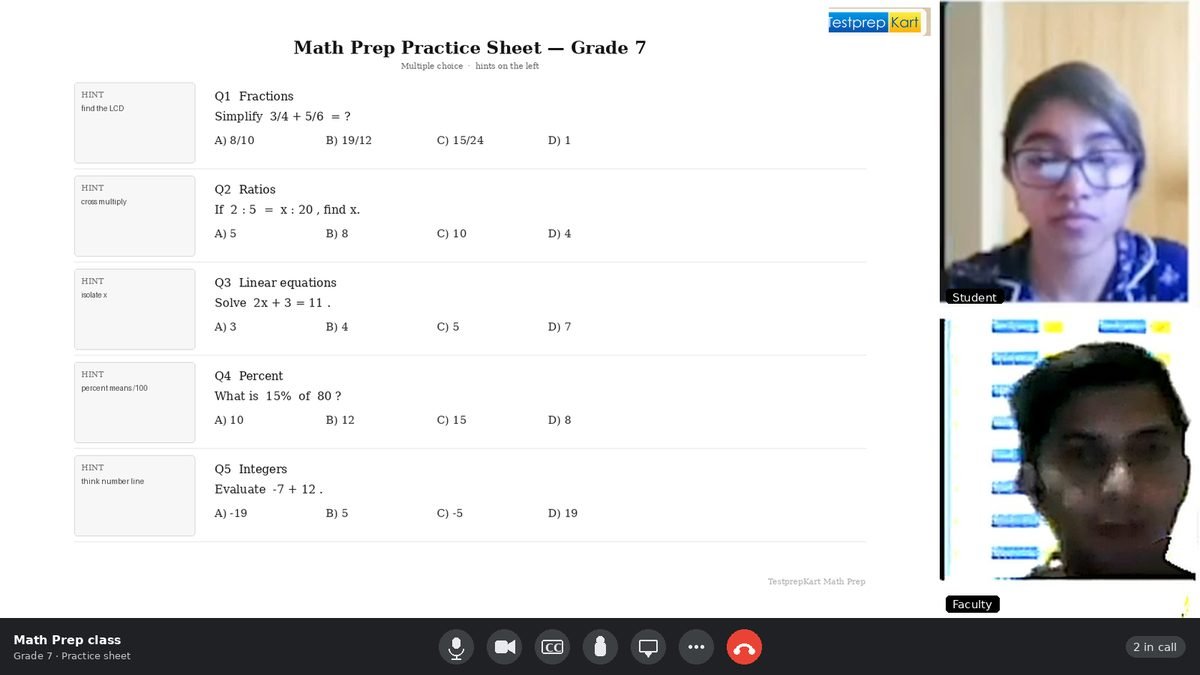
See how live Math Prep sessions run. These three clips are the same on every exam and grade page.
| Full name | CogAT · Cognitive Abilities Test (commonly Forms 7/8) |
|---|---|
| What we focus on | Quantitative battery (quantity relationships, patterns, number analogies) |
| Also on the full test | Verbal and Nonverbal batteries (+ composite) |
| Who takes it | Usually school-scheduled students in district screening / placement windows |
| Parent registration | Typically none for standard district administrations |
| Score language | SAS (mean 100), percentile ranks, stanines 1-9, Ability Profiles |
| Our coaching band | Grades 3-7 US families, including NRI and Indian-origin students |
CogAT is built to describe developed cognitive abilities, not to mirror one state's grade-level Math blueprint. Parents still ask us about the Quantitative battery because gifted and enrichment decisions often mention it.
| Eligibility | Students scheduled by the district/campus for screening or related assessment. Grade bands vary by district policy. |
|---|---|
| How to register | No typical parent self-registration. Ask the counselor or GT coordinator for the window and whether Screening Form or full batteries are used. |
| Fees | Usual public-school administration: no parent test fee. TestPrepKart tutoring is optional USD pricing on grade hubs. |
| Our coaching band | Grades 3-7 Quantitative focus, Indian faculty teaching in English, with honest gifted-rule counseling. |
Reasoning with quantities and number relationships. This is the 'CogAT Math' parents usually mean.
Verbal covers word/reasoning with language. Nonverbal uses figures and shapes. Screening Forms may sample one subtest from each battery.
Normalized score with mean 100 and SD about 16 for age peers. SAS 100 is typical development for age. Higher SAS means faster/higher development than same-age peers on that battery.
Percentile rank shows the percent of age (or grade) peers scoring below your child. Stanines compress percentiles into bands 1-9 (for example stanine 9 pairs with very high percentiles).
Profiles can mark relative strengths/weaknesses across batteries (for example a generally high profile with relative Q-). Use them to guide practice emphasis, not to label a child permanently.
| Official / district covers | What TestPrepKart adds |
|---|---|
| Administration windows, which form is used, gifted identification policy, parent score reports. | Grades 3-7 Math Prep plus Quantitative relationship practice timed to your window. |
| Interpretive guides for SAS, percentiles, stanines, Ability Profiles. | Plain-English report reading and a next-step plan that does not invent cut scores. |
| Local decisions about enrichment or further assessment. | Honest coaching on what tutoring can and cannot change before a screen. |
Early quantitative reasoning: number relationships, patterns, and analogies more than chapter drills alone.
CogAT Quantitative · school gifted screening window
Stronger multi-step quantitative relationships. Still an ability measure, not a TEKS/Common Core clone.
CogAT Quantitative · Form 7/8 style batteries (district-dependent)
Quantitative scores often sit beside achievement data in gifted conversations. We keep both stories honest.
CogAT Quantitative · gifted / enrichment decisions
Some districts re-screen in middle school. Ratio language helps school math and quantitative reasoning both.
CogAT Quantitative · middle-school placement conversations
Less common as a first screen, but reports still show up in placement talks. We read Quantitative honestly next to course grades.
CogAT Quantitative · later screening / profile review
Date, Screening Form vs full batteries, and the decision the score feeds.
Grade hub arithmetic so novel items are readable.
Analogies, series, and quantity puzzles with explanation.
Short timed blocks without answer feeding.
Translate SAS/stanine/profile into enrichment or course next steps.


A useful CogAT story is which reasoning batteries are strong, which need support, and what weekly Math Prep should emphasize next, without fake cut-score promises.
Many of our Grades 3-7 families are Indian-origin or NRI and hear 'CogAT' for the first time at a school meeting. Indian faculty teach in English, explain Quantitative score language, and keep grade-level Math Prep aligned.
A live 1:1 reasoning session. Your child works quantitative relationship items. You leave with a written plan.
The Cognitive Abilities Test (commonly CogAT Forms 7/8 from Riverside Insights) measures developed reasoning in Verbal, Quantitative, and Nonverbal batteries. Schools often use it for gifted screening or instructional planning. It is not a state accountability Math test and not a contest like AMC.
We focus on the Quantitative battery: reasoning with quantities, relationships, and number patterns. Full CogAT also includes Verbal and Nonverbal. Tell us if your district uses a Screening Form (shorter) or full batteries.
Usually no. Districts schedule CogAT. Families typically do not buy a public parent seat. Tutoring fees are separate if you hire TestPrepKart.
Common reports include Standard Age Score (SAS, mean 100, SD about 16), age/grade percentile ranks, stanines (1-9), and sometimes Ability Profiles that mark relative strengths/weaknesses across batteries (for example a relative Q-).
Familiarity with item styles, calm pacing, and stronger number relationships can help students show what they can do. CogAT is still an ability measure influenced by long-term development. No honest tutor guarantees a gifted identification cut.
No. MAP is an interim achievement/growth measure. STAAR is a state summative. CogAT targets cognitive reasoning batteries used in screening/placement conversations.
Ask the school how Quantitative (and composite) scores are used locally. Then decide whether the next step is enrichment, course acceleration talk, or steady Math Prep on the grade hub.
District parent letters plus Riverside Insights CogAT interpretive materials. We explain score language here; we do not host the publisher portal.
CogAT Quantitative is a reasoning battery, not a school calculator Math test. Students work the publisher's item formats as administered by the school. We prep relationship and quantitative reasoning habits, not calculator drills.
Book a free demo or WhatsApp us with grade, district window, and any prior score report notes.