From "Where Do We Even Start?" To A Real NEET Study Plan, Built For A U.S. School Week
The real effort starts with preparation for a 720-mark exam while still attending a full American school day after eligibility, curriculum, and logistics are resolved. Based on a U.S. schedule, this step creates a realistic, subject-weighted study plan that specifies what to study, in what sequence, and how much time each subject actually merits.

When they get to this point, the majority of American parents ask themselves, "Our child is smart and hardworking, so why does NEET feel so much bigger than anything they've prepared for before?" Scale and structure are the real answers. NEET pits pupils who frequently have a coaching-driven advantage against others who have completed three full years of science across three courses in a single sitting. There is no need to put in more effort at this point. It's about creating a plan that respects the amount of material that needs to be covered and how it can be realistically included into a U.S. school schedule.
Why A Generic Study Plan Doesn't Work For U.S.-Based Students
With minimal jet lag, no AP or IB homework vying for the same evening hours, and easy access to in-person coaching, the majority of NEET study plans that circulate online presuppose a student in India. A typical American home is not described by any of that. Your child is juggling NEET-specific preparation, a full American school day, and frequently a different set of requirements related to the U.S. system for college applications.
For NRI families, a copy-and-paste "12-month NEET plan" typically fails for precisely this reason. Your actual daily routine is not the basis for its construction. Instead, a schedule that is weighted toward the courses and chapters that carry the highest grades and constructed backward from realistic available hours works.
| Generic NEET Plan Assumes | What's Actually True For US Households |
|---|---|
| Full days free for NEET-only study | An entire school day has already begun, frequently with AP/IB assignments |
| Coaching centers within driving distance | Online instruction that is timed to coincide with US time zones |
| Peer study groups studying the same syllabus | There are few or no local peers getting ready for NEET. |
Important lesson: A study schedule that disregards your child's actual school week in the United States is only a wish list. Instead of building around the hours an India-based plan expects, build around the hours you actually have.
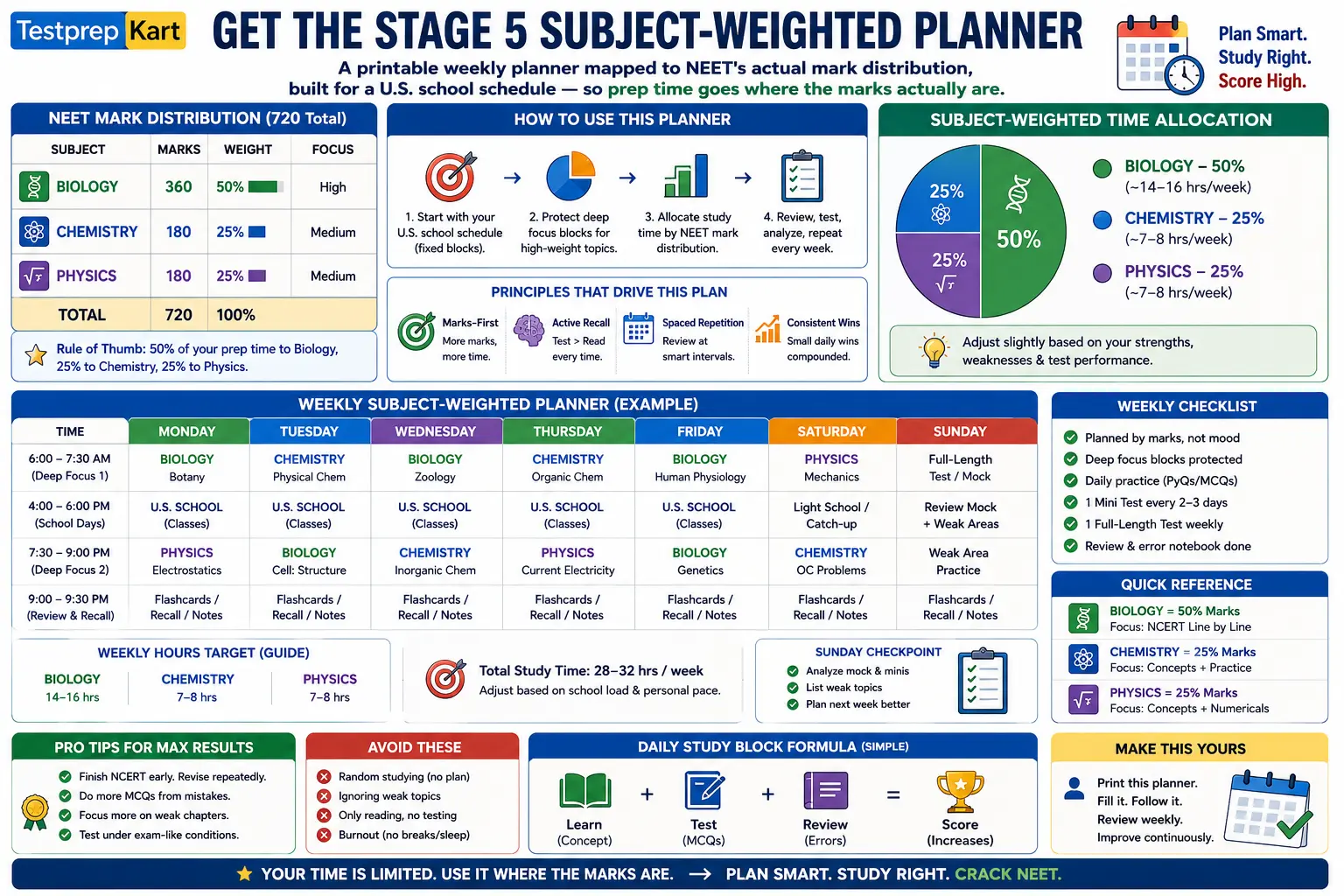
Get The Stage 5 Subject-Weighted Planner
A printable weekly planner mapped to NEET's actual mark distribution, built for a U.S. school schedule - so prep time goes where the marks actually are.
Questions about your child's specific grade or schedule? Reach our team directly at info@testprepkart.com.
Download Stage 5 Visual Sheet
Checkout few of the app features below.
1) What Stage 5 Actually Covers
This stage is purely about the study plan itself - what to prioritize, how to sequence it, and how to fit it into a U.S. week. It assumes your child's eligibility (Stage 2), curriculum match (Stage 3), and exam logistics (Stage 4) are already settled.
| Topic | Why It's Here |
|---|---|
| Subject-wise mark weightage | Understanding the true source of the 720 points alters how you spend your time. |
| High-weightage chapters per subject | The bulk of the article is covered in a concentrated collection of chapters. |
| Grade-wise phased planning (8-10 vs 11-12) | Final-year students and early beginners require rather different programs. |
| Daily and weekly routine design | transforms "study more" into a real, recurring routine |
| Revision and mock test strategy | Understanding the material is not the same as doing well on a three-hour test. |
| Subject-specific approach: Physics, Chemistry, Biology | Different study techniques are rewarded for each subject. |
2) Where The 720 Marks Actually Come From
The majority of parents are initially taken aback by this truth, which is the most helpful information in this entire stage. Half of the exam is devoted to biology alone, earning more points than chemistry and physics put together. However, many American students naturally underinvest in their biology study since they come from AP/IB programs that frequently place a greater emphasis on physics and chemistry.
| Subject | Class 11 vs Class 12 Split | Planning Implication |
|---|---|---|
| Physics | Approximately 70-75% from Class 12, 25-30% from Class 11 | Once the fundamentals are well established, give Class 12 Physics top priority. |
| Chemistry | Approximately 50-55% from Class 12, 45-50% from Class 11 | Strong, somewhat even coverage is required for both years. |
| Biology | Approximately 70-80% from Class 12, 20-30% from Class 11 | The exam's largest scoring chance is in class 12 biology. |
Important lesson: Your youngster is working against the framework of the exam if they are dividing their time equally across the three subjects. Nearly half of all NEET-specific study time should be devoted to biology alone.
3) High-Weightage Chapters Worth Prioritizing First
Within each subject, a focused set of chapters consistently shows up as high-yield across recent exam patterns. This isn't about skipping the rest of the syllabus - it's about deciding what gets tackled first, while concepts are fresh and motivation is highest.
| Subject | Commonly High-Weightage Chapters |
|---|---|
| Physics | Laws of Motion, Current Electricity, Magnetic Effects of Current & Magnetism, Thermodynamics, System of Particles & Rotational Motion, Optics, Modern Physics |
| Chemistry | Chemical Bonding, General Organic Chemistry, Aldehydes/Ketones/Carboxylic Acids, Coordination Compounds, Chemical Kinetics, Electrochemistry, Biomolecules |
| Biology | Genetics & Evolution, Human Physiology, Human Reproduction, Ecology & Environment, Cell Biology, Plant Physiology, Animal Kingdom |
Important information: Although high-weightage chapters usually cover between 60 and 70 percent of the question paper, the rest of the syllabus is still important; these chapters provide a starting point rather than a way to bypass the rest.

4) A Phased Plan By Grade Level
How your child should prepare depends heavily on when they're starting. An early starter in Grade 8-10 has room to build deep fundamentals. A student already in Grade 11-12 needs a tighter, more intensive structure. Neither situation is a disadvantage - they just call for different plans.
Build Fundamentals Early
Prioritize developing solid conceptual underpinnings in fundamental science subjects, adopting reading habits consistent with NCERT-style material, and being at ease with the notion of a regimented weekly study schedule without yet experiencing exam pressure.
Sequential, Comprehensive Coverage
Instead of bouncing about, cover things in order so that ideas logically build upon one another. Additionally, this is the year to finalize the AP/IB/state-board science combination that was verified in Stage 3.
Intensive, Weightage-Driven Prep
This is the most rigorous year and requires the most protected study time, therefore move toward high-weightage chapters, finishing the entire syllabus, frequent practice exams, and organized revision cycles.
Important lesson: Starting early is about developing the kind of conceptual basis that makes Grade 12's intense phase far less daunting, not about beginning NEET-specific cramming earlier.
Not sure which phase your child is actually in?
Our counselors assess current preparation level and build a grade-appropriate plan from there.
5) Building A Realistic Weekly Routine
A study plan is only effective if it can withstand touch with a real week. A minimum of six hours of concentrated study on school days off, shorter but regular weekday sessions rather than completely skipping weekdays, and a purposeful combination of new content, revision, and practice questions rather than just forward progress are all characteristics of the most successful routines we observe from American families.
Short, Focused Sessions
After school, devote 60 to 90 minutes to NEET-specific study, concentrating on one subject at a time rather than dividing concentration among all three.
Deep Work Sessions
Approximately six hours are allotted to each subject, with built-in breaks for problem-solving, reviewing new chapters, and making up for any time lost over the week.
Revision & Self-Testing
a set period of time, ideally at the same time every week, that is only devoted to reviewing previously covered material and self-testing—not learning anything new.
Full Mock Test + Analysis
A complete timed mock test under exam-like conditions, followed by an honest review of weak areas to adjust the next month's plan.
Important Lesson: Consistency beats intensity. A repeatable weekly rhythm that survives a busy school week will outperform an ambitious plan that collapses after two weeks.
6) Subject-By-Subject Study Approach
Physics, Chemistry, and Biology don't respond to the same study method. Treating all three the same is one of the most common reasons students plateau despite putting in real hours.
| Subject | What Actually Works |
|---|---|
| Physics | Prioritize concept clarity over complex problem-solving. Knowing "why" is important before learning formulas by heart; have a personal formula reference sheet for easy review. |
| Chemistry | Consider the following three sub-subjects: Physical Chemistry requires formula practice similar to Physics, Inorganic primarily relies on NCERT memorization, and Organic requires both deep conceptual understanding and practice. |
| Biology | The main source is NCERT, as NEET substantially and directly borrows from NCERT language and graphics, read it several times, ideally three to five full passes before the test. |
Important lesson: Repetition and NCERT proficiency are rewarded in biology. Problem-solving skills are rewarded in physics and physical chemistry. A combination of both is rewarded in organic chemistry. Align the approach with the topic.
More Prep Strategy Videos From TestprepKart
Specifically designed for U.S.-based NEET candidates, our "NRIs Medical Preparation" YouTube channel offers study tips, syllabus walkthroughs, and exam preparation advice.
As the NEET syllabus and exam format change every cycle, new videos are introduced on a regular basis.
From NEET Aspirant to AIIMS | TestprepKart Achievers Podcast
7) Common Study-Plan Mistakes U.S. Families Make
Splitting time equally across all three subjects
Half the points go to biology. Students who receive an equal three-way split are less prepared for the exam's highest-weighted subject.
Jumping between random chapters
Studying out of order makes it more difficult to create connections between similar ideas and loses time on subsequent revisions.
Relying only on AP/IB textbooks for Biology
Using only AP/IB biology textbooks
Even with great AP Bio knowledge, missing NCERT immediately costs unnecessary scores because NEET Biology questions are strongly linked to NCERT's precise phrasing and illustrations.
Skipping full-length mock tests
Understanding the material is not the same as doing well on a three-hour test. Time-management deficiencies remain undetected until exam day in the absence of practice exams.
8) Quick Facts: NEET Preparation Planning
Primary Biology Source
The majority of direct NEET Biology questions are derived from NCERT Biology textbooks, which are regarded as the most significant source.
Cross-Subject Overlap
Strong foundations in one discipline can help with the other because physics and chemistry share several themes (such as thermodynamics ideas).
Scoring Benchmark
Aiming for scores of up to 650 out of 720, which necessitates near-mastery of high-weightage chapters, students usually aspire for competitive government medical college seats.
Online Coaching Advantage
Since the majority of NRI students in the United States are unable to access in-person coaching centers, structured online coaching combined with independent study tends to effectively narrow that gap.
9) This Week's Action List
- Determine which phase your child is in by comparing their present grade to the above phased schedule.
- Set up a set weekly study schedule that includes lengthier weekend sessions in addition to weekday sessions.
- If your child doesn't already have a set of NCERT Biology textbooks, get them.
- Choose three to five important chapters for each subject to start with.
- Even if it's a few months away, set aside time for the first comprehensive practice exam.
- For regular strategic content, subscribe to TestprepKart's NRI YouTube channel.
Important lesson: A plan is only effective if it is scheduled and documented. This week, put at least the first two things on this list into a real calendar.
10) Where This Fits Into The Bigger Picture
When a study plan is underway, most families naturally wonder who should be teaching it self-study alone, a coaching provider, or a combination of the two. Since selecting the appropriate support system is a separate decision from creating the study plan itself, we thoroughly compare the practical coaching possibilities available to NRI families in the United States in the next stage.
11) How TestprepKart Helps U.S. Families Build A Study Plan
We build study plans specifically around NEET's actual mark distribution and a real U.S. school week - not a generic India-first template. Our counselors can assess your child's current level, confirm which phase they're in, and build a weighted weekly schedule that fits around school, sleep, and sanity.
- "How should we split study time across Physics, Chemistry, and Biology?"
- "What does a realistic weekly schedule look like for our child's grade?"
- "Which chapters should we prioritize first?"
- "How do we know if our child is actually on track?"
Get a study plan built around your child's actual week.
Free assessment session, mapped to grade level, current preparation, and available study hours.
Download NEET E-Book For NRI's Students

Planning to pursue MBBS in India through the NRI Quota? This FREE NEET Guide for USA-based NRI students and parents provides everything you need in one place-from NRI eligibility criteria and required documents to NRI quota fees, seat availability, top medical colleges accepting NRI admissions, important deadlines, and the complete admission process. You'll also discover alternative pathways beyond NEET Main and expert insights to help you make informed decisions and avoid costly mistakes during NEET 2026 admissions. Download now and stay ahead in your MBBS admission journey.
Keep Exploring
Questions U.S. NRI Parents Ask Us Most
How many hours a day should my child study for NEET alongside U.S. school?
60 to 90 minutes of concentrated time is reasonable on most school days. Aim for about six hours divided between subjects with pauses on weekends or school days off. Weekly consistency is more important than sporadic long sessions.
Why does Biology get more study time than Physics or Chemistry?
Physics and Chemistry both provide 180 marks, while Biology makes up 360 of NEET's 720 total points, or precisely half of the test. Aligning effort with the actual scores is all it takes to match study time to this weighting.
My child is strong in AP Biology. Do they still need NCERT?
Yes, in general. Even excellent AP Biology students usually require diligent NCERT reading often numerous passes to do well since NEET Biology questions are strongly linked to NCERT's particular material, phrasing, and graphics.
When should my child start taking full-length mock tests?
After a significant amount of the curriculum has been covered, full-length assessments should ideally be administered every month until Grade 12. Time-management and accuracy problems that are not revealed by content review alone are revealed by mock examinations.
Is it too late to start if my child is already in Grade 11 or 12?
No, instead of the slower foundation-building method employed in Grades 8–10, it just calls for a more rigorous, weight-driven plan. The curriculum can still be successfully covered in the remaining time with a targeted approach that prioritizes high-weightage chapters.
Where can we find more structured NEET preparation guidance for NRI students?
Both our course offerings and TestprepKart's "NRIs Medical Preparation" YouTube channel are designed especially for NRI students, the majority of whom are based in the United States. They cover study techniques in addition to paperwork and logistical support.