AP, IB, Or Regular U.S. High School: Does Your Child's Curriculum Actually Match What NEET Expects?
The NEET checklist for Physics, Chemistry, and Biology doesn't directly match an American transcript. The U.S. system has different course titles, lab numbers, and grading systems, and this exact difference is what causes eligible students to get stuck in document verification.
This takes your child’s actual schoolwork and maps it to the NEET standards, so you can see if there is a problem to address at this point—while you still can—rather than waiting until spring.
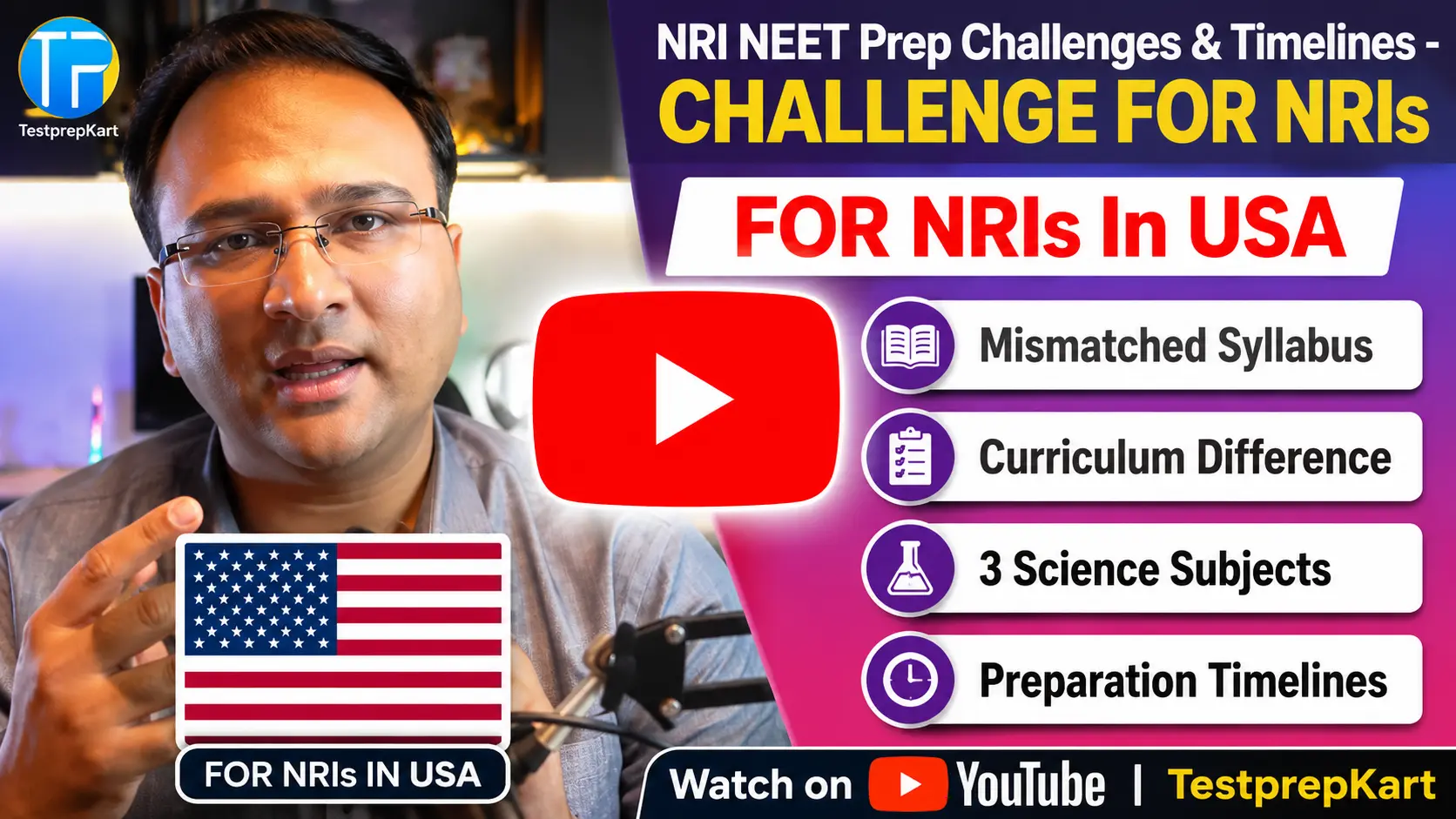
This scenario is often heard from US-based parents. All believe that it is "equivalent" to an Indian Class 12 PCB. Then, while preparing for NEET paperwork, one learns their school never offered a full-year lab science study of Physics or their IB Diploma combination does not include Higher Level Bio. Stage 3 is so you learn this information now, not at the time of NEET registration, while you still have time to change your electives.
Why "We're Doing Well In School" Isn't The Same As "We Match NEET"
NEET does not grade your child's performance in school, it is looking for a specific, limited thing: full-year courses in English, physics, chemistry and biology (or biotechnology) with a 'real' lab component, taken during the last two years of school, and with results that can be translated into a percentage per the Indian system. Even if your child did well on AP scores or maintains a 4.0 GPA, you cannot be sure it makes the cut.
The arrangement of American high schools is actually a little different. There is built into American schools flexible, student-choice timetables. These classes, 11 and 12 in India is a set science stream. Gaps are found when a flexible system adheres to a set checklist; these are usually small, but if they are not found in time, they can cause big delays.
| What U.S. Schools Optimize For | What NEET Actually Requires |
|---|---|
| Flexible electives, student-chosen course load | All three subjects physics, chemistry and biology are fixed every year. |
| GPA and class rank as the main success metric | A specific percentage of PCBs, taken into account using AIU standards |
| AP/IB scores as college-admission currency | Full year classes with practical and laboratory work recorded |
Key takeaway: Achieving success in an AP or IB science course does not equate to meeting the content, duration, and lab requirements of NEET. Different things are being measured by the two systems.
See Your Child's Exact Subject-By-Subject Gap
We map AP, IB, and standard U.S. coursework against NEET's PCB checklist and flag exactly what's missing - before it becomes a registration-week emergency.
Questions about your specific transcript? Reach our team directly at info@testprepkart.com.
Download Stage 3 Visual Sheet
Checkout few of the app features below.
1) What Stage 3 Actually Covers
This stage is purely about academic alignment - what your child has actually studied, versus what NEET expects them to have studied. It does not cover quota seats or category status; those are handled elsewhere in this roadmap.
| Topic | Why It's Here |
|---|---|
| AP courses vs NEET's PCB checklist | AP Biology/Chemistry/Physics does not cover the depth of NEET's entire syllabus automatically |
| IB Diploma vs NEET's PCB checklist | Here, 2-year's is a threshold and SL vs. HL matters. |
| Regular U.S. high school science vs NEET | State-board science sequencing rarely maps onto Indian 11–12's. |
| IGCSE / A-Level mapping | Good to know for families moving back and forth between the American and British curriculums |
| Managing three sciences in a U.S. schedule | American schools almost always don't have PCB together. |
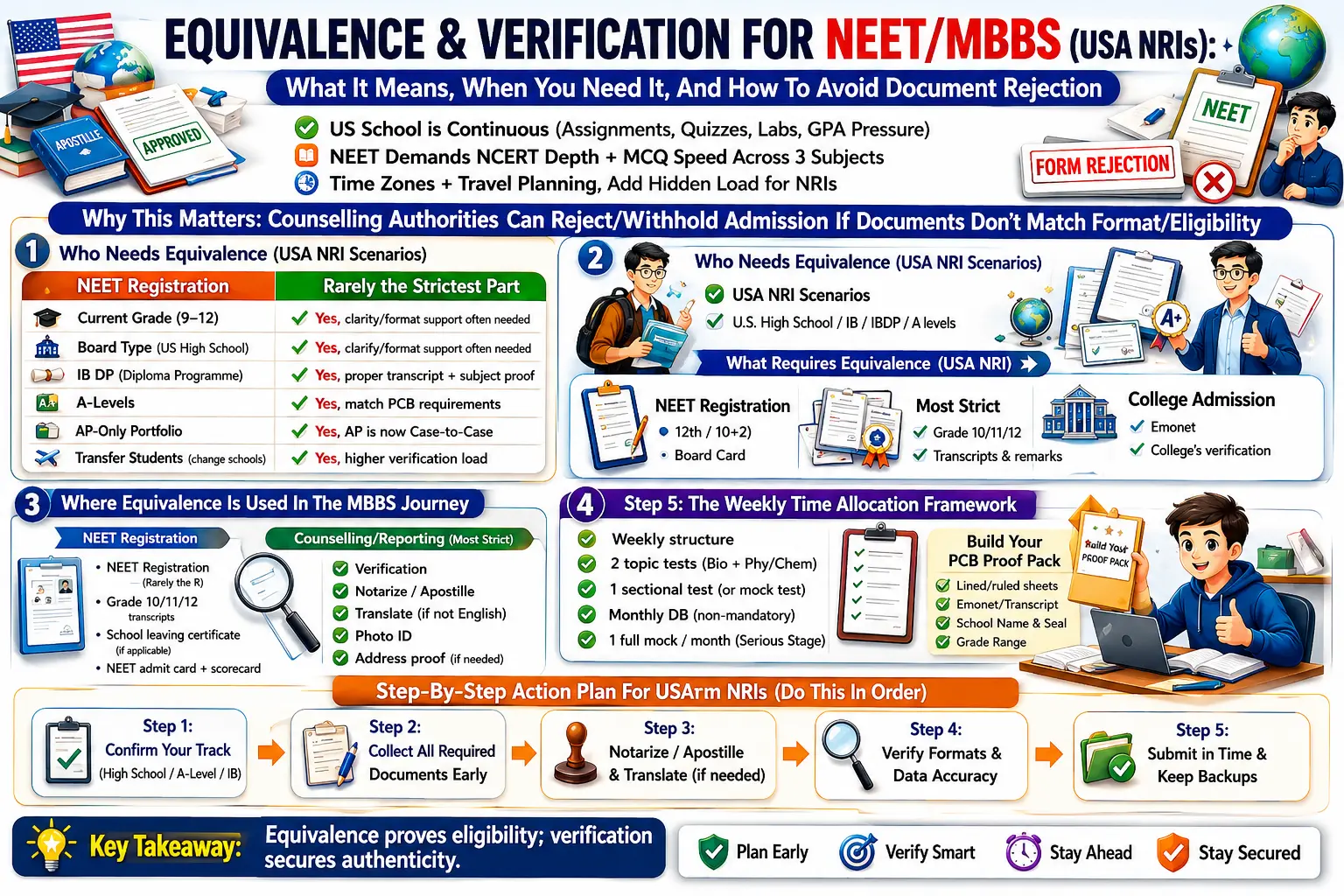
| AIU equivalence & verification | The official document that tells NEET your transcript "counts" |
2) AP Courses Against NEET's PCB Requirement
The most popular way for academically gifted kids in the US to meet NEET is through AP. But approval is based on the specific set of courses and its duration, not just the 'AP' label. In your last two years of high school, NEET requires that you complete a year of physics, chemistry, and biology, all with meaningful lab work or practical component.
The problem with the American school system is that many American students take AP Chemistry one year and AP Biology the other year, and don't take AP Physics, but take a regular or honors level physics class instead. This is usually OK, but you need to read the NEET documents carefully to make sure, and not just assume that it will work.
| AP Combination | Typical Fit With NEET | What To Verify |
|---|---|---|
| AP Biology + AP Chemistry + AP Physics 1/2 | Usually, a strong, direct match | Verify that both years include the whole PCB, not just one. |
| AP Biology + AP Chemistry + regular/honors Physics | NEET is widely accepted because it does not always require a "AP" level. | Verify that the non-AP Physics course included lab work. |
| AP Biology only, no full-year Chemistry or Physics | Most likely a real gap | Before the senior year finishes an elective or summer/online course is required. |
Key takeaway: "We took AP science" is not specific enough. Confirm all three of Physics, Chemistry, and Biology were taken as full-year courses with lab components - not just the strongest one or two.
3) IB Diploma Against NEET's PCB Requirement
A little different pitfall lurks for IB families. NEET requires the full, two-year IB Diploma Program. A one-year IB certificate, a handful of stand-alone IB courses, is not enough. One can take Physics either at the Standard Level or at the Higher Level in the Diploma, but it still must be a real, full-year course, with lab work.
The real planning question for IB families is subject selection at the advent of DP1: did the student pick two of the three Group 4 science subjects together with an unrelated Group 4 subject, or did they actually select Physics, Chemistry, and Biology together? Two years later, same decision—taken at the beginning of eleventh grade—quietly controls NEET eligibility.
| IB Setup | NEET Fit |
|---|---|
| Complete 2-year Diploma, including all three sciences: Physics, Chemistry, and Biology | directly satisfies NEET's requirements |
| Complete Diploma, but has only taken two sciences | Gap: The science that is lacking must be handled independently. |
| IB Certificate pathway (not a complete Diploma) | does not, by itself, meet NEET's two-year requirement |
Key takeaway: If your child is still choosing DP1 subjects, lock in Physics, Chemistry, and Biology together now. Fixing a missing science after DP2 has started is far harder than choosing correctly at the outset.
4) Regular U.S. High School Science Against NEET
It’s not always a given that every NRI family’s child is in some AP or IB track, and that’s perfectly fine - the standard state-board science sequence is acceptable too, so long as the same core checklist gets followed: full-year Physics, Chemistry and Biology with lab components, taken in the final two years. The hazard here is usually sequencing, not content. Many US state curricula prefer to sprinkle Biology, Chemistry and Physics all over the grade spectrum, rather than offer all three in Grades 11 and 12 simultaneously.
Worth checking specifically: does your child’s school even offer Physics as a senior-year option, and does the lab component get recorded in a way a transcript check would recognize?
| Common State-Board Pattern | What To Check |
|---|---|
| Biology in Grade 9, Chemistry in Grade 10, no senior Physics | Physics might not be included in the mandatory last two-year window. |
| Physical Science combined course, not separate Physics/Chemistry | It could be necessary to clarify whether this meets the subject-specific requirements of NEET. |
| Standard PCB sequence across Grades 11–12 | Verify that lab hours are recorded; this is typically the clearest match. |
Key takeaway: The subject name on a transcript matters less than when it was taken and whether it included a documented lab. Check both before assuming you're covered.
5) IGCSE And A-Level: For Families Who've Moved Between Systems
Some NRI families, especially those who moved abroad before relocating to the United States, have switched between American and British-curriculum schools. The mapping question is slightly different for these students: A-Levels carry the weight of the Class 12 equivalency, whereas IGCSE is generally regarded as equivalent to Indian Class 10. This means that A-Level Physics, Chemistry, and Biology must be the actual subjects studied, not just any three science-adjacent A-Levels.
If your child's academic history includes both an IGCSE and a period of high school in the United States, don't assume that one system offers the whole story; instead, treat this as its own mapping project.
| Background | Mapping Note |
|---|---|
| IGCSE (through Grade 10) + U.S. high school (Grades 11-12) | IGCSE typically provides Class 10 equivalency; PCB requirements are compared to the U.S. part. |
| Full A-Level track, Physics + Chemistry + Biology | In general, a good fit for NEET's Class 12 PCB requirement |
| Mixed IGCSE/A-Level with only 2 sciences at A-Level | For the missing subject, a documented equivalency check is probably required. |
Key takeaway: Mixed academic histories aren't a problem, but they do need their own equivalence check rather than borrowing assumptions from a single curriculum.
6) The Real Bottleneck: Fitting Three Sciences Into A U.S. Schedule
This is the single most common practical obstacle we see, and it has nothing to do with ability. Many U.S. high schools simply don't build a default schedule where a student takes Physics, Chemistry, and Biology together in the same year - counselors often assume students will pick one or two sciences alongside electives, not all three as a fixed block, the way Indian Class 11-12 students do automatically.
This becomes a scheduling and advocacy problem more than an academic one. Parents often need to proactively request the right course combination, sometimes pushing back against a counselor's default recommendation.
Practical steps that actually work
- When you visit with your child's academic counselor, make specific requests for all three sciences; don't wait for recommendations.
- Schedule this discussion before to Grade 11 scheduling, not later.
- Inquire about summer school, online/dual-enrollment possibilities, or additional community college courses if the school is truly unable to accommodate all three.
- As this is verified during equivalency review, keep written confirmation of each course's lab component.
Key takeaway: A three-science schedule rarely happens by default in a U.S. high school. It happens because a parent asked for it early and specifically.
7) AIU Equivalence: The Certificate That Makes It Official
The Association of Indian Universities (AIU), which verifies that a foreign qualification is equal to India's 10+2 system, provides formal approval to NEET even in cases where your child's coursework truly satisfies its requirements. This certificate may be required for students from AP, IB, A-Level, state-board, and recognized homeschooling backgrounds. As part of the same procedure, PCB scores from a foreign grading scheme are transformed into an Indian-style percentage using AIU standards.
You cannot choose to forego this certificate if you are certain that your child is "obviously eligible." It's the official bridge that NEET truly depends on, and getting it should be scheduled well in advance of registration rather than crammed in later.
| Question | What To Know |
|---|---|
| Who needs an AIU equivalence certificate? | Generally students from AP, IB, A-Level, and other non-CBSE/non-Indian-board backgrounds |
| What does it confirm? | that the foreign certification is comparable to Indian Class 12, with PCB marks transferred appropriately |
| When should you apply? | Before NEET registration begins as processing takes time |
Key takeaway: Treat the AIU certificate as a required document, not a backup plan. Start the process early enough that it's done, not pending, when NEET registration opens.
8) The Ten-Minute Curriculum Check
Sit down with your child's current transcript or course plan and answer these. By the end, you'll know exactly which gaps, if any, need attention before senior year wraps up.
- Has your child taken (or is scheduled to take) full-year Physics in Grades 11 or 12?
- Has your child taken (or is scheduled to take) full-year Chemistry in Grades 11 or 12?
- Has your child taken (or is scheduled to take) full-year Biology in Grades 11 or 12?
- Did each of those courses include documented lab or practical work?
- If IB: is your child enrolled in the full 2-year Diploma, with all three sciences in Group 4?
- Is English a confirmed core subject across the relevant years?
- Do you know whether your child's school separates "Physical Science" from standalone Physics and Chemistry?
- Have you started the AIU equivalence application, or do you have a realistic timeline for it?
- If a gap exists, is there time this academic year to fix it through electives or supplemental courses?
- Do you have transcripts and syllabi organized in one place for equivalence review?
| If You Found A Gap In | Reasonable Next Step |
|---|---|
| Missing full-year Physics or Chemistry | Next semester, add it as an elective, or look at online or summer opportunities. |
| IB Diploma missing one Group 4 science | Talk about subject-change alternatives as soon as you can with the IB coordinator. |
| AIU equivalence not yet started | Start the application today, well in advance of the deadlines for NEET registration. |
Key takeaway: Most curriculum gaps are fixable if caught a year or two early. They become real problems only when discovered during NEET registration itself.
9) This Week's Action List
- Take your child's most recent transcript and compare it to the PCB + English checklist mentioned above.
- Verify that each science course's lab and practical components are recorded.
- Lock in all three sciences immediately if your child hasn't selected a Grade 11 or DP1 topic yet.
- If you haven't already, start the AIU equivalency application process.
- If there is a gap, discuss elective or supplemental choices with your child's counselor this term.
- For future verification, keep lab records, transcripts, and curricula in one folder.
Important lesson: Waiting until the conclusion of senior year is not necessary for any of these processes. It is easier to close a gap if it is discovered early.
10) Where This Fits Into The Bigger Picture
Once your child's curriculum is confirmed to match NEET's requirements, the next planning layer is building an actual study and timeline strategy around that confirmed eligibility - how to prepare for NEET's syllabus depth while still managing a full U.S. school course load. We cover that structured preparation planning in detail in the next stage, since building a study roadmap is a distinct task from confirming curriculum eligibility, which is what this stage is for.
11) How TestprepKart Helps With Curriculum Mapping
If you would want a second opinion, our team frequently compares state-board, AP, IB, and A-Level transcripts to NEET's PCB checklist. They are able to identify any deficiencies early enough to address them with supplementary courses, elective modifications, or a precise AIU equivalency timetable. We specialize in this particular U.S.-to-NEET translation issue, but we are not a replacement for your school counselor.
- "Does my child's current course load actually meet NEET's PCB requirement?"
- "What should we change before subject registration locks in?"
- "When should we start the AIU equivalence process?"
- "How does this curriculum gap affect our overall NEET prep timeline?"
Download NEET E-Book For NRI's Students

Planning to pursue MBBS in India through the NRI Quota? This FREE NEET Guide for USA-based NRI students and parents provides everything you need in one place—from NRI eligibility criteria and required documents to NRI quota fees, seat availability, top medical colleges accepting NRI admissions, important deadlines, and the complete admission process. You'll also discover alternative pathways beyond NEET Main and expert insights to help you make informed decisions and avoid costly mistakes during NEET 2026 admissions. Download now and stay ahead in your MBBS admission journey.
Keep Exploring
Questions U.S. NRI Parents Ask Us Most
Is the American High School Diploma accepted for NEET?
In general, yes, provided that the age requirement is satisfied and Physics, Chemistry, Biology, and English were studied as full-year courses with lab components. An AIU equivalency certificate can also be necessary, depending on the particular curriculum and credits.
My child only took AP Biology and AP Chemistry, not AP Physics. Is that a problem?
Not necessarily - NEET doesn't strictly require the "AP" label on every science, but it does require full-year Physics with lab work somewhere in Grades 11–12. A regular or honors-level Physics course can often satisfy this; the key is confirming it was taken and properly documented.
Does a one-year IB certificate meet NEET's requirement?
No. NEET requires the full two-year IB Diploma Programme. A standalone one-year IB certificate or partial IB coursework does not satisfy this requirement on its own.
What exactly is an AIU equivalence certificate, and do we need one?
From the Association of Indian Universities, it’s a certificate verifying that a foreign qualification—a transcript with APs, IB, A-Level, or another non-Indian board—satisfies Indian Class 12 equivalency, with PCB marks transformed into an Indian-style percentage. Most NEET applicants with a U.S.-curriculum need it, making it a good thing to start early.
Our school doesn't offer Physics, Chemistry, and Biology together in the same year. What can we do?
This is a typical scheduling challenge, not an eligibility barrier. Consult your kid’s academic advisor in time—ideally before Grade 11 registration—and ask directly about squeezing all three in, or augmenting through summer/online/dual-enrollment courses if need be.
If we have a mixed IGCSE and U.S. high school background, how does equivalence work?
Usually, it's handled as a unique case: IGCSE refers to Class 10 equivalence, but the PCB criteria is compared to whatever curriculum they took Grades 11–12 in. This sort of hybrid background merits a bespoke equivalence consideration rather than presuming that either system covered it.