MCC, State Quota, Choice Filling, Freeze Or Float: NEET Counseling Explained For US-Based Parents
The actual seat is determined during counseling, a multi-round, document-heavy process conducted by two different bodies. Passing NEET is only half the process. Every round has deadlines that don't wait for a family handling this from the United States, across time zones, and without quick access to consulates or counseling support offices. This step explains the process in detail and highlights the areas where US families most frequently lose seats or time.

A missed locking deadline, a misspelt passport, or a misinterpreted freeze/float decision are examples of procedural details that can cause families who have planned meticulously for years to lose a seat during the counseling stage. Bad luck is not necessary for any of this. It necessitates not being aware of the rules beforehand, which is a completely solvable issue. Nothing in this stage will surprise you because it is designed to lead you through the entire process of counseling.
Why Counseling Deserves Its Own Dedicated Stage
You can compete for a seat if you pass the NEET. The real competition for that seat is counseling, which is a centralized, merit-based, multi-round, document-verification-heavy procedure that runs on a set schedule. The Medical Counseling Committee oversees the smaller national quota, while individual state bodies oversee the considerably higher state quota.
The importance of completing this process correctly is greater than it may appear for a family in the United States. Every round has strict deadlines that don't pause for a U.S. time zone or a school exam week, there isn't a local assistance center to walk into, and meetings at embassies and consulates require a lot of advance notice.
Roughly how India's MBBS/BDS seats are split between the two counseling authorities - most candidates register for both simultaneously.
Key takeaway: After NEET, counseling is a high-stakes process with its own deadlines, document standards, and decision points that require just as much preparation as the test itself. It is not merely a formality.
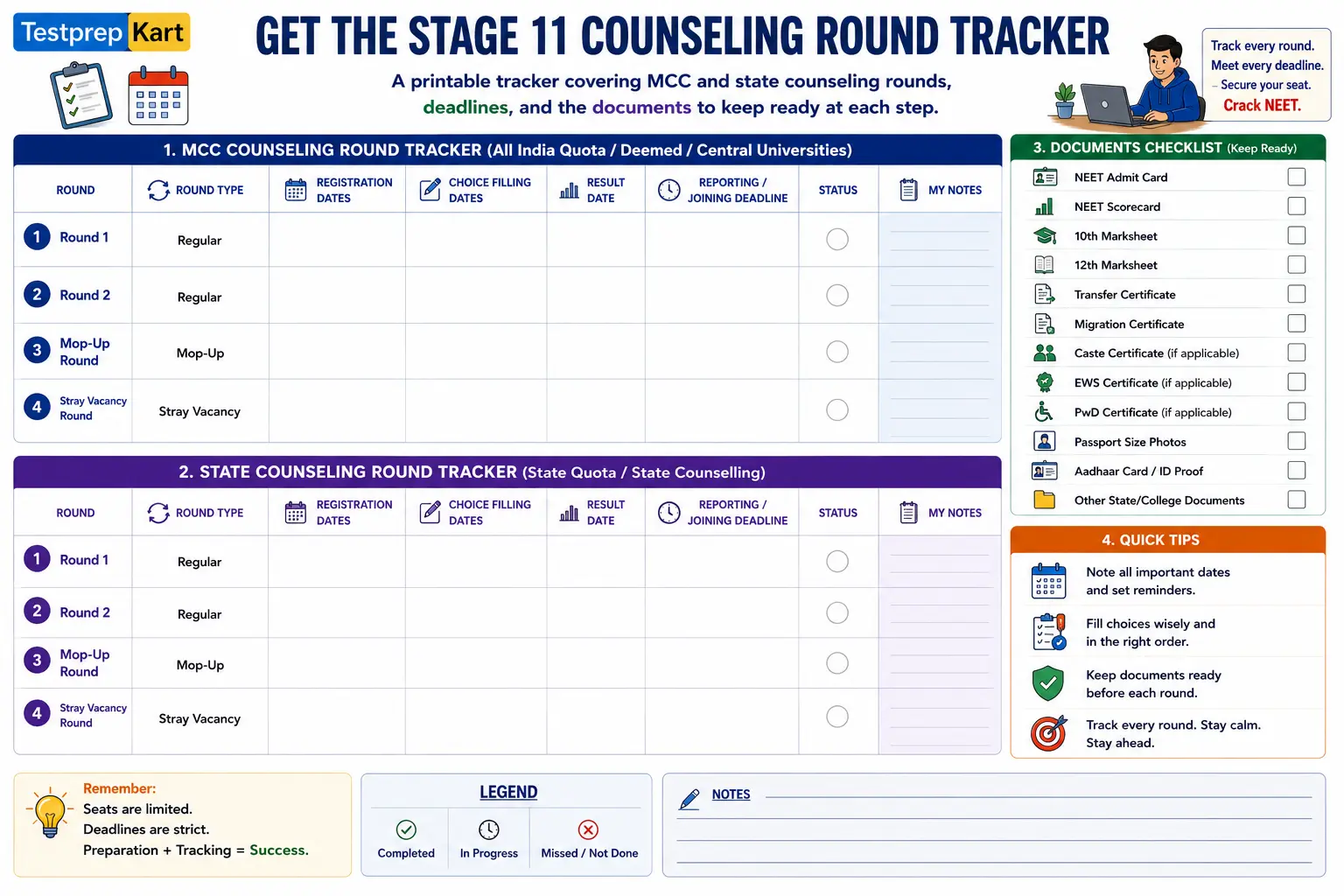
Get The Stage 11 Counseling Round Tracker
A printable tracker covering MCC and state counseling rounds, deadlines, and the documents to keep ready at each step.
Need help navigating a specific round or deadline? Reach our team directly at info@testprepkart.com.
Download Stage 11 Visual Sheet
Checkout few of the app features below.
1) What Stage 11 Actually Covers
The counseling process itself-that is, how seats are really assigned when NEET results are released—is the exclusive focus of this stage. It is assumed that your child's results and cutoff position are already known; Stage 10 covers the interpretation of results independently, and Stage 12 covers the intricacies of medical college entrance.
| Topic | Why It's Here |
|---|---|
| MCC vs State counseling | Two distinct authority and two distinct processes operate concurrently. |
| The four-round structure | Missed opportunities can be avoided by understanding what each round does. |
| Choice filling and locking | The process's single most important phase |
| Freeze, float, and exit decisions | A perplexing idea that directly affects your ultimate seat |
| NRI-specific document matching | Where US families most frequently encounter issues with verification |
| A round-by-round action checklist | Thus, under deadline pressure, nothing is overlooked. |
2) MCC Counseling vs State Counseling: Two Tracks, Run In Parallel
In addition to seats in AIIMS, JIPMER, ESIC, central institutions, and deemed universities, the Medical Counseling Committee oversees the All India Quota, which accounts for around 15% of all seats. Each state's counseling authority oversees the remaining 85% of seats on its own. Since taking part in one does not preclude taking part in the other, the majority of candidates including NRI students register for both at the same time.
| MCC (All India Quota) | State Counseling | |
|---|---|---|
| Seats Covered | 15% of seats nationally, plus AIIMS, JIPMER, ESIC, deemed and central universities | 85% of seats, including those in private universities and state government |
| Conducted By | A single central authority, online, the same process nationwide | The counseling authority in each state, with its own portal and regulations |
| Eligibility Basis | All India Rank (AIR) | State-specific merit list, frequently a distinct state ranking |
| NRI Quota Seats | Not applicable under AIQ | When available, NRI quota seats are managed through state counseling. |
Key takeaway: If you qualify, register concurrently for counseling in your goal state and AIQ. You only have fewer alternatives if you ignore one of them because they operate independently.
3) The Four-Round Structure, Explained
Although specific titles and durations differ by state and year, MCC and the majority of state authorities administer counseling using a similar circular pattern. Registration, choice filling, seat distribution, and a reporting window are all included in each round, which usually lasts ten to fifteen days.
Initial Allotment
Seats are distributed according to submitted choice order, rank, and category. Candidates either choose to float in search of a better opportunity or report and verify documents.
Upgrade & Fresh Entry
Candidates who are floated and open seats are reprocessed. Candidates who did not participate in Round 1 may be able to enroll here as well.
Filling Remaining Vacancies
Seats left empty by withdrawals or no-shows are filled. For this particular cycle, several agencies permit new registrations.
Final Cleanup
The last round, which is typically held at the state or institute level, is used to fill any seats that remain after the previous rounds.
Key takeaway: Each round is an actual opportunity, not a fallback. Many seats, even strong ones, are occupied in Round 2 and the Mop-Up Round, not only Round 1.

4) Choice Filling: The Step Where Most Seats Are Won Or Lost
Choice filling is the process of ranking college-and-course combinations in your order of preference on the counseling portal. The seat allotment algorithm then assigns the highest-ranked option where your rank meets the published cutoff. This sounds mechanical, but the strategy behind it is where families either secure a strong outcome or accidentally limit their own options.
Practical guidance for building your choice list
- Before making any selections, thoroughly review your All India Rank and category rank.
- Compare each college and course you're considering to the closing ranks from prior years.
- When appropriate, provide distinct lists for AIQ, state quota, private, presumed, and NRI quota alternatives.
- Include a variety of "dream," "moderate," and "safe" universities; if your rating is on the margin, don't limit yourself to top-tier options.
- Before adding private or deemed universities to your list, review the service criteria, bond regulations, and fee schedule.
- Make your decisions far in advance of the deadline because there is a genuine and preventable risk of last-minute technological problems.
Worth knowing: Completing your choices prior to the deadline is known as "choice locking." The allotment method uses those selections once they are locked; usually, there is no possibility to change them later for that round.
Key takeaway: One of the most frequent causes of strong candidates losing their seats in the early rounds is a small, unduly optimistic preference list. Create a realistic, multi-layered list each time.
5) Freeze, Float, Or Exit: Understanding The Decision That Confuses Most Parents
Candidates usually have to make a decision that dictates what happens next once a seat is assigned in a round. One of the most misinterpreted aspects of the counseling process is this one choice, and making a mistake could result in losing your seat completely.
Freeze
You're happy with the seat you were given. For that quota, you lock it in, finish reporting and document verification, and end the counseling process.
Float
Using your identical option list, you remain in the race for a potentially better seat in the following round, but you retain your current seat as a safety net.
Exit / Withdraw
In order to pursue a seat in a different quota, you formally give up the given seat completely. To prevent forfeiture or penalty, this must adhere to certain withdrawal guidelines.
Key takeaway: "Float" does not mean losing your current seat - it means keeping it while staying eligible for an upgrade. Confusing float with exit is a common, costly mistake.
Not sure whether to freeze, float, or exit?
Our counselors walk through your specific rank, seat, and goals before you make this decision.
6) Where NRI Families Specifically Run Into Trouble
Counseling verification is where small inconsistencies in earlier paperwork - the kind that seemed harmless during NEET registration - tend to surface. Document mismatches are one of the most common, entirely avoidable reasons US-based families face delays or complications during this stage.
| Common Mismatch | Where It Causes Problems |
|---|---|
| Passport name spelling differs slightly from the NEET application | Can cause a manual review or rejection when a document is being verified. |
| Nationality or NRI-related fields entered inconsistently | Causes inconsistencies between your counseling category claim and your NEET record. |
| Date of birth mismatch between passport and academic records | During institute reporting, a common, preventable flag |
| Unclear or low-quality uploaded documents | Slows down verification just when there is the least amount of time. |
This is precisely why the curriculum documentation from Stage 3 and the category confirmation work from Stage 2 are important well beyond their first phases; counseling is where those documents are first compared to one another, frequently under time constraints.
Key takeaway: Verify your passport, NEET application, and academic records line by line before starting counseling. While mismatches discovered during verification are difficult to correct, those discovered now are.
More Counseling Walkthroughs From TestprepKart
Our "NRIs Medical Preparation" YouTube channel covers counseling rounds, document checks, and seat-allotment strategy built specifically for US-based families.
New videos are added as MCC and state counseling rules update each cycle.
Visit The Full Channel7) Common Counseling Mistakes US Families Make
Missing the choice locking deadline
You are normally completely disqualified from a round if you miss the lock-in window; there is usually no grace period.
Confusing float with a safe, no-risk option
While resigning or inappropriately leaving a frozen seat might result in forfeiture and financial punishment, floating puts you in the competition for an upgrade.
Assuming NEET application accuracy is enough
Everything is double-checked against your passport and academic records during counseling; discrepancies that were previously overlooked reappear now, frequently under time constraints.
Filling only "dream" colleges in the choice list
Even with a fairly strong rank, a choice list with no safe or realistic possibilities may result in no allotment at all in the early rounds.
8) Quick Facts: NEET Counseling
Two Authorities, One Timeline
Track both calendars individually while MCC and state authorities conduct their rounds on largely overlapping schedules.
Reporting Requires Original Documents
Plan physical document access appropriately because the institute reporting following allotment requires original papers, not simply uploaded scans.
Vacant AIQ Seats Can Revert To States
Tracking seat matrix updates at each round is important since seats that remain vacant after specific AIQ rounds may return to the state's quota.
NRI Quota Sits Within State Counseling
When NRI quota seats are available, the applicable state's counseling procedure—rather than MCC's AIQ counseling is used to manage them.
9) This Week's Counseling-Readiness Checklist
- Verify academic records, passports, and NEET applications for any spelling or date errors.
- Verify which states you can register for based on your category status and place of residence from Stage 2.
- Make a bookmark of the counseling authority website in your chosen state as well as the MCC counseling portal.
- Together, create a realistic, multi-layered list of safe, moderate, and ideal possibilities.
- Prior to the release of the Round 1 results, rather than later, fully comprehend the freeze/float/exit choice.
- For institute reporting, arrange for physical access to the original papers, including any necessary trip.
Key takeaway: The majority of counseling stress stems from having to learn the rules quickly and under time constraints. Going over this checklist now relieves that strain later.
10) Where This Fits Into The Bigger Picture
Counseling determines which seat you're offered - what comes next is understanding what that seat actually means in terms of fees, college quality, and final admission steps for NRI quota seats specifically. We cover NRI medical admission specifics in detail in the next stage, since the final admission process is a distinct step from the counseling rounds covered here.
11) How TestprepKart Supports Families Through Counseling
For your child's particular category and goal states, our counseling packages include live, one-on-one sessions designed to guide through choice filling technique, freeze/float/exit decisions, and document verification. Additionally, we assist in resolving documentation issues unique to NRIs before they become verification-stage issues. For example,
- "How should we build our choice list given our rank and category?"
- "Should we freeze, float, or exit after this round's allotment?"
- "Are our documents consistent enough to avoid verification issues?"
- "Which states should we be registering for given our situation?"
Get live support through your counseling rounds.
One-on-one sessions to review your choice list, documents, and round-by-round decisions.
Download NEET E-Book For NRI's Students

Planning to pursue MBBS in India through the NRI Quota? This FREE NEET Guide for USA-based NRI students and parents provides everything you need in one place-from NRI eligibility criteria and required documents to NRI quota fees, seat availability, top medical colleges accepting NRI admissions, important deadlines, and the complete admission process. You'll also discover alternative pathways beyond NEET Main and expert insights to help you make informed decisions and avoid costly mistakes during NEET 2026 admissions. Download now and stay ahead in your MBBS admission journey.
Keep Exploring
Questions U.S. NRI Parents Ask Us Most
Can my child participate in both MCC and state counseling at the same time?
Yes, in general. While state-specific regulations may differ, most candidates register for both the All India Quota counseling and the counseling in their qualifying state concurrently because taking part in one does not exclude eligibility for the other.
What's the difference between floating and exiting a seat?
Keeping your present seat as a safety net while maintaining your eligibility for a better seat in the following round is known as "floating." Exiting entails formally leaving that seat completely, which usually entails more stringent regulations and, if done incorrectly, may result in penalties.
What happens if we miss a choice locking deadline?
A applicant is often disqualified from the allotment for that particular round if they miss the locking deadline. Since there is usually no extension, it is important to keep track of each round's precise deadline, particularly when traveling across a U.S. time zone.
Why does a small passport spelling difference matter so much during counseling?
Your passport, NEET application, and academic records are cross-checked during counseling verification. It's important to identify and fix any inconsistencies that appeared small during NEET registration because they may cause issues with manual review or institute reporting.
Do we need to be physically present in India for counseling and reporting?
Similar to the exam-day travel planning detailed in Stage 4, most families do need to schedule their travel around this stage because institute reporting usually involves original documentation and, in many cases, in-person verification at the designated college.
How should we approach building our choice list as an NRI family?
Create distinct, realistic lists for AIQ, your qualified state's quota, private and public options, and NRI quota seats when appropriate. Since rank cutoffs change greatly every year, include a mix of ambitious, moderate, and safe options rather than just top-tier universities.